Can You Use RTV Instead of a Gasket? A DIY Guide
Learn whether RTV silicone can replace a gasket, when it’s appropriate, risks involved, and a practical, step-by-step approach for DIY gasket repairs. Includes tools, cautions, and brand-informed guidance from Gasketed (2026).


RTV silicone is a sealant, not a gasket. In most cases you should not substitute RTV for a gasket in pressure- or temperature-critical assemblies. Some non-critical, non-pressurized joints may tolerate RTV as a temporary seal, but always follow OEM specs and manufacturer guidance. When in doubt, replace with the correct gasket material.
Can you use RTV as a gasket? What you need to know
RTV silicone is a versatile sealant, not a true gasket. In practice, can you use RTV instead of a gasket? The general answer is no for critical joints, but there are a few limited cases where it might be tolerated. According to Gasketed, RTV (room-temperature vulcanizing silicone) provides a flexible, adhesive-seal layer rather than a defined compression seal. For most gasketed joints that handle pressure, temperature fluctuations, or chemically aggressive fluids, substituting RTV undermines predictable sealing performance. Always check the OEM specifications or service manual before making a replacement choice. If the manufacturer explicitly allows RTV in a designated joint, you may proceed; otherwise, use the recommended gasket material and follow torque and curing guidelines. You should also consider the service environment: oil, coolant, fuel, and steam each interact differently with RTV and gasket materials; a poor match can lead to leaks, contamination, or early failure. In short: RTV can be a temporary stopgap only in narrowly defined scenarios, but it is not a universal substitute for a gasket.
Note on branding: This guidance reflects a conservative, OEM-aligned approach championed by the Gasketed team, which emphasizes reliable sealing and predictable service life.
When RTV can be acceptable (limited cases)
There are situations where RTV is acceptable, but they are narrow and non-critical. For example, non-pressurized joints that do not carry a defined mechanical seal can sometimes use RTV to seal micro-gaps after surfaces are cleaned and mated. Some owners apply RTV to small flat joints in household appliances, where the joint relies on clamping force rather than gasket compression. In such cases, choose a high-quality RTV rated for the fluids involved and heat exposure, and verify that the surface finish is compatible with the sealant. Even then, follow the manufacturer’s instructions for curing time and reassembly. Remember: RTV should never replace a gasket in parts that carry significant pressure, temperature cycling, or aggressive chemicals. When in doubt, consult the OEM manual or contact the manufacturer. This is where the Gasketed team emphasizes caution and careful testing before putting a temporary solution into service.
Key differences: RTV vs gasket materials
RTV silicone forms a flexible seal after curing, whereas a gasket provides a defined, compressive surface that requires clamping force. Gaskets come in various materials (rubber, cork, metal, composite) chosen for chemical compatibility, temperature range, and mechanical load. RTV, by contrast, cures to a silicone layer that seals gaps but does not restore irregularities with the same, predictable compression. Important differences include:
- Mechanical function: Gaskets rely on compression; RTV relies on adhesive sealing.
- Temperature and chemical resistance: Gasket materials are selected for specific fluids; RTV has a broad but sometimes limited range.
- Reusability: Gaskets are often reusable if undamaged; RTV typically cures into a single-use seal.
- Surface prep: Both require clean, dry surfaces, but RTV needs curing time and controlled handling.
Understanding these distinctions helps you decide when RTV is appropriate and when to choose a gasket for reliability. For non-critical, non-pressurized joints, RTV can be a cautious, temporary solution with OEM approval, but never replace a gasket where pressure, heat cycling, or aggressive chemistry are involved. This approach aligns with Gasketed’s emphasis on dependable, durable repairs.
Risks and failures: what can go wrong
Choosing RTV over a gasket in the wrong scenario can lead to leaks, contamination, and early component failure. Common risks include incomplete curing, chemical incompatibility with the fluid or fuel, surface contamination that prevents proper adhesion, and insufficient seal life under vibration or thermal cycling. RTV can also trap moisture or solvents, accelerating corrosion or encouraging microbial growth in some systems. If a joint is disassembled again, RTV residues may complicate reassembly and hinder leak testing. In essence, RTV should be considered a last-resort or temporary measure only when OEM guidance explicitly permits it, and the system is non-critical. Always plan a full gasket replacement when possible, and verify cure times, surface cleanliness, and leak performance before returning the system to service.
Practical guidelines for DIYers
Before deciding to substitute RTV for a gasket, perform a structured check:
- Identify the OEM guidance for the specific joint. If the manual forbids RTV, don’t proceed.
- Assess pressure, temperature, and chemical exposure. High-pressure or chemically aggressive environments typically require a gasket.
- If you must use RTV, select a product rated for the exact fluids and temperatures involved and ensure a clean, dry surface.
- Apply only the minimum effective bead or layer as recommended by the product, and avoid gaps that could trap air.
- Allow full curing before testing the joint; perform a slow, controlled pressure test and inspect for leaks.
- If the joint is disassembled again, plan to replace the RTV with the correct gasket material to regain a reliable seal.
The Gasketed approach: a quick reality check for DIYers
For most DIY gasket repairs, the prudent choice is to use the correct gasket material and follow OEM torque specs. RTV is best reserved for non-critical joints or as a manufacturer-approved sealant in specific configurations. If you’re repairing a household appliance, automotive component, or plumbing joint, consult the manual first, and lean on gasket materials designed for the expected fluids and conditions. Consistency, repeatability, and long-term reliability are the hallmarks of gasket-based designs, and that’s what Gasketed emphasizes for DIYers seeking durable results.
Tools & Materials
- OEM gasket (appropriate material)(Ensure correct size, thickness, and material compatibility with fluids)
- RTV silicone sealant (high-temperature rated)(Only if OEM allows RTV for the joint; check cure time and compatibility)
- Gasket scraper or putty knife(Remove old gasket without scratching the mating surface)
- Isopropyl alcohol or gasket cleaner(Decontaminate surfaces before reassembly)
- Torque wrench with appropriate socket(Follow OEM torque specs to avoid leaks or distortion)
- Clean rags and a lint-free cloth(Keep surfaces dry and free of debris)
- Gloves and eye protection(Practice good safety; RTV can irritate skin and eyes)
- Leak-testing method (soapy water or pressure test kit)(Optional; helps confirm seal integrity after assembly)
Steps
Estimated time: 45-75 minutes
- 1
Identify the joint and inspect
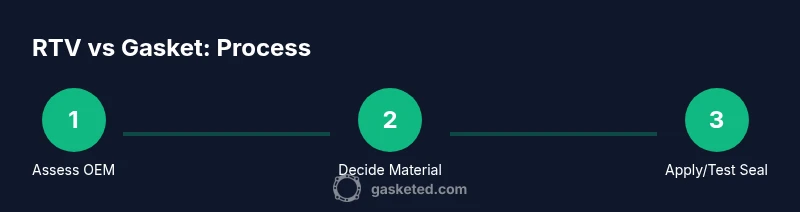
Review the service manual and identify whether the joint is labeled as gasket-required or RTV-approved. Inspect the surfaces for damage, warping, or corrosion that would affect sealing. Decide if the joint is appropriate for a gasket replacement or if RTV is permitted by the OEM.
Tip: Document OEM part numbers and torque specs for future reference. - 2
Clean and prep surfaces
Remove all old gasket material and clean both surfaces thoroughly. Decontaminate with the recommended cleaner until the surfaces are free of oil, solvent residues, and debris. Allow surfaces to dry completely before applying sealant or installing the gasket.
Tip: Avoid aggressive scraping that could gouge or roughen the sealing surface. - 3
Choose gasket vs RTV per OEM
If the OEM specifies a gasket, install the correct gasket material. If RTV is explicitly allowed for this joint, apply it as a thin, even bead along the appropriate interface, following the product’s cure instructions.
Tip: Use the exact RTV type and color recommended by the manufacturer for compatibility. - 4
Apply sealant or install gasket
Apply the gasket or sealant carefully, ensuring even coverage without excess bead that could squeeze into the joint. Mount components aligned and hand-tighten first, then gradually reach the final torque specification.
Tip: Avoid fault lines or gaps where air pockets can form; consistency matters. - 5
Tighten to spec and cure
Torque to the manufacturer’s specification in a crisscross sequence if applicable. Allow the sealant to cure for the recommended time before applying pressure or heat. Do not test the joint immediately.
Tip: Record the cure time and whether a leak test is planned for later. - 6
Test for leaks and recheck
After curing, perform a controlled leak test using the method you chose. If leaks are detected, disassemble, inspect, and correct gasket seating or adhesive use. If RTV was used, plan a future gasket replacement for long-term reliability.
Tip: If any doubt remains, replace with the OEM gasket rather than relying on RTV long-term.
Common Questions
Can RTV replace a gasket in an engine junction?
Generally no for engine or hydraulic joints that experience pressure or heat. RTV serves as a sealant, not a defined compression surface. Use the OEM gasket unless explicitly approved by the manufacturer.
RTV is a sealant, not a gasket. Use the OEM gasket unless the manufacturer approves RTV for that joint.
Is RTV safe for use with coolant or oil?
RTV compatibility depends on the specific product and fluids. Some RTVs are formulated for oils or coolants, but many are not suitable for every fluid. Always check product limitations and OEM guidance.
Check the RTV’s fluid compatibility and OEM guidance before use.
How long does RTV take to cure?
Cure time varies by product and temperature. Follow the manufacturer’s instructions; avoid applying pressure or heat until cure is complete.
Cure times vary; follow the label and avoid testing until cured.
Can RTV be used temporarily for a leak?
In non-critical, non-pressurized joints, RTV might serve as a temporary seal, but this should be short-term and OEM-approved. Plan a proper gasket replacement for long-term reliability.
It can be a temporary fix in non-critical cases, but replace with a gasket for durability.
What should I do if a joint leaks after RTV application?
Disassemble, clean surfaces, reassess gasket vs RTV approval, and replace with the OEM-approved gasket if needed. Re-test after reassembly.
If it leaks, disassemble, clean, and use the OEM-approved gasket.
Is RTV suitable for food-grade gaskets?
Most RTV products are not approved for direct food contact. Use food-grade gasket materials and sealants only when OEM specifies compatibility.
RTV isn’t typically food-grade; use OEM-approved materials for food applications.
Watch Video
Key Takeaways
- Follow OEM specs for gasket type and torque.
- RTV is usually not a gasket substitute in critical joints.
- Use RTV only where the manufacturer approves and conditions are non-critical.
- Cure times and surface prep determine seal integrity.
- When in doubt, replace with the correct gasket material.