Can You Use Gasket Maker on a Water Pump? A DIY Guide
Discover whether gasket maker is suitable for sealing a water pump, when to use it, and safety tips for DIY repairs. Learn best practices and alternatives for a lasting seal.


Yes—gasket maker can be used on a water pump in select, low-pressure sealing scenarios as a temporary fix. It is not a replacement for the factory gasket, and you should source the correct gasket as soon as possible. Always follow the product label for cure times and compatibility, and limit the application to the intended seal area.
Can You Use Gasket Maker on a Water Pump? A Practical Overview
Can you use gasket maker on a water pump? The short answer is: it depends. In some DIY scenarios, a thin layer of gasket maker can help seal a minor leak or gap temporarily, especially when the original gasket is missing or damaged and you need a quick stopgap while you source a replacement. That said, gasket maker is not a universal fix for every pump, nor is it a substitute for a properly sized, manufacturer-approved gasket. The Gasketed team emphasizes that the safest, most durable repair involves using the correct gasket material designed for your pump’s operating conditions. If you decide to try a gasket maker, ensure you limit the repair to a specific seal surface, avoid over-application, and verify compatibility with cooling fluids and long-term exposure to heat. Always consult the pump’s manual or manufacturer guidance before applying any sealant, and treat gasket maker as a temporary measure rather than a permanent solution.
When Gasket Maker Makes Sense (and When It Doesn't)
Gasket maker can be reasonable as a short-term fix when you can’t immediately obtain the OEM gasket, and when the leak is limited to a straightforward sealing surface. It is less suitable for pumps with warped housings, fractured components, or leaks through bolt holes where proper torquing and gasket seating are required. For many residential or vehicle water pumps, a misapplied sealant can trap heat, fail under pressure, or contaminate cooling channels. In short, use gasket maker sparingly and only if you have confirmed, clean, dry surfaces and a clear path to a proper gasket replacement. As noted by the Gasketed team, this approach should be considered a temporary measure rather than a final repair.
Types of Gasket Maker and Their Compatibility with Water Pumps
There are several families of gasket makers, each with different heat resistance, oil compatibility, and cure profiles. Silicone RTV gasket makers are common for many gasket-like repairs because they resist water and tolerate modest heat. Some water pumps, especially automotive or appliance pumps, may require an oil-rated or high-temperature silicone or a product labeled as compatible with coolant mixtures. Do not mix brands or product types unless the manufacturer confirms compatibility with your pump’s coolant and temperature range. Gasketed analysis notes that choosing the wrong type can lead to brittle bonding, slow curing, or leaking. Always check the label for temperature ratings, cure times, and chemical resistance to coolant.
Surface Preparation and Application: Do's and Don'ts
Effective gasket maker applications hinge on clean, dry, and flat sealing surfaces. Start by removing any residual gasket material, old sealant, oil, and coolant residues. Wipe with isopropyl alcohol or a dedicated degreaser and allow the surface to dry completely. Apply a thin, even bead along the mating surface—avoid thick layers that can squeeze into passages and create blockages. Align the gasket carefully and tighten bolts in a crisscross pattern to seat the surface evenly. Cure times vary by product, so follow the label for handling and timing. If any part of the sealing surface shows signs of damage or warping, replace the gasket rather than rely on sealant.
Alternative Solutions: Replacing the Gasket vs. Using Sealants
When possible, replacing the gasket with an OEM or manufacturer-approved part yields the most reliable seal. Sealants like gasket maker may be appropriate as a temporary measure on a clean, defect-free surface, but they should not substitute for the gasket’s intended material and thickness. In some cases, bonding a gasket maker to the pump cover can impede cooling flow or alter tolerances, leading to overheating or leaks. If you suspect a warped mounting surface or a cracked housing, seek a proper replacement or professional repair.
How to Test for Leaks After Application
After applying gasket maker to a water pump, perform a careful leak test. Reconnect all components and gradually restore pressure, observing around the seal for signs of moisture or coolant seepage. If you notice a leak, stop and re-evaluate: reseat the joint, adjust torque per manufacturer specs, or replace the gasket altogether. Do not run the system at full load if a leak persists. Keep the area clean and monitor the leak for several cycles to determine if the seal is stabilizing or failing.
AUTHORITY SOURCES
- U.S. Department of Energy: Consumer guidelines on cooling systems and leak prevention (https://www.energy.gov)
- National Institute of Standards and Technology (NIST) – General engineering references on seals and gaskets (https://www.nist.gov)
- Family Handyman – Practical repair and maintenance guidance (https://www.familyhandyman.com)
Note: Always consult the specific product instructions and warranty terms before using gasket makers on any pump. The guidance here focuses on temporary fixes and may not apply to all pump models.
Tools & Materials
- Gasket maker (RTV silicone sealant, high-temperature/oil-rated as appropriate)(Choose a product compatible with coolant and pump temperature range; avoid generic room-temperature sealants for hot coolant paths.)
- New gasket or gasket kit sized for your water pump(OEM or manufacturer-recommended part is preferred for best fit and long-term seal.)
- Gasket scraper or plastic putty knife(Use a plastic blade to avoid scratching the mating surfaces.)
- Solvent or degreaser(Use to remove old sealant and residues; follow safety guidelines when handling solvents.)
- Isopropyl alcohol (70% or higher)(For final surface wipe-down and drying.)
- Lint-free rags(Pat dry and wipe without leaving fibers behind.)
- Gloves and eye protection(Prevent skin contact with sealant and protect eyes during cleanup.)
- Torque wrench (if applicable)(Use to achieve manufacturer-specified bolt tightness and avoid overtightening.)
Steps
Estimated time: 2-3 hours for prep, application, and assembly; curing time per gasket maker label may add additional hours
- 1
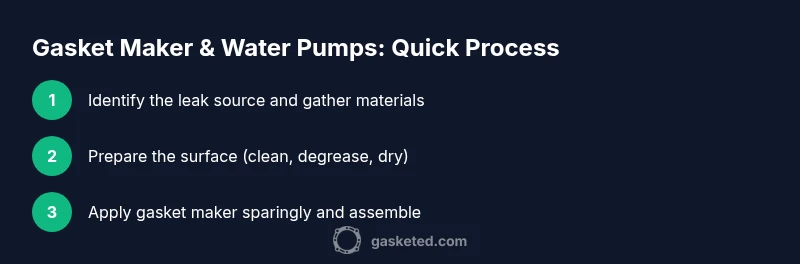
Identify leak source and gather materials
Inspect the pump area to locate the exact seal or gasket surface that’s leaking. Collect gasket maker, the correct gasket, cleaning solvents, and tools before starting to minimize repeat disassembly.
Tip: Double-check the gasket type required for your pump model to avoid incompatible sealants. - 2
Prepare the mounting surface
Drain any coolant if required, then remove debris and old sealant from both mating surfaces. Degrease the surface and ensure it is dry before applying any gasket material.
Tip: A clean, dry surface is essential for a reliable bond; moisture can compromise cure and seal integrity. - 3
Apply gasket maker thinly and evenly
Apply a uniform, thin bead along the gasket seating surface, avoiding excessive amounts that can squeeze into passages. Allow the sealant to set according to the label before reassembly if required by the product.
Tip: Do not spread the sealant across bolt holes; use a small amount only on the seam surface. - 4
Install and torque the pump components
Reinstall the gasket and mount the pump, tightening bolts in a crisscross pattern to seat evenly. If your product label specifies a cure time, wait that long before applying pressure.
Tip: Avoid cross-threading and over-tightening, which can crack housings or warp the gasket seat. - 5
First leak test and observation
Reconnect systems and run briefly to check for drips around the joint. Observe for several minutes and look for any signs of coolant seepage. If leaks persist, reassess the seal or replace the gasket.
Tip: A slow leak may indicate a misalignment; stop and re-seat rather than forcing a tighter seal. - 6
Document and plan for a proper gasket replacement
If the leak remains after a temporary fix, plan to replace the gasket with the correct part and recheck the system after reassembly. Keep the temporary seal as a short-term measure only.
Tip: Record part numbers, torque specs, and cure times for future maintenance to simplify repairs.
Common Questions
Can gasket maker fix a leaking water pump permanently?
No. Gasket maker is typically a temporary stopgap. A proper gasket and surface condition should be restored for a durable seal.
Gasket maker usually serves as a temporary fix until you can replace the gasket with the correct part.
What type of gasket maker is best for water pumps?
Use a high-temperature, coolant-compatible silicone gasket maker. Check the label for temperature ratings and coolant compatibility relevant to your pump.
Choose a high-temperature silicone that works with coolant and follows the label directions.
Should I remove gasket maker after applying it?
That depends on the situation. Generally, gasket maker should be cured and only removed if you are replacing the gasket or surface, not as a routine cleanup.
Only remove it if you’re replacing the gasket or fixing a damaged surface.
Is surface prep important for gasket maker success?
Yes. Clean, dry surfaces prevent premature seal failure and ensure proper adhesion and sealing.
Yes, prep is essential for a good seal.
What safety precautions should I take?
Work in a ventilated area, wear gloves and eye protection, and follow all product safety data. Avoid skin contact with the sealant.
Ventilate, wear gloves and eye protection, and read the label for safety guidance.
Can I reuse a water pump after gasket maker cures?
Reuse is possible if the joint seals properly and the pump is in good condition, but if the pump or gasket shows wear, replace with a proper gasket and re-test.
If it seals well and the pump is sound, you can reuse, but inspect for wear and test thoroughly.
Watch Video
Key Takeaways
- Gasket maker can be a temporary fix on a water pump, not a permanent solution.
- Thorough surface prep is critical for a durable seal.
- Always use the correct gasket material and follow cure times on the label.
- If in doubt, replace with OEM gasket to ensure reliability.