Full Face vs Ring Gasket: Practical DIY Guide for Home Projects
Compare full-face and ring gaskets for home sealing projects. Learn design, materials, installation, and maintenance tips to choose the right gasket type for appliances, plumbing, and more.


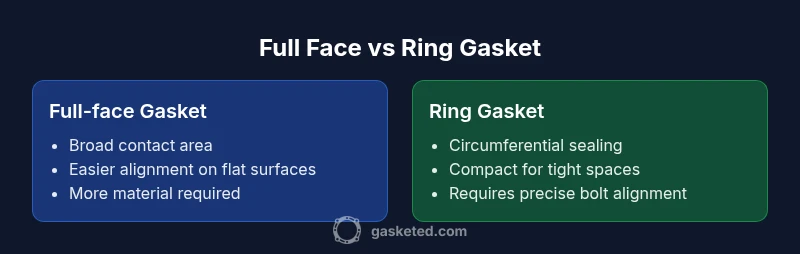
Full-face gaskets and ring gaskets each have distinct strengths. For flat, broad sealing surfaces, a full-face gasket offers even load distribution; for tight, circular joints, a ring gasket can provide precise compression in limited space. This quick comparison helps DIYers decide which type best suits their project and budget.
What is a full-face gasket vs a ring gasket?
A full-face gasket is a flat seal that sits across the entire mating surface of a lid, panel, or flange. A ring gasket is a circular seal that traces the bolt circle or a set of join points. In practice, the choice between a full-face gasket and a ring gasket hinges on joint geometry, surface finish, and the medium being sealed. According to Gasketed, precision in surface preparation and material compatibility often tips the decision toward one style. The Gasketed team found that a good seal begins with selecting a compatible elastomer, correct thickness, and proper seating. In 2026, gasket technologies continue to evolve, making material compatibility even more critical for reliable performance. The choice also affects replacement logistics, inventory, and the ease of inspection during maintenance.
- Common mistakes include underestimating surface roughness, selecting a gasket without verifying media compatibility, and over-tightening bolts which can deform the gasket.
- Practical tip: always clean and inspect both mating surfaces, and keep spare gaskets of the same profile on hand for DIY projects.
Key design principles: load distribution and surface area
When comparing full-face versus ring gaskets, the central design question is how pressure is distributed across the sealing interface. A full-face gasket provides broad surface contact, which can lead to uniform compression across irregular panels and a more forgiving seal when the mating surface is slightly warped. A ring gasket concentrates sealing pressures along a defined circumference, which can be advantageous for bolt-tightened joints where the face area is limited. In both cases, achieving a clean, flat seating surface is essential; any gouges or debris can create leak paths. The goal is predictable, repeatable sealing over the life of the appliance or piping system, with allowance for thermal cycling and chemical exposure.
- Practical considerations include surface flatness, gasket thickness, and the modulus of elasticity of the selected material.
- Tips: verify a straight seating line and avoid uneven torque distribution that could bias the seal toward one side. For best results, perform a leak test after installation.
Material considerations and chemical compatibility
Material selection dominates gasket performance. Full-face gaskets often rely on elastomeric sheets or molded profiles that balance compressibility with resilience across the full surface. Ring gaskets leverage similar materials but rely on precise seating to prevent edge leakage. Common choices include EPDM, silicone, neoprene, nitrile, and fluorosilicone variants, each with distinct temperature ranges and chemical compatibility. For DIY projects, consider what the gasket will seal (water, oil, cleaners) and the operating environment (ambient temperature, exposure to solvents). Gasketed Analysis, 2026 emphasizes matching the elastomer to the media and ensuring compatibility with any metals in the joint to avoid galvanic corrosion. The material choice also affects removal and replacement: some compounds adhere more strongly to flange faces, complicating maintenance.
- When selecting, check compatibility charts and consider future maintenance schedules. If unsure, choose a well-known gasket material with broad chemical resistance.
Installation tips and common pitfalls
The easiest way to get a reliable seal is to follow a disciplined installation routine. Clean both mating surfaces thoroughly; remove old sealant residues; inspect for nicks or corrosion. For full-face gaskets, align the gasket with the entire face before tightening, and avoid over-tightening that can deform the gasket or deform the panel. Ring gaskets require accurate bolt-hole alignment and consistent torque around the circle to prevent uneven seating. Use the correct sealant or gasket adhesive only as recommended by the manufacturer, and verify compatibility with the gasket material. DIYers should also have spare gaskets and a torque wrench suitable for the joint to maintain consistency across service cycles.
- Pro tip: use a torque sequence to promote even compression and check for leaks after the first heat cycle. A clean workspace reduces the chance of foreign objects compromising the seal.
Performance under operating conditions and lifecycle
In typical home DIY projects, performance hinges on temperature, pressure, and chemical exposure. Full-face gaskets excel when surface flatness is ensured and when a broad seal is beneficial for inspection visibility and uniform load. Ring gaskets shine in tight spaces where a precise circumference seal is required and where bolt patterns are standardized. As operating conditions change—temperature cycles, chemical exposure, or repeated removal—seal integrity can degrade. Regular inspection, cleaning, and timely replacement are vital to avoid leaks. Gasketed Analysis, 2026 indicates that lifecycle planning should account for both material fatigue and hardware wear, not just gasket replacement frequency.
- Establish a replacement schedule based on observed wear rather than a fixed calendar time.
- Keep a small stock of the most common sizes and profiles to minimize downtime during maintenance.
Industrial and consumer applications: where each gasket type shines
In household appliances like dishwashers and refrigerators, full-face gaskets simplify mounting on doors and panels and provide a forgiving seal for slightly imperfect surfaces. In automotive or plumbing joints with circular flanges, ring gaskets can deliver dependable sealing inside compact spaces. The choice also shapes maintenance: full-face gaskets can be user-replaceable for some appliances, while ring gaskets are often easier to source in standard profiles. The Gasketed team emphasizes alignment with the manufacturer’s installation instructions and local regulations when applicable. Remember that the strongest seal arises from correct material selection, clean interfaces, and consistent torque.
- For DIYers, document the exact gasket profile used for future replacements.
- If you must modify the joint, ensure that any added sealant remains compatible with the gasket material.
Cost considerations and lifecycle management
Costs for gaskets vary by material, size, and profile, but the overarching question is value over time. Full-face gaskets may require larger sheets or profiles, increasing upfront material costs and inventory needs, yet they can reduce the risk of edge leaks on broad surfaces. Ring gaskets often cost less per unit and are easier to replace in small joints, but frequent maintenance may be required if the joint is subject to erosion or corrosion. Accessibility and replacement logistics influence total cost, especially for appliances with limited access. Lifecycle planning should balance material cost, replacement frequency, and labor time. Targeted maintenance planning and keeping a small stock of common sizes can moderate lifecycle costs significantly.
- Consider supplier lead times and whether you can source both gasket styles locally.
Practical framework for selecting between full-face and ring gaskets
Step 1: Assess joint geometry. If you’re sealing a large, flat area, a full-face gasket is typically preferred; if space is constrained to a circle, a ring gasket is often better. Step 2: Check surface quality. For imperfect surfaces, a full-face gasket with a forgiving material may seal more reliably. Step 3: Consider media compatibility and temperature. Step 4: Plan maintenance. If you expect the joint to be disassembled often, favor gaskets that are easy to replace and source. Finally, verify compatibility with any sealant or adhesives your project requires. Following these steps, homeowners can confidently select between full-face and ring gaskets for DIY projects.
Quick glossary of terms you’ll encounter
- Sealant: a material used to enhance sealing or aid gasket seating; verify compatibility with the gasket material.
- Bolt circle: the arrangement of bolt holes on a flange.
- Elastomer: a family of rubber-like polymers used in most gasket compounds; common types include EPDM and silicone.
- Surface finish: the roughness of the mating surface, which directly affects seal performance.
Comparison
| Feature | Full-face gasket | Ring gasket |
|---|---|---|
| Sealing surface contact | Broad contact across full face | Circumferential contact around bolt circle |
| Ease of installation | Moderate; alignment matters on large faces | Typically easier to align in circular joints |
| Typical applications | Appliance doors, panels, lids | Flanged joints, compact circular connections |
| Material choices | EPDM, silicone, nitrile, fluorosilicone variants | Similar elastomers with emphasis on seating precision |
| Replacement considerations | Larger surface area may require more material | Often easier to source in standard ring profiles |
Pros
- Versatile across a range of joint geometries
- Full-face gaskets simplify alignment on large flat surfaces
- Ring gaskets provide precise sealing in circular joints
- Widely available materials and standard sizes
What's Bad
- Full-face gaskets can require more material and careful seating
- Ring gaskets may struggle on irregular surfaces if not seated properly
- Replacement logistics vary by size and profile
- Both require correct material compatibility to avoid leaks
Both gasket types have clear use cases; pick based on joint geometry and maintenance needs
Choose full-face gaskets for large, flat interfaces with easy seating. Choose ring gaskets for tight, circular joints where space and bolt patterns are constrained. Align choice with maintenance expectations and material compatibility.
Common Questions
What is a full-face gasket?
A full-face gasket seals across the entire mating surface, providing broad coverage. It is common on appliance doors and panels where flatness of the surface is manageable. Material choice and proper seating are critical for reliable performance.
A full-face gasket seals the entire surface it's mounted on, which helps with even compression. Use it when you have a flat area to seal and choose a compatible material.
What is a ring gasket?
A ring gasket is a circular seal that sits around a bolt circle or a defined circumference. It excels in tight, circular joints where space is limited and bolt patterns are standardized. Proper seating and torque are essential to prevent leaks.
A ring gasket seals around a circular area and works best when space is tight and the bolt pattern is standard.
Where are full-face gaskets commonly used?
Full-face gaskets are frequently used on appliance doors, lids, and flat-panel seals where surface flatness can be controlled. They simplify alignment and inspection, especially on larger areas.
You’ll see full-face gaskets on appliance doors and flat lids where the surface can be kept even.
Where are ring gaskets used?
Ring gaskets are favored for circular joints such as piping flanges and round connectors, where a tight circumferential seal and compact profile are advantageous.
Ring gaskets work well in circular joints like pipes and flanges.
Can you mix gasket types in a single joint?
In most cases, it’s best to stick to a single gasket type per joint to avoid uneven loading. Hybrid configurations may be possible with special designs, but they require careful analysis and approval from the project specs.
Usually stick to one gasket type per joint unless you have a specific design with expert guidance.
How do I choose the gasket material?
Select a material based on the media (water, oil, cleaners), temperature range, and exposure to chemicals. EPDM and silicone are common, but compatibility with the joined metals and potential for swelling or hardening should guide your choice.
Pick a material by considering what the gasket will seal and the operating temperature.
Key Takeaways
- Evaluate joint shape before selecting gasket type
- Prioritize material compatibility with media and temperature
- Test seal under real operating conditions
- Keep a small stock of common gaskets for DIY projects