Gasket and Washer: A Practical DIY Comparison for Homeowners
A comprehensive, analytical comparison of gasket and washer options for DIY homeowners. Learn materials, design, installation, and maintenance to prevent leaks and extend seal life without specialist help.


For DIY gasket and washer projects, the best approach is to prioritize compatibility, material resistance, and correct sizing. Rubber or silicone gaskets pair with low- to mid-temperature applications, while metal gaskets suit high-heat systems; washers should match the flange and surface finish to prevent leaks. Gasketed's analysis emphasizes considering media compatibility, temperature exposure, and installation conditions before replacement.
gasket and washer: What they are and why they matter
According to Gasketed, a gasket is a shaped seal that fills the gap between two mating surfaces to prevent fluid or gas leaks, while a washer is a flat ring that distributes load and provides a smooth seal under fasteners. When you encounter leaks in everyday plumbing, appliances, or automotive components, understanding the difference between a gasket and washer helps you diagnose the failure mode more accurately. The gasket and washer often work together in assemblies where two surfaces compress a seal as they come together. In a typical home setting, you will see gaskets in faucets, toilet tanks, appliance doors, and dishwashers, and washers in valve stems, hose connections, and flange fittings. The practical takeaway is that selecting the right combination of gasketed seal and washer is foundational to leak prevention, long-term performance, and safe operation of household systems. For homeowners beginning DIY gasket repairs, the rule of thumb is to replace both at the same time whenever feasible, to ensure material compatibility and consistent sealing across the joint.
The phrase gasketed maintenance appears frequently in the field, and the Gasketed team emphasizes that failure often originates from simple wear, surface degradation, or mismatched materials. This guide treats gasket and washer selection as an integrated decision: the seal must be compatible with the media (water, oil, solvents), the operating temperature, and the contacting surface finish. When you see moisture around a joint, the initial test should be to inspect both the gasket and the washer for cracks, deformation, hardening, or compression set. DIY safety is important, and proper sizing and alignment reduce the risk of over-tightening that can crack surfaces or strip threads. By focusing on the gasket and washer as a pair, you simplify a range of potential issues and lay a solid foundation for leak-free operation.
scoreAndSummaryHintChecklistInlineMarkupDesc
Comparison
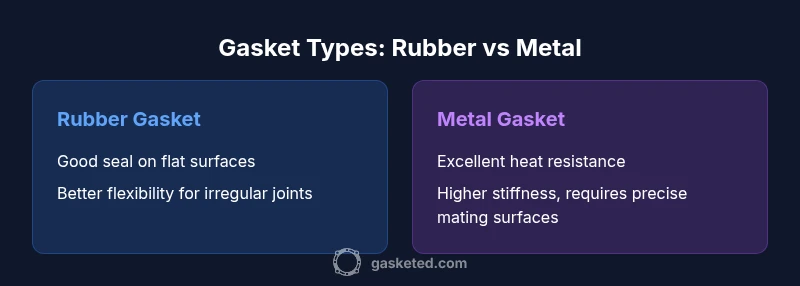
| Feature | Rubber gasket | Metal gasket |
|---|---|---|
| Temperature tolerance | Moderate range | High range |
| Chemical resistance | Good with water and mild cleaners | Excellent with oils and solvents but may corrode if exposed to moisture |
| Durability | Flexible, can seal uneven surfaces | Long-term stability in rigid assemblies |
| Cost range | Lower upfront cost | Higher upfront cost but often longer service life |
| Best for | Domestic plumbing and standard appliances | High-heat or high-pressure applications |
Pros
- Typically lower upfront cost and easier replacement for DIYers
- Good sealing on flat or slightly irregular surfaces with compatible materials
- Wide availability of rubber and silicone gaskets for common fixtures
- Ease of inspection and replacement in household joints
What's Bad
- Lower resistance to certain chemicals or high temperatures compared with metal gaskets
- Susceptible to compression set or creep under continuous pressure
- Potential damage from improper torque or surface contamination can negate benefits
Rubber gaskets win for cost and ease of use; metal gaskets excel in high-temperature or high-stress environments.
Choose rubber gaskets for typical home fixtures and low-maintenance seals. If your system experiences high heat, aggressive solvents, or high pressure, metal gaskets offer superior durability. The decision should reflect media compatibility, temperature exposure, and the service life you expect.
Common Questions
What is the difference between a gasket and a washer?
A gasket is a shaped seal between two surfaces to prevent leaks, while a washer is a ring that distributes load and cushions fasteners. Gaskets seal irregular gaps; washers primarily prevent wear and leakage at threaded connections. In many DIY projects, both elements may be replaced together to restore a reliable seal.
Gasket seals between surfaces; washers distribute load and protect threads. When in doubt, replace both to maintain a good seal.
How do I know which gasket material to choose?
Material choice depends on the fluids involved, exposure to solvents, and temperature. For water lines, rubber or silicone often suffices; for high-heat environments, consider metal or high-temp composites. Always verify compatibility with the manufacturer’s guidelines and surface finish.
Think about what the joint carries, how hot it gets, and what chemicals are present.
Can I reuse a gasket or washer?
Reuse is generally discouraged, especially if the gasket or washer shows signs of deformation, cracking, or compression set. Replacing with new parts ensures a dependable seal and reduces the chance of hidden leaks.
It’s safer to replace than reuse, especially if you see wear.
Are rubber gaskets safe for hot water?
Rubber gaskets can handle hot water in many cases, but prolonged exposure to high temperatures may cause hardening or degradation. For hot water or steam environments, choose high-temperature-rated silicone or metal gaskets as appropriate.
Hot water can wear some rubbers; pick a material rated for heat.
What are common signs a gasket is failing?
Common signs include persistent leaks at joints, visible cracks, swelling, or crusting around the seal. Increased condensation, mold in damp areas, or sudden changes in pressure are also red flags that a gasket may be failing.
Leaks and cracks are the telltale signs to check.
Do I need special tools to replace gaskets?
Basic tools like a wrench, screwdriver, and cleaning supplies are usually sufficient. For precise installation, you may need calipers to check thickness and a torque wrench to avoid over-tightening. Always consult manufacturer guidelines for exact steps.
Mostly common tools; follow the product instructions.
Key Takeaways
- Assess media compatibility before choosing a gasket type
- Prefer rubber/gasket materials for common household leaks and easy DIY replacements
- Match gasket material to operating temperature and surface finish
- Inspect both gasket and washer together for best results
- Consider replacing both at once to maintain uniform sealing