Difference Between Gasket and Washer: A DIY Guide
A practical, evidence-based guide explaining the difference between gasket and washer, with definitions, materials, typical applications, installation tips, and maintenance guidance for DIY repairs.


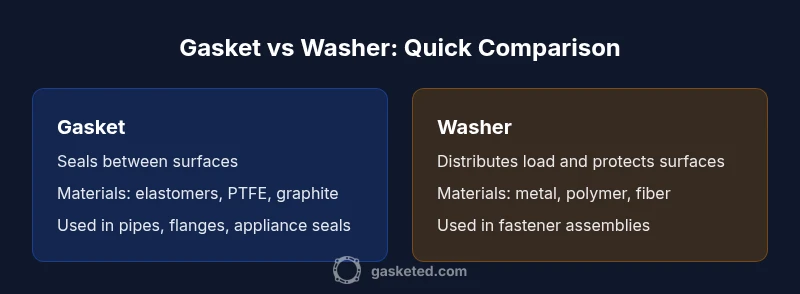
The gasket and the washer are not interchangeable: a gasket is a compressible seal placed between surfaces to stop leaks, whereas a washer mainly distributes load and protects the fastener. In most DIY scenarios, use a gasket when a true seal is required (pipes, flanges, appliance gaskets), and use a washer for load distribution and protection. When in doubt, inspect for wear and replace both if the seal may fail.
The difference between gasket and washer in DIY practice
Understanding the difference between gasket and washer is essential for any DIY project that involves joints, seals, or fasteners. The term 'difference between gasket and washer' captures a core distinction: gaskets are engineered to seal, while washers mainly support hardware and manage load. This practical guide uses examples across plumbing, appliance repair, and automotive maintenance to show when to pick each part. According to Gasketed, choosing the right sealing element reduces leaks, extends service life, and minimizes costly rework. In this article we break down definitions, materials, and installation considerations so readers can make informed, durable choices. The guidance here reflects common industry practices and the DIY realities of home maintenance, where a small part choice can prevent larger failures. Throughout, we emphasize evidence-based decision-making, material compatibility, and proper installation technique to maximize longevity and minimize water damage or coolant loss.
Definitions: what is a gasket and what is a washer?
A gasket is a deformable or compressible ring that sits between two mating surfaces to create a tight seal. It compensates for small irregularities and prevents liquids or gases from leaking along the joint. A washer, by contrast, is a flat ring placed under a bolt, screw, or nut to distribute clamping force, protect the surface, and reduce friction. In many assemblies, the two parts serve distinct roles: the gasket seals the joint while the washer supports the fastener and helps control load. When a joint is designed to hold pressure or fluid, a gasket is usually required; a washer is often used to smooth the load path and prevent surface indentation. The correct pairing improves service life and reduces the risk of leaks or looseness under vibration.
Core functions and how they seal or bear load
The primary function of a gasket is to establish a leak-free interface. Gaskets deform under compression to fill microscopic gaps, and their material choice (PTFE, silicone, neoprene, graphite, etc.) determines chemical compatibility and temperature tolerance. Washers, meanwhile, preserve the integrity of fasteners by spreading the clamping force across a larger area, reducing embedded wear, and protecting soft surfaces. In some assemblies, a washer can contribute to sealing when paired with a gasket or using a sealing washer (like a rubber-coated or fiber washer). The key takeaway: if you anticipate shear, vibration, or fluid leakage, prioritize the gasket’s sealing capability; if you expect load-bearing or spacer roles, rely on the washer.
Materials and tolerances: how composition affects performance
Gaskets come in elastomeric compounds (NBR, EPDM, silicone), fluoropolymers (PTFE), compressed non-asbestos fibers, and metal variants (copper, stainless steel). Their thickness and compression set determine sealing reliability and long-term performance. Washers are made from metal (steel, stainless, brass), polymers, or composites; their thickness, inner diameter, and outer diameter influence how well they distribute load and how easily they seat. The critical material consideration is chemical compatibility and temperature exposure. A gasket that softens under heat may lose seal, while a too-rigid washer can distribute force unevenly. For recycled or long-lasting systems, check compatibility with cleaners, solvents, and automotive fluids. Material selection is often governed by industry standards and environmental exposure; documentation from manufacturers guides the best match.
Common applications across plumbing, appliances, automotive
In plumbing, gaskets seal pipe joints, flanges, and valve housings, while washers lubricate and protect threaded connections. In appliances, door gaskets and lid gaskets provide leakage prevention, and washers cushion mounting hardware. In automotive assemblies, gaskets seal exhaust manifolds, intake manifolds, and oil pans, while washers support head bolts, flange connections, and sensor mounts. The practical rule is straightforward: use a gasket where sealing is essential and use a washer when the goal is to protect surfaces, control gap, or avoid overtightening. This distinction remains relevant across DIY projects, home repairs, and hobbyist engines. Maintenance and proper matching reduce the risk of leaks and mechanical wear over time.
Installation considerations: torque, surface finish, and mating surfaces
A good seal begins with a clean, flat mating surface. Mismatched surfaces or scratches can prevent proper gasket compression. Torque specifications are critical for gaskets; under-tightening may cause leaks, while over-tightening can crush the gasket or warp the joint. Washers also require proper torque and sometimes anti-rotation features or washers with seals. Surface finish class and roughness impact how well the gasket seats and seals; for some gasket materials, lubricants or assembly pastes are recommended. When installing, ensure the gasket is properly aligned and the washer sits flat without rocking. Finally, replace both parts when signs of degradation appear, and avoid reusing gaskets after disassembly unless the manufacturer allows it.
Failure modes and maintenance tips
Gasket failures include compression set, chemical attack, aging, and misalignment, which can lead to leaks or sudden pressure loss. Washers can corrode, crack, or experience embedded damage that concentrates stress. Regular inspection during maintenance is key: look for hardening, cracking, or swelling in gaskets, and check washers for wear, rounded edges, or deformation. When replacements are needed, match the material and thickness to the original design and verify compatibility with fluids and temperatures. Keep spare gaskets and washers categorized by diameter, thickness, and material so you can quickly select the correct part during future service.
How to choose between gasket and washer in a DIY project
Begin by identifying the system’s sealing requirement. If any form of leakage is possible, prioritize the gasket. If you are dealing with mechanical fasteners and need to prevent surface damage or distribute load, the washer is the better choice. Material compatibility matters: choose elastomers for flexible seals, PTFE for chemical resistance, or metal for high-temperature environments. For mixed scenarios, you may use a sealing washer or a gasket-washer combo. Always verify torque specs and replacement intervals from the manufacturer. When in doubt, consult manufacturer guidance or trusted DIY references. The Gasketed perspective emphasizes long-term reliability and compatibility with household fluids.
Comparison
| Feature | Gasket | Washer |
|---|---|---|
| Definition/Primary role | Gasket: compressible seal between mating surfaces to prevent leaks | Washer: flat ring to distribute load and protect surfaces; not primarily a seal |
| Typical materials | Gaskets: elastomeric options, PTFE, graphite, or metal depending on application | Wasers: metal, polymer, or composite |
| Primary function | Seal leaks and maintain joint integrity | Distribute clamp force and prevent surface damage |
| Best use/Applications | Static joints requiring a leak-proof seal (pipes, flanges, appliance doors) | Bolt assemblies, spacers, load-bearing joints |
| Sealing capability | High sealing capability with proper material and torque | Limited sealing capability; often used with a gasket when sealing is needed |
| Installation considerations | Surface finish, correct compression, torque | Thickness, seating, and compatibility with fasteners |
| Maintenance frequency | Requires periodic inspection and replacement based on environment | Typically inspected during service; long life when undisturbed |
Pros
- Gaskets provide reliable seals when selected for the correct environment
- Washer-based assemblies protect surfaces and distribute load effectively
- Both parts are widely available and replaceable in hardware stores
- Gaskets can accommodate minor surface irregularities through compression
What's Bad
- Gaskets can degrade or fail if mischosen or improperly torqued
- Washer-only solutions may not seal in leak-prone joints
- Mismatched materials can cause corrosion, swelling, or accelerated wear
Gasket is essential for sealing; washers are best for load distribution and protection; use both appropriately.
Prioritize proper gasket selection for true seals, especially in fluid systems. Use washers to manage load and protect surfaces; follow manufacturer torque specs and material compatibility guidelines to maximize longevity.
Common Questions
What is the difference between gasket and washer?
A gasket provides a compressible seal between surfaces to prevent leaks, while a washer distributes load and protects surfaces but does not seal on its own. The two are used together when a leak-proof joint and stable fastening are both required.
A gasket seals; a washer protects and spreads load. Use a gasket for leaks and a washer for mechanical support, and pair them when needed.
When should I use a gasket?
Use a gasket whenever the joint must be leak-proof, such as pipe connections, valve housings, or appliance doors. Select a material compatible with the fluid and operating temperature, and ensure proper torque to avoid leaks.
Use a gasket when sealing is essential, like pipes or flanges, and pick the right material for the environment.
Can I substitute a gasket with a washer?
In most cases, a washer cannot substitute for a gasket when sealing is required. A sealing washer can help, but it does not provide the same level of leak protection as a true gasket. Assess the system’s sealing needs before deciding.
Usually not. A gasket is needed for sealing; a washer alone won’t seal leaks effectively.
How do I choose material for gaskets and washers?
Match gasket material to temperature, chemicals, and pressure: common options include silicone, EPDM, NBR, and PTFE. For washers, select based on corrosion resistance, strength, and wear. Always check compatibility with the fluids and the service environment.
Choose gasket material for environment and chemicals, and match washer material to strength and corrosion needs.
Are there maintenance steps that apply to both?
Yes. Inspect for signs of aging, cracking, or swelling in gaskets, and check washers for rounding or deformation. Replace both parts if signs of wear are evident, and keep spare parts organized by size and material.
Inspect both regularly and replace when you see wear or damage.
Key Takeaways
- Assess whether a leak seal is required before choosing parts
- Choose a gasket for true sealing in joints with fluids
- Use washers to spread load and protect surfaces
- Check material compatibility and temperature ratings
- Inspect joints after maintenance and replace components as needed