How Long to Replace Head Gasket: Time Guide
This in-depth guide explains how long a head gasket replacement takes, the factors that influence timeline, and practical steps for DIYers and professionals.


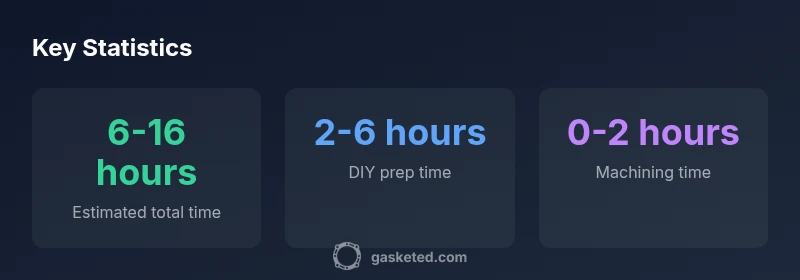
For most passenger vehicles, a head gasket replacement spans about 6-16 hours of labor, depending on engine type, tooling, and whether machining is required. In a shop, plan for a full day or more; DIYers should budget extra time for learning curves. Always factor cooling system and timing adjustments.
Understanding the timeline for head gasket replacement
The phrase how long to replace head gasket is not one-number answer; it depends on engine design, access to components, and whether machining is required. For most cars, a straightforward head gasket replacement involves disassembly, head inspection, and reassembly with a new gasket. The process also includes verifying proper head torque, coolant circulation, and timing alignment. Because engines differ in complexity, the total calendar time can vary from a dedicated Saturday at home to a full day of shop work. In addition, the inclusion of other related maintenance tasks—such as timing belt, water pump, or thermostat replacement—can extend the overall duration. Understanding these steps helps set expectations and prevent rushed errors.
Key drivers that affect how long it takes
Several core factors determine the duration of a head gasket replacement. First is engine design: a simple inline-four with accessible valve covers is faster to work on than a modern overhead-cam V6 or DOHC setup with multiple timing chains. Second is tooling and experience: a well-equipped shop or a DIYer with proper torque wrenches, micrometers, and a good hoist can save hours. Third is machining: if the head or block is warped, resurfacing or machining is required, adding hours. Fourth is ancillary work: replacing the water pump, thermostat, and hoses adds complexity. Finally, the decision to perform a full timing belt/chain service or replace other seals can expand the window. In short, the timeline is a function of access, accuracy, and scope.
Typical time ranges by engine type
Engine type strongly influences the time to complete the job. Inline-four engines with simple access generally fall in the 6–12 hour range for labor, while V6/V8 configurations often land near 8–16 hours due to extra components and tighter spaces. Diesel engines, with heavier components and more complex cooling systems, can push the window toward 10–18 hours or more. Note that these ranges reflect professional shop labor under typical conditions and assume a correctly identified head gasket failure with no structural damage. DIY attempts tend to require more time, especially for first-timers.
DIY vs professional shop: time and planning
Choosing to DIY or hire a shop dramatically changes the timeline. A seasoned DIYer with a proper gasket kit and service manual might finish in the lower end of the range, while a shop allocates time for machine work, teardown, reassembly, and a calibrated leak test. Labor rates and scheduling also influence the total calendar time. If you lack a dedicated space, portable stands, or a vehicle hoist, the project may stretch over multiple weekends. Plan for a contingency: a 10–20% buffer is common to account for unexpected discoveries.
Preparation steps before starting the job
Preparation reduces wasted time once you start. Confirm the head gasket type and obtain a full gasket kit with all seals. Ensure you have a clean workspace, the right torque specs, a resurfacing plan if required, and a timing tool kit. Drain cooling system and remove necessary accessories. Label components and take photos as you disassemble to simplify reassembly. If you’re unsure about head surface condition or warping, have the head checked by a pro before removal to avoid missteps.
A high-level step-by-step outline (no shortcuts)
- Disconnect battery, drain coolant, and remove the components blocking access to the head.
- Remove the head bolts in the correct sequence, and lift the head with care.
- Inspect the head and block surfaces for warping or cracks; ship to a machine shop if needed.
- Clean combustion chambers and install the new gasket with correct orientation.
- Reassemble per torque specs and timing procedures; replace water pump and thermostat if indicated.
- Refill coolant and perform initial startup, bleed air, and inspect for leaks. This outline highlights essential steps while avoiding risky shortcuts.
Common bottlenecks that extend the timeline
Delays often stem from warped heads, corroded head bolts, or seized studs. Incorrect gasket orientation or torque sequence causes leaks and returns to the bench. Incomplete cooling system bleed can trap air, leading to overheating on first start. Missing special tools for timing belt/chain service or failing to verify cam/crank timing can necessitate a redo. Being prepared with the right parts and a clear plan prevents these common bottlenecks.
How to gauge whether your model falls in the typical range
While every vehicle is different, you can compare your model to common patterns: entry-level four-cylinder engines typically sit at the lower end; larger or turbocharged engines tend to be longer; and DOHC variants with more accessories add to the time. If a shop confirms machine work or head resurfacing is required, expect the high end of the range. When in doubt, request a written time estimate based on the specific engine.
Post-replacement checks and break-in
After the gasket is installed, perform a leak test and a controlled coolant bleed to remove air pockets. Start and run the engine to observe steady idle, no coolant leaks, and stable temperature. Recheck compression and leak-down to confirm cylinder sealing. Break-in driving should be gentle for the first 500 miles; avoid heavy loads. Document any anomalies and address leaks promptly to ensure long-term reliability.
Time estimates by engine type
| Engine Type | Estimated Time | Notes |
|---|---|---|
| Inline-4 | 6-12 hours | Basic access; likely quickest route |
| V6/V8 | 8-16 hours | More components; tighter spaces |
| Diesel | 10-18 hours | Heavier components; more cooling work |
Common Questions
How long does a head gasket replacement typically take?
In most engines, expect 6-16 hours of labor in a shop setting; DIY timelines may be longer due to familiarity and tools. This assumes no major head damage and standard testing.
Most jobs take a day in a shop, or longer for DIYers new to the process.
Can I drive a car with a blown head gasket?
No. Driving with a blown head gasket risks severe engine damage, coolant loss, and overheating. If you suspect a failure, tow to a repair shop.
Don’t drive it—get it checked before you cause more damage.
What factors affect replacement time the most?
Engine design, accessibility, required machining, and whether you replace ancillary components all influence the timeline.
Engine layout and whether parts need resurfacing are the big time drivers.
Is machining always required when replacing a head gasket?
Not always. If the head and block surfaces are true, machining may be avoided; otherwise resurfacing adds time.
Only if the surfaces are warped or damaged.
Should I replace the water pump and timing belt during the gasket job?
Replacing the water pump and timing components is common and can prevent future failures; it adds time but improves reliability.
Yes—it's often wise to do it while you’re in there.
What are signs of incorrect timing after replacement?
Misfires, rough idle, or low compression can indicate timing problems; verify cam/crank timing and recheck after reassembly.
If it runs rough or pings, recheck timing.
“A head gasket replacement is a meticulous job; proper planning and accurate torque are crucial for lasting seals.”
Key Takeaways
- Plan for 6–16 hours in a shop for typical engines
- Machining or resurfacing adds hours
- DIY time tends to be longer for first-timers
- Schedule a full day with a contingency of 10–20%
- Consider replacing water pump and timing components during the job