Replacing Head Gasket Without Resurfacing: A DIY Guide
Learn how to replace a blown head gasket without resurfacing, with step-by-step instructions, tools, safety tips, and long-term maintenance guidance for DIY enthusiasts.


You can replace a head gasket without resurfacing by following a careful, torque-sequence procedure to ensure the head is flat and the gasket seals properly. This approach is feasible for engines that show no warping and have accessible valve trains. Key requirements include a clean workspace, proper tools, fresh head gasket set, and adherence to torque specs.
What replacing the head gasket without resurfacing really involves
Replacing the head gasket without resurfacing is a repair approach that focuses on sealing a blown gasket while avoiding a full resurfacing of the cylinder head. This strategy is most viable on engines where the head and block are found to be flat within specs, there’s no warping, and the gasket failure is localized. In practice, it means removing the head, cleaning mating surfaces, installing a new gasket, and reassembling with proper torque in the correct sequence. It also requires careful inspection for cracks, corrosion, and residual coolant or oil seepage that could undermine a fresh seal. For DIY enthusiasts, this path can save time and cost when executed with patience and attention to detail. However, it’s not a one-size-fits-all solution; the decision hinges on a solid deck surface, clean coolant channels, and an accurate assessment of head integrity, often guided by the service manual and a few key measurements. According to Gasketed, this approach should only be used when the head is verified flat and no warped surfaces are detected.
Is this approach right for your engine? When to consider skipping resurfacing and when to do it anyway
This approach is most appropriate when the head and block surfaces are confirmed flat using a straightedge and feeler gauges, and the engine has not suffered significant overheating that caused warping or cracks. Visual checks for cracks in the head or deck, strengthened coolant passages, and the absence of heavy corrosion are important signals. If there’s any doubt about head integrity, or if the timing surface shows distortion, resurfacing or a professional evaluation is strongly advised. Gasketed analysis, 2026, emphasizes validating flatness and cleanliness before committing to a non-resurfacing route. When in doubt, err on the side of resurfacing to prevent repeated head gasket failures.
Planning, safety, and upfront checks you should perform before touching the engine
Begin with a clean workspace, cool engine, and a comprehensive plan. Label wires and hoses, take plenty of photos, and have a service manual on hand for torque specs and sequence. Verify that you have the right tools and replacement parts ready, including a new head gasket set, sealants prescribed by the manufacturer, and fresh coolant. Inspect coolant passages for blockages, test the radiator and water pump flow, and confirm there are no active leaks in the cooling system. Finally, prepare a method to drain fluids safely and collect them for proper disposal.
Risks, trade-offs, and why some engines need resurfacing
Skipping resurfacing carries risks if the head or block is not perfectly flat. A warped head can cause inaccurate gasket seating, hot spots, and repeated leaks. Resurfacing removes a thin layer of metal to restore flatness and seal, which can be essential for engines with marginal surfaces or prior overheating. The trade-off is cost and time versus the risk of future leaks. If the head is suspected to be bowed or cracked, or if valve seats show damage, resurfacing or new head work may be the safer route.
Step-by-step overview of the process (high-level)
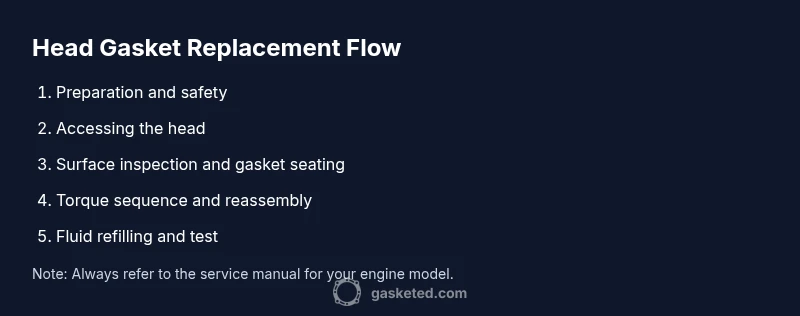
In this stage, you get a high-level sense of the workflow: disconnect the battery, drain fluids, remove components to access the head, lift the head, inspect surfaces, prep the block and head, install the new gasket, reassemble with correct torque and sequence, refill fluids, and perform initial startup checks. The goal is to complete a clean, precise rebuild that preserves engine integrity. Detailed steps follow in the dedicated Step-by-Step section.
Diagnostics after installation: tests to confirm a good seal
Once the engine is back together, perform a careful coolant and oil fill, bleed air from the cooling system, and check for leaks at the gasket seam. A controlled compression test and a leak-down test help verify sealing integrity. Watch for overpressurization in the cooling system, unusual noises, or rapid coolant loss. If issues arise, re-check gasket seating, torque sequence, and accessory alignments. Regularly monitor oil color and coolant clarity in the first few days of operation.
Maintenance considerations after replacement
After successful installation, change the oil and replace the oil filter, as contaminants may have entered during the repair. Refill the cooling system with fresh coolant and ensure proper air bleeding. Schedule periodic checks for head gasket symptoms like milky oil or overheating. Store a spare head gasket set and sealant in your workshop for future maintenance. Keeping a consistent maintenance routine will help extend the life of your repair.
Common mistakes and how to avoid them
Common errors include failing to verify head flatness, skipping proper torque sequencing, using the wrong gasket material for your engine, and not cleaning mating surfaces thoroughly. Avoid cross-threading bolts, over-tightening head bolts, and reusing old head bolts. Always follow the manufacturer’s torque pattern and consult the service manual for your specific engine.
Final checks, documentation, and when to call a pro
Before firing up the engine, double-check all electrical connections, hoses, and belts. Keep a log of the work performed, torque specs, and any measurements taken. If you encounter persistent leaks, misfires, or overheating after startup, seek professional evaluation. The Gasketed team recommends documenting your process for future maintenance and warranty considerations.
Tools & Materials
- Vehicle service manual(Torque specs and sequence specific to your engine.)
- Head gasket replacement kit(Includes gasket set, head bolts, and seals.)
- Torque wrench(Calibrated; required for proper bolt tension.)
- Socket set with extensions(Flat-head and cross-head sockets as needed.)
- Torque-angle gauge(Useful for final bolt tightening in some engines.)
- Gasket scraper and solvent(Thoroughly clean the head and block surfaces.)
- Sealant/RTV silicone (manufacturer-approved)(Only if specified in manual.)
- Coolant drain pan(To collect and dispose of old coolant.)
- Engine coolant(Use the correct type for your engine.)
- Oil drain pan and new oil(Change oil after the repair.)
- Shop rags and degreaser(Keep surfaces clean during reassembly.)
- Gasket sealant remover/solvent(Assists when removing old sealant.)
- Marker or tags(Label hoses and wires for reassembly.)
Steps
Estimated time: 4-8 hours
- 1
Prepare and disconnect power
Ensure the engine is cool, disconnect the negative battery cable, and label critical wiring. This prevents short circuits and makes reassembly safer. Take photos of connections before removal.
Tip: Label wires with tape and note their routing. - 2
Drain fluids and remove components
Drain coolant and oil to prevent spills. Remove components obstructing access to the head, such as the intake manifold, ignition coils, and valve covers. Keep track of fasteners and their locations.
Tip: Keep a labeled tray for small bolts. - 3
Access the cylinder head
Loosen head bolts in the reverse sequence from the service manual and carefully lift the head. Check for surface corrosion and inspect the head for warping or cracks.
Tip: Use a hoist or engine stand if needed to avoid dropping the head. - 4
Inspect mating surfaces
Thoroughly clean the deck and head surfaces. Look for pitting or scoring and verify flatness with a straightedge and feeler gauges. Do not reuse damaged surfaces.
Tip: Only use approved solvent and avoid gouging the metal. - 5
Install fresh gasket and prepare seals
Place the new head gasket in the correct orientation. Apply sealant only where specified, ensuring seals on water jackets and oil passages align properly.
Tip: Always confirm gasket orientation before placing the head. - 6
Torque the head bolts correctly
Reinstall the head and tighten bolts in the manufacturer’s sequence to the specified torque, then perform any required angle tightening if prescribed.
Tip: Do not skip the final step if angle tightening is indicated. - 7
Reassemble engine components
Reattach timing components, manifolds, and any sensors. Replace gaskets as needed and ensure no leftover fasteners remain.
Tip: Cross-check service manual for timing marks and alignment. - 8
Refill fluids and bleed air
Fill the cooling system with fresh coolant and the engine with clean oil. Bleed air from the cooling system and watch for leaks as the system primaries start to pressurize.
Tip: Avoid running the engine at high RPM until you see steady coolant temperature stability. - 9
Initial start and test
Start the engine and monitor for leaks, unusual noises, and temperature behavior. Perform a compression test if available to verify proper sealing.
Tip: If indicators show trouble, shut down and recheck torque sequence and gasket seating.
Common Questions
Can I replace a head gasket without resurfacing if I notice a slight warp?
A slight warp may still allow a non-resurfacing repair if the warp is within service limits and the gasket seating surface remains flat and clean. If in doubt, have the head checked by a professional to avoid repeats.
A small warp might be okay, but if there’s any doubt, get a professional check to avoid a repeat failure.
What are the signs I should look for to decide on resurfacing later?
Persistent overheating, visible head warping, or recurrent leaks after a gasket replacement are signals that resurfacing or a head work may be needed. Always verify flatness with precise measurements.
Overheating or persistent leaks after replacement means you may need resurfacing.
Do I need special torque specifications for non-resurfacing repairs?
Yes. Use the manufacturer’s specified torque sequence and final torque for the head bolts. Do not improvise, as incorrect tension can cause leaks or head damage.
Follow the exact torque pattern in the service manual.
How long does this repair typically take for a DIYer?
Most DIYers spend 4–8 hours depending on engine layout, accessibility, and experience. Complex engines or tight compartments can take longer.
Plan for several hours, often half a day to a full day.
Is it safe to drive the vehicle after a gasket replacement without resurfacing?
If the repair is done with proper torque, clean surfaces, and no leaks, the vehicle can be driven to a nearby shop for a final check. Avoid long trips until you confirm stability.
Drive cautiously to a safe location for a follow-up check.
Watch Video
Key Takeaways
- Verify head flatness before deciding on resurfacing.
- Follow exact torque sequences for head bolts.
- Inspect surfaces and clean thoroughly to ensure a good seal.
- Test thoroughly after installation before regular use.
- Document the process for maintenance and warranties.