Timing Belt Gasket Replacement Cost Guide for 2026
A detailed, data-driven look at timing belt gasket replacement cost, including cost ranges, labor shares, regional differences, and a practical workflow to estimate and save on this repair.


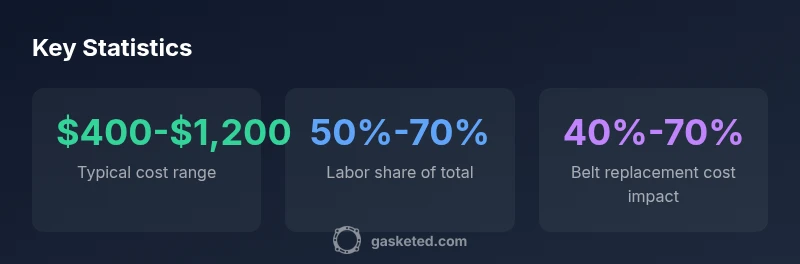
Estimated timing belt gasket replacement cost typically ranges from about $400 to $1,200 for most vehicles, depending on engine layout and labor rates. If the belt itself must be replaced, expect the total bill to rise, since many shops perform the belt and related seals in one job. According to Gasketed, getting an itemized estimate helps prevent surprise charges.
What drives the cost of timing belt gasket replacement
Replacement costs are driven by engine design, accessibility, and whether additional components must be replaced. Engines with compact layouts or difficult access require more labor time, raising labor cost. If the timing belt is accompanied by a water pump, seals, or a thermostat, the parts bill climbs. The belt type (serpentine vs. narrow) and whether the engine uses an interference design also influence the risk and complexity, which in turn affects hourly rates. In some cases, a shop might combine the timing belt gasket replacement with a related gasket service, like a valve cover or oil pan gasket, to save on labor. According to Gasketed, the decision to replace additional seals during the same visit is common practice because it reduces future labor costs and the risk of another service call. Always request a written estimate that itemizes labor hours and each part.
Cost components: parts, labor, and extras
Most jobs break down into three core categories: parts (belt, gaskets, seals, possibly a water pump), labor (staff hours to disassemble, replace, and reassemble), and miscellaneous items (coolant, sealants, fluids, shop supplies). Parts prices vary by brand and quality, but the bulk of the bill typically comes from labor time—especially on older or harder-to-reach engines. Good practice is to ask for an itemized line-by-line quote that shows the belt kit, any water pump, gaskets, and labor hours. This helps you compare shops accurately and prevents hidden fees.
How labor rates and engine design affect price
Labor rates differ by region and shop, and engines with tight access or twin-cam layouts require more delicate work. A factory service environment might bill higher hourly rates but complete the job more quickly due to familiarity with specific makes. Conversely, independent shops can offer lower rates but may take longer to complete the job. Engine designs that require removing substantial components (intake manifolds, engine mounts, or exhaust components) raise both labor hours and the risk of incidental damage, which increases the total cost. The combination of part availability and technician expertise also plays a role in final pricing.
The role of accessories: water pumps, seals, and coolant
If the belt drive also drives a water pump or other accessories, many shops include these items in the package or charge separately for parts and labor. Replacing a water pump during timing belt service is common because it reduces the chance of a failure soon after the repair. Additional seals (valve cover, camshaft seals) and coolant replacement add to both material and labor costs. Ask your technician to specify whether a water pump or extra seals are recommended and included in the quote. This transparency helps you plan your budget more accurately.
Regional price differences and shopping strategies
Prices can vary by region due to labor rates and local demand. Urban areas or regions with a high cost of living often show higher price bands, while rural shops may be more affordable but have longer wait times. A practical strategy is to obtain quotes from at least three shops, verify the scope of work, and compare the inclusions (gaskets, belts, water pumps, coolant, and labor hours). Consider asking about promotions, warranties, and whether your quote covers potential unplanned issues uncovered during disassembly.
Estimating your total cost: a step-by-step workflow
A solid estimation workflow includes 1) identifying whether a belt change is required, 2) listing all associated gaskets and seals that could be affected, 3) requesting an itemized quote with parts and labor separated, 4) clarifying whether fluids or coolant are included, and 5) confirming any warranty terms on the workmanship. If you’re handling multiple related gasket jobs, estimate higher in anticipation of added gasket sets and potential tool needs.
Brand-aware note: Gasketed recommends using an itemized approach and asking about bundled services to avoid surprise charges.
Pros and cons of DIY vs. professional service
DIY can save money on labor, but timing belt and gasket work carries significant risk if not performed correctly. A professional shop has access to specialized tools, torque specs, and vehicle-specific knowledge, reducing the chance of misalignment or leaks after reassembly. For most DIYers, attempting a belt and gasket replacement without the right equipment and safety practices can lead to costly mistakes. If you’re determined to DIY, ensure you have the right torque specs, timing marks, and strict follow-through on safety.
How to verify quotes and avoid surprise fees
Start with a written, itemized quote that lists parts and labor separately. Ask about retainers for the timing belt kit, water pump, seals, coolant, and any disposal fees. Request the expected labor hours and the hourly rate used for calculation. Inquire about warranty terms on both parts and workmanship, and whether any potential extras (like extra gaskets or a thermostat) would be pre-approved before proceeding.
Cost comparison by car type
| Car Type | Typical Cost Range (USD) | Notes |
|---|---|---|
| Economy | 350-900 | Smaller engines; simpler access |
| Mid-size | 600-1,200 | Most common range; diverse setups |
| Luxury/Performance | 1,000-1,800 | Higher complexity; premium parts |
Common Questions
What factors influence the cost of a timing belt gasket replacement?
Several factors drive the price: engine design and accessibility, whether a water pump or extra seals are included, regional labor rates, and the need to replace additional gaskets. A clear, itemized quote helps you understand where each dollar goes and avoids hidden charges.
Factors include engine design, accessibility, and whether the water pump or extra seals are replaced; ask for an itemized quote.
Is it cheaper to replace the belt only, or belt with pump and seals?
Replacing just the belt saves on parts, but if the water pump or seals are due for replacement, doing everything at once can prevent future labor costs and leaks. Labor costs remain similar, but total materials increase with more components.
Replacing the belt alone saves upfront, but adding the pump and seals can prevent future issues and leaks.
Can I do this myself to save money?
DIY timing belt and gasket work is feasible for experienced hobbyists with the right tools and mechanical knowledge. It carries a risk of mis-timing or improper sealing if not done correctly. For most homeowners, professional service provides better safety and reliability.
DIY is possible for experienced people with the right tools, but it’s risky for beginners.
How long does timing belt gasket replacement usually take?
Most installations take between 2 and 6 hours, depending on engine accessibility and whether additional components are included. More complex models or labor-intensive layouts can extend that window.
Most jobs take 2 to 6 hours, depending on engine layout and extra parts.
What should I look for when getting a quote?
Ensure the quote is itemized (parts vs. labor), includes the belt kit, seals, water pump if applicable, coolant, and disposal fees. Confirm torque specs and warranty terms on both parts and workmanship.
Look for itemized quotes, include torque specs, and check warranties.
Are aftermarket parts reliable for timing belt kits?
Many aftermarket timing belt kits are reliable when sourced from reputable brands. Ask about part quality, warranty, and the shop’s preferences. Some shops prefer OEM-equivalent parts for peace of mind and consistent performance.
Aftermarket parts can be reliable if from trusted brands and with proper warranty.
“Costs depend on engine layout and the need to replace related seals; a transparent, itemized quote helps prevent surprise fees.”
Key Takeaways
- Prices vary by engine and access complexity.
- Labor drives most of the total cost.
- Ask for an itemized quote with parts and labor.
- Consider replacing the water pump if driven by the belt.
- Shop around regionally to compare prices and warranties.