Valve Cover Gasket Cost Guide 2026: What to Expect
Explore valve cover gasket replacement costs in 2026, including parts, labor ranges, DIY options, and tips to estimate accurately. Learn how engine design and region affect pricing with practical, data-driven guidance.


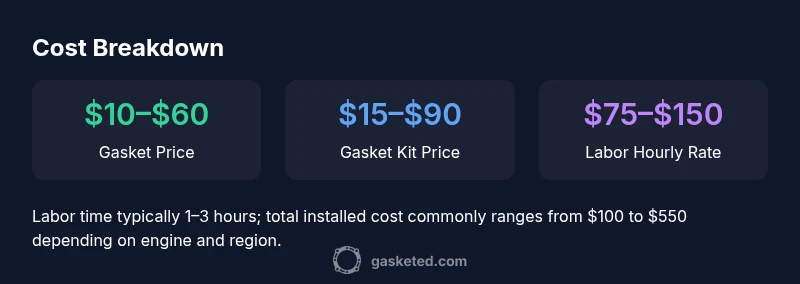
In most cases, valve cover gasket replacement totals run in the low hundreds. Expect parts to cost roughly $10–$60 and labor to range from about $75–$150 per hour, with typical jobs taking 1–3 hours. All told, installed prices usually fall between about $100 and $550, depending on your vehicle and region. According to Gasketed, DIY can lower costs, but a pro ensures proper seal.
Valve Cover Gasket Cost: What You Pay For
According to Gasketed, the cost of replacing a valve cover gasket depends on several variables, with the engine layout and access playing major roles. In practical terms, you’re looking at a price range that includes parts, hardware, and labor. The broad takeaway is that most pass-through repairs land in the low hundreds, but the exact number hinges on your car and location. Labor rates can vary by region, and some engines require additional seals or components that increase the bill. When budgeting, remember that modern engines often have smaller service windows and more intricate access paths, which can nudge prices upward. This is especially true if the job requires removing substantial breather assemblies or the engine cover. For DIYers, the primary math is parts plus labor; for shop work, you also pay for shop overhead and warranty coverage. In 2026, the Gasketed team notes that most homeowners can expect a practical cost range, with the bulk of jobs landing in the hundreds rather than the thousands.
Key takeaway: familiarize yourself with the parts you’ll need and the typical labor hours for your specific engine. The mechanical effort can vary significantly across makes and models.
Price breakdown: gasket, kit, and labor
A valve cover gasket replacement bill is usually composed of three major components: the gasket itself, any gasket kit or seals, and the labor to perform the job. The gasket price is typically the smallest share, ranging from about $10 to $60 depending on whether you choose aftermarket or OEM parts. A full gasket kit or seal set (which may include spark plug tube seals, bolts, and PCV-related seals) can range from roughly $15 to $90. Labor costs are the dominant variable for most car owners, often calculated on an hourly basis (common ranges: $75–$150 per hour). Labor time typically spans 1–3 hours for many engines, but complex or hard-to-reach locations can extend this window. When you add in potential incidental parts or gaskets that wear out concurrently, the total installed cost can rise. For context, a straightforward job on a simple four-cylinder engine will generally be at the lower end of the spectrum, while modern V6/V8 configurations in tighter engine bays can push the price higher. See the cited sources for real-world estimates and regional variations.
Tips to save: compare aftermarket vs OEM pricing, request a full parts list, and ask about any additional seals that might be prudent to replace at the same time.
DIY vs professional: cost, risk, and timing
DIY gasket replacement can dramatically reduce labor costs, but it isn’t the right choice for everyone. If you have basic mechanical skills, access to the right hand tools, and a clean workspace, you can save substantially by performing the repair yourself. However, consider the risk: if the gasket is not seated correctly or the PCV hoses and breathers aren’t reinstalled properly, you could suffer post-repair leaks or motor oil contamination. A professional shop offers certainty, torque verification, and a warranty on the labor, but you’ll pay a premium for the convenience and accountability. In 2026, many DIY enthusiasts report saving hundreds by supplying parts and performing the fix, while still choosing to consult a professional for stubborn engines or tricky access points. The decision often comes down to comfort with torque specifications, gasket seating, and the time you’re willing to invest.
Pro tip: use a restore-and-retest approach—replace the gasket, recheck torque specs, and run the engine to verify there are no leaks before closing up.
How regional labor rates and engine types affect cost
Labor rates vary widely across regions, with urban areas typically commanding higher hourly wages than rural ones. The engine type also matters: some engines have straightforward access to the valve cover, while others require removing intake manifolds, coils, or fuel rails to reach the gasket. Engine design can influence the amount of time required for disassembly and reassembly, which in turn affects the final price. For example, a conventional inline-four engine in a mid-size sedan usually falls at the lower end of the cost spectrum due to easier access, whereas a complex V6 or V8 in a modern crossover might push the job into the middle or higher end. In practice, you should expect regional and engine-related factors to be the primary drivers of price variability.
Recommendation: request a line-item estimate that separates parts and labor, and explicitly note any additional component replacements that could add to the bill. This helps you compare quotes more accurately and avoid sticker shock.
Case studies: typical scenarios
Case A: A 4-cylinder sedan with straightforward valve cover access. Parts cost approximately $20–$40 for a quality gasket and kit, and labor might be around 1–2 hours at $75–$125 per hour. Total installed cost could range from roughly $120 to $350. Case B: A mid-size SUV with a more complex engine bay and additional seals. Parts cost could be $40–$90, with labor extending to 2–4 hours. Regional rates may push the total toward the $350–$550 range or higher, especially if other gaskets are implicated or the PCV system needs service. These examples illustrate how hardware choices and access decisions drive price variability.
Takeaway: your vehicle’s engine layout and your local labor market are the biggest price levers.
How to get an accurate estimate and save money
To get a precise figure, start with a diagnostic checklist that includes: (1) verify the valve cover gasket type (OEM vs aftermarket), (2) confirm whether spark plug tube seals or PCV seals are included in the kit, (3) assess access points and whether any auxiliary components must be removed, and (4) obtain written estimates from multiple shops. Use these steps to compare quotes effectively. Consider DIY only if you can source all required parts at a reasonable price and are confident in reassembly torque specs. You can also reduce costs by ordering parts online and having a local shop install them, or by choosing a DIY-friendly gasket kit that includes clear installation instructions. In all cases, request a warranty on the labor and ask about potential leaks under running conditions.
Action steps: 1) gather model-specific details, 2) request itemized quotes, 3) plan for a leak-test period after completion, 4) keep documentation for warranty coverage.
Data sources, methodology, and references
This article synthesizes practical cost ranges from common repair scenarios and the vehicle-access realities faced by DIYers and pros. The data reflects typical market conditions in 2026 and incorporates regional variations. For readers seeking deeper context, see external cost guidance from major automotive publications and service estimates. The Gasketed Analysis, 2026 provides the core pricing framework, while external sources offer corroboration for price benchmarks and regional variance.
Key citations and context: the breakdown of parts versus labor, industry-standard hourly rates, and engine-access considerations are discussed with reference to RepairPal, Kelley Blue Book, and related automotive repair cost guidance. Always validate prices with current quotes because regional differences can meaningfully shift totals.
mainTopicQuery
Cost components for valve cover gasket replacement
| Component | Low end | High end | Notes |
|---|---|---|---|
| Valve Cover Gasket Price | 10 | 60 | OEM vs aftermarket price difference |
| Gasket Kit Price | 15 | 90 | Seals, bolts, and tubes included |
| Labor Cost (hourly) | 75 | 150 | Regional variation |
| Estimated Labor Time (hours) | 1 | 3 | Typical range by engine |
| Total Installed Cost | 85 | 510 | Parts + labor |
| Additional Seals/Parts (optional) | 5 | 40 | Breather, PCV, etc. |
| Warranty on Labor | N/A | N/A | Shop policy varies |
Common Questions
What is the typical total price to replace a valve cover gasket?
Most cars fall in the range of about $100 to $550 total installed, depending on engine layout, parts quality, and regional labor rates. Complex engines or tight access can push costs higher. Always request a line-item estimate to avoid surprises.
Most jobs cost between $100 and $550, depending on engine design and your location. Ask for a line-item estimate to understand parts and labor separately.
Is DIY cheaper than hiring a shop for valve cover gasket replacement?
DIY can significantly reduce labor costs but requires time, the right tools, and confidence with torque specs. If you’re uncertain, a shop warranty and proper torque verification may justify the extra cost.
DIY often saves labor costs, but you’ll trade in time and risk if you’re not comfortable with torque specs and reassembly.
What factors influence the labor time besides the gasket itself?
Engine layout, access to the valve cover, whether related components must be removed, and the need to replace additional seals all affect labor time and price. Regions with higher labor rates also raise the final bill.
Access, other seals, and regional rates mainly drive labor time and cost.
When should you replace other gaskets or seals at the same time?
If you’re already disassembling parts, inspect and consider replacing breather hoses, PCV components, spark plug tube seals, and related gaskets to prevent future leaks and reduce the chance of a repeat service call.
If you’re in there, check and replace nearby seals to prevent future leaks.
Do aftermarket gaskets differ in price or quality from OEM?
OEM-style aftermarket gaskets typically cost less but aim to match the original fit and seal. For critical engines, some homeowners prefer OEM to minimize risk, while others accept aftermarket quality for routine maintenance.
OEM-style parts are usually more expensive, but aftermarket options can be reliable if chosen carefully.
“Understanding the cost breakdown of valve cover gasket work helps homeowners budget more accurately. Labor, parts, and potential related seals all factor into the final price.”
Key Takeaways
- Compare OEM and aftermarket gasket prices before purchasing.
- Expect total installed costs to range roughly from $100 to $550.
- DIY installation saves money but carries leak-risk and torque concerns.
- Get written, itemized estimates from multiple shops.
- The Gasketed team recommends a professional inspection if leaks persist.