Cost of Gasket Repair: What DIYers Need to Know
Explore realistic estimates for gasket repair costs across common home scenarios, with practical budgeting tips, DIY vs pro options, and cost-saving strategies for 2026.


The typical cost range for gasket repair in a home setting is roughly $150 to $900, depending on gasket type, replacement parts, and labor. Larger tasks—such as appliance seals with refrigeration components or engine head gaskets—often exceed $1,000, especially if diagnostics or specialized tools are required. DIY savings are common when replacement parts are affordable and labor is minimal.
Understanding the Cost of Gasket Repair
For homeowners, the phrase cost of gasket repair encompasses more than just the sticker price of a replacement part. It captures parts, adhesives or sealants, and any hardware required to complete the seal. It also includes labor—whether you do the work yourself or hire a professional—diagnostics to identify the correct gasket size and type, and potential travel or shop fees. According to Gasketed, costs hinge on gasket type, accessibility, and whether the job is straightforward or requires disassembly of critical systems. This means a simple fridge door gasket swap can be economical, while an engine head gasket job in a vehicle can trigger a much higher commitment of money and time. The core idea is to avoid surprise charges by getting a clear scope and a written estimate before starting.
Budget planning should consider both parts and labor as separate lines in your estimate, plus a small contingency for unforeseen complications. If you’re tackling a plumbing gasket or an appliance seal, you often can source off-the-shelf parts that fit most models, which keeps costs predictable. For more complex tasks, however, you may encounter model-specific parts or the need for specialty tools. Gasketed’s approach emphasizes transparency: know what you’re paying for and what the job entails before you begin.
Typical Cost Ranges by Gasket Type
Costs vary widely by application. For common home scenarios, here are approximate ranges to guide planning (note these are broad estimates and depend on local labor rates and parts availability): fridge and freezer door gaskets, oven door gaskets, toilet gaskets or wax rings, washer/dryer door gaskets, and lightweight plumbing seals. Simple appliance gaskets might fall in the low hundreds, while more complex or heavy-duty seals push into the mid-to-upper hundreds, or even beyond for specialty parts. When considering engine-related gaskets, such as head gaskets, costs trend toward the higher end due to the combination of parts, labor, and potential machine work. Always verify compatibility with your exact model and the included warranty terms. In practice, many DIY enthusiasts save by pairing affordable universal gaskets with careful re-sealing work, whereas professional jobs include diagnostics and potential re-testing after installation.
Factors That Drive the Price
Several variables influence the final bill:
- Gasket type and size: Larger, more complex gaskets (like engine head gaskets) cost more due to material and precision fabrication.
- Accessibility: Gaskets tucked behind panels or inside sealed assemblies require more labor time.
- Parts availability: Rare models or specialty appliances may need dealer-only parts, increasing price.
- Labor rates: Local rates vary widely, and pro shops may add diagnostic fees or minimum service charges.
- Condition of surrounding components: If adjacent seals or mounts are worn, the repair can expand in scope.
- Warranty and returns: Some parts come with longer warranties, which can affect up-front cost but provide long-term value.
Understanding these factors helps you decide whether to DIY a straightforward seal replacement or hire a professional for complex upholstery, plumbing, or engine-related gaskets.
DIY vs Hiring a Pro: Pros, Cons, and Break-even Points
DIY advantages include lower material costs and hands-on control, especially for simple gasket swaps where the parts are affordable and the job is accessible. Pros emphasize avoiding labor charges and learning a practical skill. Cons include potential safety risks, warranty considerations, and the possibility of damaging fixtures if you lack the proper tools or experience. Prospective break-even points usually arise when the time, tools, and risk weigh more heavily than the cost of a professional service. If your repair involves critical systems (gas lines, high-pressure water, vehicle engines) or potential safety hazards, a pro’s diagnostic and workmanship guarantees can be worth the price. In general, start with small, non-critical gasket repairs to build confidence and evaluate whether DIY is sustainable for your needs.
How to Budget for Gasket Repair
A practical budget starts with a realistic scope. List the gasket type, the model (if applicable), and the expected labor hours. Add 10–20% as a contingency for unexpected issues—especially if you’re dealing with older appliances or vehicles. Get at least two written estimates from reputable technicians if you’re hiring help, and request a clear breakdown for parts and labor. When calculating DIY costs, factor in your own time as well as the cost of any tools you may need to purchase. Don’t forget to check the manufacturer’s warranty on the gasket itself and any service guarantees from the installer. With careful planning, you can avoid overspending and still achieve a reliable seal.
Cost-Saving Strategies and Pro Tips
- Source common gasket kits that match your model when possible; these are often cheaper than dealer-specific parts.
- Maintain and clean gasket surfaces; a clean surface reduces the chance of premature leaks.
- Compare local labor rates and consider virtual or in-home consultations that can save travel time and fees.
- Review warranties on parts and services; a longer warranty can offset higher upfront costs.
- If you’re unsure about safe handling (gas appliances, fuel systems, or high-voltage equipment), prefer a pro for safety-critical tasks.
By combining careful sourcing with a clear scope, you can keep the cost of gasket repair within a predictable band.
When to Replace vs. Repair and Warranties
Not every leak or seepage is a candidate for repair. If a gasket shows visible cracks, persistent deformation, or recurring failures, replacement tends to be the more reliable option. Even when a gasket is technically repairable, repeated failures may indicate worn mating surfaces or misalignment that undermine a temporary fix. Warranty coverage may influence the decision: some brands or installers provide part warranties and workmanship guarantees, which can shift the cost balance toward replacement when failures occur again within the warranty period. For appliances and plumbing, a proactive replacement can prevent more expensive damage down the line.
Representative gasket repair cost references by type
| Gasket Type | Typical Cost Range | Notes |
|---|---|---|
| Fridge door gasket | $50-$250 | DIY-friendly; check for leaks and insulation |
| Oven door gasket | $120-$450 | Model-specific; verify fit and seal integrity |
| Toilet wax gasket | $70-$180 | Relatively affordable; ensure proper seal to prevent leaks |
| Washer/Dryer door gasket | $150-$400 | Good for frequent cycles; examine hinges and mounting |
| Engine head gasket (vehicle) | $1,000-$3,500 | High-skill job; often requires teardown and machining |
Common Questions
What is the average cost to repair a common home gasket?
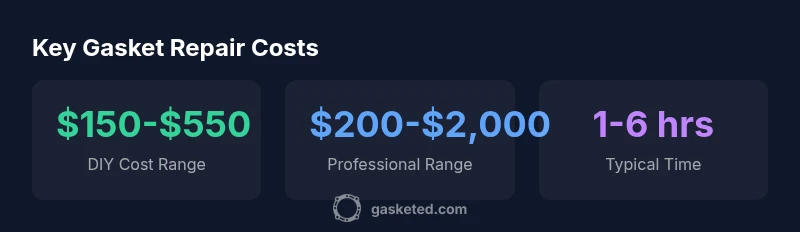
Costs vary by type; for common household gaskets, expect a range of roughly $150-$550, including parts and labor in many regions.
Costs vary, but common home gaskets typically fall in the low hundreds to mid-hundreds once parts and labor are included.
Does it matter if the gasket is automotive vs household?
Yes. Automotive gaskets—especially head gaskets—are far more expensive and complex than most household appliance gaskets.
Yes—car gaskets are more expensive and complex.
Is DIY always cheaper for gasket repair?
DIY can save money on parts and labor, but some tasks require professional tools or safety protocols, particularly engines and gas appliances.
DIY can save money, but not always—safety and tooling matter.
How long does gasket repair usually take?
Most simple gasket fixes take a few hours; more involved jobs may span a day or more depending on access and disassembly requirements.
Most fixes take a few hours; complex jobs take longer.
Are there warranties on gasket repairs?
Warranties vary by installer and parts; check parts warranty and service guarantee before starting.
Check warranties before you begin.
When should I replace rather than repair a gasket?
If the gasket is cracked, deformed, or multiple failures occur, replacement is more reliable than repeated repairs.
If cracked or repeatedly failing, replace.
“Gasket repair costs reflect both material quality and labor intensity; a clear, upfront estimate helps homeowners avoid sticker shock and misplanning.”
Key Takeaways
- Budget realistically for parts and labor before starting
- Know the gasket type to estimate costs accurately
- DIY fixes can save money on simple gaskets
- Request written estimates to compare
- Consider warranty and replacement if failures persist