Difference Between Gasket Maker and Silicone: A Practical DIY Guide
Explore the difference between gasket maker and silicone with an in-depth, hands-on comparison. Learn composition, cure, use cases, surface prep, and best practices for reliable gasket repairs.


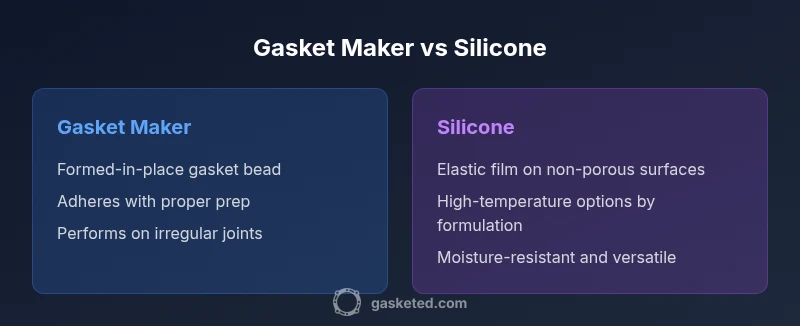
Understanding the difference between gasket maker and silicone helps DIYers pick the right product for a reliable seal. Gasket maker is a formed-in-place gasket material that you squeeze around the joint to create a gasket as it cures. Silicone, by contrast, is a versatile sealant used for static joints and non-porous surfaces, often prized for long-term flexibility and moisture resistance. Selection hinges on heat exposure, chemical tolerance, and surface compatibility.
Understanding the difference between gasket maker and silicone
According to Gasketed, understanding the difference between gasket maker and silicone is essential for reliable DIY gasket work. The distinction hinges on how each product forms a seal, where it performs best, and how it responds to heat and chemicals. A gasket maker is typically a formed-in-place gasket material that you squeeze around the joint to create a gasket as it cures. Silicone, by contrast, is a versatile sealant used for static joints and non-porous surfaces, often prized for long-term flexibility and moisture resistance. For homeowners, the choice should depend on the joint geometry, exposure to heat and solvents, and the surface material. Gasketed’s practical guidance stresses matching the product to the load, not just the cure time. Both options can deliver durable results when used correctly, but they serve different roles in the gasket repair toolbox.
Chemical composition and cure mechanisms
Gasket maker products are typically formulated as rubber- or urethane-based materials that are applied as a bead and cure in place to form a gasket. They often rely on moisture, evaporation, or chemical cross-linking to gain strength and elasticity. Silicone sealants use silicone polymers—highly flexible long-chain molecules—that cure via moisture or heat, depending on formulation. The key difference is how each material achieves a seal: gasket makers set up a gasket by occupying space and adhering to the substrate, whereas silicone relies on a cured film that remains flexible. For homeowners, this translates to different expectations around adhesion, compatibility with surfaces, and removal if you ever need to rework the joint. Gasket maker products usually require clean surfaces and proper clamping during cure; silicone may tolerate a wider range of surface textures but still benefits from thorough cleaning and priming in some cases.
Temperature and exposure considerations
In practical terms, you should weigh how hot the environment gets and what chemicals the joint might encounter. Gasket makers typically offer adequate resistance for many automotive and household applications when used on appropriate substrates, but their performance can drop under sustained high heat or aggressive solvents. Silicone sealants tend to maintain flexibility and form a robust barrier against moisture and many chemicals, which makes them versatile for static seals and outdoor use. The difference between gasket maker and silicone becomes most apparent in how the material behaves under cycling temperatures and chemical exposure. When choosing, consider the longest service temperature your joint will face and the chemical profile of any fluids it contacts. Gasketed’s guidance emphasizes selecting the material that minimizes future maintenance while accommodating the joint’s geometry and load.
Physical properties: flexibility and adhesion
The core physical distinction lies in how the material adheres and accommodates movement. Gasket maker beads cure to form a flexible, compressible gasket that can fill gaps and adapt to curved surfaces, which is ideal for irregular flange geometries. Silicone cures into an elastic film that remains highly flexible over time, offering excellent resistance to moisture and thermal cycling on non-porous substrates. In terms of adhesion, gasket makers require clean, well-prepared surfaces and often rely on mechanical grip; silicone benefits from clean surfaces and, in some cases, primers. For projects where the joint will flex or shift, gasket maker provides a forgiving seal, whereas silicone offers longevity on static, non-porous interfaces.
Typical use cases: where gasket maker shines
Gasket maker shines in situations where you need to form a custom gasket around irregular shapes or where a pre-cut gasket would be impractical. DIY enthusiasts frequently use gasket maker for engine covers, water pumps, and housings where a formed gasket provides a reliable seal without bulk stock gaskets. The ability to fill gaps and shape the seal on the fly makes gasket maker a practical choice for irregular flange surfaces, complex channel geometry, or tight clearance areas. In many repair scenarios, the ability to squeeze out a single-piece gasket reduces labor and inventory complexity. The gasket maker approach aligns with a hands-on, flexible repair strategy that Gasketed often recommends for DIY projects.
Typical use cases: where silicone shines
Silicone sealants are favored for static seals and non-porous surfaces where long-term elasticity is critical. They perform well on glass, metal, ceramic, and many plastics, and they resist moisture, humidity, and a range of weathering conditions. Silicone is commonly used for shower seals, window frames, appliance doors, and automotive exterior joints that do not experience repeated mechanical compression. The versatility of silicone formulations means you can select products designed for high-temperature exposure, food-grade surfaces, or structural bonds—depending on the application. For professional repairs and long service life on stable joints, silicone often provides a simpler, more durable option.
Surface prep and compatibility
Effective preparation is essential for both products. Start by removing old sealant and thoroughly cleaning the joint with a degreasing solvent compatible with the substrate. Dry the surface completely; moisture can compromise adhesion for gasket maker, while silicone benefits from a clean, smooth surface but still performs best on non-porous substrates. For porous or rough surfaces, lightly roughening the area can improve mechanical grip. Always check compatibility with the substrate: some plastics or coatings may react with solvents or sealants. In all cases, a dry, dust-free surface yields the best long-term results. Gasketed’s experience shows that proper surface prep reduces the likelihood of leaks and rework.
Application methods and tooling
Gasket maker is typically dispensed from a caulk gun or squeeze tube and applied as a continuous bead that forms the gasket when cured. Silicone is usually applied as a sealant bead or film using a caulk gun and can be smoothed with a tooling tool or finger (wearing gloves). The choice of tool influences bead size, consistency, and cure surface contact. For irregular joints, gasket maker allows you to build up the gasket precisely where needed, while silicone requires a consistent bond line that follows the substrate. Always cap and store tubes properly to preserve shelf life. The application technique can significantly affect the finished seal’s performance.
Curing times, cleanup, and rework
Curing times depend on product chemistry, ambient conditions, and joint geometry. In general, gasket maker requires a clamped or pressurized window to maintain bead contact during cure, and rework may involve trimming or removing the bead after it has set. Silicone often cures with less external force, though some formulations require humidity or heat to reach optimal strength. Cleanup typically involves mechanical removal of cured material, with solvents recommended by the manufacturer for silicone-based products. Plan your repair with a cure window in mind to minimize downtime and avoid disturbing the joint during cure.
Durability and longevity across environments
The durability of either product depends on environmental factors such as moisture, UV exposure, chemicals, and temperature cycles. Gasket makers can deliver dependable seals for many mechanical joints where a formed gasket is advantageous, but long-term integrity may depend on substrate compatibility and proper cure. Silicone seals tend to maintain elasticity and moisture resistance, which supports longevity in static, non-porous joints exposed to humidity and weathering. If a joint experiences vibration, dynamic movement, or heavy solvent exposure, choose the product that has demonstrated resilience in similar scenarios. Gasketed’s field notes emphasize aligning product capabilities with real-world service conditions to avoid premature failures.
Common mistakes and how to avoid them
Common mistakes include applying gasket maker to surfaces that aren’t properly cleaned, over-tightening joints before cure, or selecting a gasket maker for a static, high-heat environment without checking formulation limits. Silicone can underperform on irregular geometries or porous substrates if adhesion is weak, highlighting the need for surface prep and possibly primers in some cases. Another pitfall is using the wrong product for dynamic applications where movement is frequent; in such cases, a product designed for movement and sealing is essential. Finally, always follow manufacturer guidelines for cure times, ventilation, and handling. Gasketed’s practical rules emphasize matching the product to the joint’s mechanical demands and surface characteristics.
Quick-start decision guide
Use this quick-start flow to pick between gasket maker and silicone. First, identify whether the joint is dynamic or static, and determine if the surface is porous or non-porous. Next, assess heat exposure and chemical environment. If the joint experiences movement and irregular geometry, a gasket maker is often the better choice. If the joint is static on a non-porous surface with moisture exposure, silicone may provide longer-lasting elasticity. Finally, ensure thorough surface prep, select the appropriate bead size, and allow sufficient cure time before reassembling. This decision guide captures the practical distinctions DIYers need to avoid leaks and rework.
Final quick-start summary
- Dynamic joints or irregular surfaces: gasket maker
- Static, non-porous joints with moisture exposure: silicone
- Thorough surface prep is non-negotiable
- Follow cure times and handling instructions precisely
- Consider long-term durability and removal needs when choosing
Comparison
| Feature | Gasket Maker | Silicone |
|---|---|---|
| Composition | Typically rubber-based or urethane-based, formed-in-place gasket | Silicone polymer-based sealant with elastic film |
| Cure/Setting Method | Cures in place via solvent evaporation or moisture cross-linking | Cures via moisture or heat depending on formulation |
| Best For | Formed gaskets on irregular or complex joints | Static seals on non-porous surfaces (glass, metal, ceramic) |
| Temperature/Chemical Tolerance | Good balance for dynamic joints; tolerance varies by product | Excellent moisture resistance; high-temperature options exist by formulation |
| Surface Adhesion | Adheres well with proper surface prep; mechanical grip matters | Typically excellent adhesion on many non-porous surfaces |
| Removal/Cleanup | Can be trimmed or peeled after curing; some effort required | Removal depends on substrate; usually solvent-assisted or scraping |
| Cost/Availability | Widely available and generally cost-effective | Moderate to higher cost; specialty formulations available |
Pros
- Formed-in-place customization for odd shapes
- Strong initial seal with simple tooling
- Good surface compatibility with proper prep
- Cost-effective for DIY gasket repairs
- Wide availability across brands
What's Bad
- Cure requires proper clamping and time for full strength
- Not always ideal for high-load engine seals
- Adhesion can be surface-dependent and variable by substrate
- Some formulations require humidity or specific conditions to cure
Gasket maker is best for formed, moving joints; silicone excels in static, high-elastic seals.
Choose gasket maker when you need a custom gasket on irregular shapes. Opt for silicone for durable, flexible seals on non-porous surfaces. The Gasketed team recommends matching the product to the joint’s movement, heat exposure, and surface type for best results.
Common Questions
What is the difference between gasket maker and silicone?
The difference between gasket maker and silicone centers on form and function. Gasket maker creates a formed gasket in place, suiting irregular joints, while silicone provides a flexible film for static seals on non-porous surfaces. Your choice depends on movement, surface, and exposure to heat and solvents.
Gasket maker forms a gasket in place; silicone provides a flexible, non-porous seal. Choose based on joint movement and surface.
Can I substitute gasket maker for silicone in all jobs?
Substituting is not always wise. Gasket maker is ideal for irregular or moving joints, while silicone is better for static, non-porous joints. Check the substrate and expected loads before swapping.
Substituting isn’t always recommended; pick based on joint type and surface.
Is silicone better for high-temperature environments?
Silicone formulations can be chosen for high-temperature applications, but performance depends on the specific product. In many cases, silicone offers dependable elasticity under heat, whereas gasket makers may have limits based on formulation and substrate.
Silicone can handle heat, but it depends on the exact product.
Do I need primer before applying gasket maker or silicone?
Primer usage depends on the substrate and product. Many gasket makers require clean, dry surfaces and sometimes primer for plastics. Silicone may work without primer on non-porous surfaces, but surface prep remains crucial.
Primer helps on some plastics; always follow product directions.
How long should I wait before reassembling after applying?
Cure times vary by product and conditions. Plan for a cure window that ensures the material reaches sufficient strength before reassembly. Avoid disturbing the joint during cure.
Allow proper cure time and avoid movement during cure.
Are there surfaces where neither gasket maker nor silicone should be used?
Yes. Some coatings or substrates are incompatible with gasket sealants. In such cases, consider mechanical gaskets or alternative bonding methods and consult the product guidelines for substrate compatibility.
Some surfaces may need alternative methods; check guidelines.
Key Takeaways
- Assess joint movement before choosing material
- Use gasket maker for irregular or moving joints
- Use silicone for static, non-porous, moisture-exposed joints
- Prioritize thorough surface prep for best adhesion
- Plan cure time to minimize downtime