Difference Between Gasket Maker and Sealant: A DIY Guide
Explore the difference between gasket maker and sealant, including when to use each, curing times, substrates, and practical tips for reliable DIY gasket repairs.


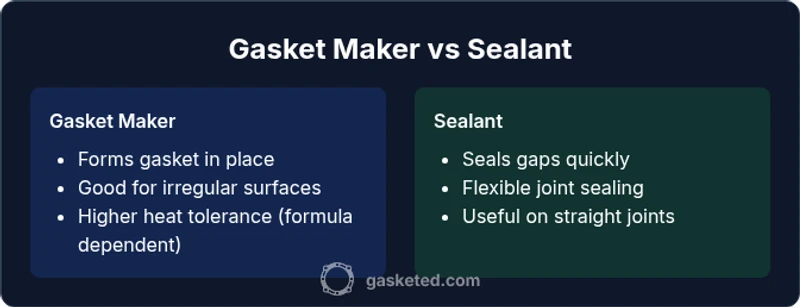
The difference between gasket maker and sealant centers on form and function: gasket maker is a moldable, putty-like silicone that cures in place to form a gasket, while sealant is a flexible liquid seal that fills gaps and joints. For DIYers, selecting the right option depends on surface irregularities, movement, temperature exposure, and the required level of gasket integrity.
Understanding the difference between gasket maker and sealant
The phrase difference between gasket maker and sealant captures a simple idea with big practical consequences for DIY gasket repair. A gasket maker is a moldable silicone-based product designed to form an entirely new gasket in situ. It is pressed, shaped, and allowed to cure to a flexible elastomer that can seal irregular surfaces. Sealant, in contrast, is a liquid or paste that fills gaps and joints. It adheres to surfaces and remains flexible, but it does not always create a true gasket where movement and repeated disassembly are expected. In many cases, the gasket maker provides a more durable, long-lasting seal for engine blocks, water heaters, and plumbing flanges, while sealants excel at narrow gaps, delicate substrates, or quick fixes. This introduction sets the stage for a deeper dive into chemistry, substrates, and real-world usage that DIY enthusiasts can apply in daily repairs.
Chemical basis and curing behavior
Gasket maker formulations are typically silicone-based and designed to cure in place to form a continuous gasket. They often rely on the ambient humidity or a moisture-activated cure, and the resulting material tends to be highly elastic and resistant to heat and oil exposure. Sealants can be silicone, polyurethane, or other chemistries, and their curing mechanism varies by type (moisture-curing, solvent-based, two-part systems). The key distinction is that gasket makers are engineered to create a gasket profile, while sealants primarily seal and fill gaps. The right choice depends on factors such as substrate hardness, exposure to fuels or coolants, and whether the assembly will be disassembled periodically.
Substrate compatibility and temperature tolerance
Substrate compatibility matters more than most DIYers realize. Gasket makers generally perform well on metal, glass, and many plastics when the surface is properly prepared. They tolerate higher operating temperatures and mechanical movement better than some sealants, which can become stiff or crack if used on highly dynamic joints. However, sealants are often more forgiving on porous substrates and in tight gaps where a gasket-like bead is hard to form. Always consult the product data sheet for temperature ranges, chemical resistance, and surface prep requirements. Gasketed assemblies in automotive or appliance contexts demand careful selection to prevent leaks under pressure and vibration.
When to use gasket maker vs sealant in common DIY scenarios
In DIY projects, the choice often comes down to how the joint behaves under load and how persistent the seal must be. For irregular flange surfaces or where a gasket profile is needed without a replacement gasket, gasket maker can be a reliable choice. It provides a continuous seal, resists oil and coolant exposure, and remains elastic after curing. Sealants are ideal for sealing straight joints, small gaps, or where disassembly is frequent and the joint does not see high lateral movement. Plumbing, appliance repair, and even some automotive tasks benefit from a correct blend of both products.
Application steps and best practices
Successful use begins with surface prep: clean, dry, and free of oils or old sealant. Apply gasket maker as a continuous bead along the surface to form a gasket profile; shape it as needed with a tool or finger for uniform thickness. Allow curing time per product instructions, avoiding full assembly until the cure is complete. Sealant should be used to fill gaps or seal around fasteners, and it should be applied in a thin, even layer to prevent squeezing out into unintended areas. Always consider the direction of movement, pressure, and temperature when choosing which product to apply.
Common mistakes and how to avoid them
Common mistakes include using gasket maker where a tight, non-movable seal is needed, or applying sealant on a surface that benefits from a molded gasket. Another pitfall is incorrect surface prep, which reduces adhesion and longevity. Avoid mixing products unless the manufacturer explicitly allows it; mixing can compromise curing and seal strength. Finally, over-application can create a squeeze-out that contaminates the joint and requires cleanup, wasting time and increasing the risk of failure.
Safety, storage, and disposal considerations
Both gasket makers and sealants typically require standard PPE: gloves and eye protection. Work in a well-ventilated area, because some formulas emit fumes during curing. Store products in a cool, dry place and keep containers tightly sealed to prevent premature cure. Dispose of leftover materials in accordance with local regulations. If a product cures inside a joint, do not force disassembly; follow the recommended removal procedure to avoid damage to the mating surfaces.
Troubleshooting and performance checks
If a joint leaks or shows signs of failure after curing, inspect the bond line for gaps, surface contamination, or incomplete cure. Reapply only after fully removing old material and ensuring the surface is clean and dry. In some cases, combining a gasket maker with a sealant for specific areas can improve reliability, such as on long, irregular flanges where a continuous gasket profile is challenging to achieve. Always verify compatibility with fuels, coolants, and lubricants present in the system.
Practical examples and decision cheat sheet
For home plumbing joints with irregular surfaces, consider gasket maker to form a gasket-like seal. For window and door frames or non-pressurized gaps, sealant can provide a fast, flexible seal. When replacing a gasket on an engine or a high-temperature joint, consult product specifications to select a high-temperature gasket maker. In all cases, choose the formula that matches substrate compatibility, movement, and exposure to solvents or fuels.
Long-run cost and availability considerations
Gasket makers and sealants come in a range of price points. In many DIY contexts, gasket makers offer more durability for high-movement joints, while sealants provide cost-effective, flexible seals for quick jobs. Availability varies by brand and region, so it's prudent to stock a couple of formulations that cover your most common needs. Always track shelf life; aged products may cure prematurely or lose adhesion.
Final guidance for DIY decision-making
The difference between gasket maker and sealant is not merely a label. It reflects how the product behaves under movement, temperature, and exposure to fuels or coolants. For most DIY gasket repairs, choose gasket maker when you need a robust gasket in place and a predictable seal under stress; choose sealant for rapid, flexible sealing of gaps and non-load-bearing joints. Testing on a small area is advisable if you are unsure.
Summary and best-practice recommendations
In practical terms, stock a gasket maker for gasket-like needs and a sealant for general sealing tasks. Prioritize correct surface prep, correct formulation for temperature and chemical exposure, and proper cure times. By aligning your choice with the joint’s mechanical requirements, you’ll achieve a more reliable, longer-lasting seal.
Comparison
| Feature | Gasket Maker | Sealant |
|---|---|---|
| Best use | Forms a gasket in place; ideal for irregular surfaces | Seals joints and gaps; quick, flexible seal |
| Cure time | Typically several hours to fully cure | Often faster; depends on formula |
| Substrate compatibility | Metal, glass, many plastics with proper prep | Wide range; good on porous and narrow gaps |
| Flexibility after cure | High elasticity; tolerates movement | Good flexibility but varies by type |
| Removal/cleanup | Harder to remove; may require solvents | Easier with appropriate formulations; clean-up varies |
| Temperature/chemical resistance | High heat tolerance on engines; formula dependent | Depends on formula; generally good chemical resistance |
Pros
- Forms a true gasket in place, reducing part handling
- Versatile for irregular surfaces and complex geometries
- Provides durable seals under vibration and heat when used correctly
- Maintains elasticity after curing, resisting minor movements
What's Bad
- Some formulas require longer cure times or heat to cure fully
- Using the wrong type can lead to leaks or brittle joints
- Removal can be difficult and may damage mating surfaces if forced
Gasket maker generally wins for forming a gasket in place; sealant wins for quick sealing of gaps.
Choose gasket maker for gasket-like seals on irregular surfaces and high-movement joints. Choose sealant for fast, flexible sealing of gaps and non-load-bearing joints; verify chemical compatibility and cure requirements first.
Common Questions
What is the difference between gasket maker and sealant?
Gasket maker is a moldable silicone that cures to form a gasket in place. Sealant is a flexible liquid used to seal gaps and joints but may not create a full gasket profile. Use gasket maker for irregular surfaces or engine-like assemblies; use sealant for quick seals and straight joints.
Gasket maker forms a gasket in place; sealant seals gaps. Use gasket maker for irregular surfaces and engines, sealant for quick, flexible sealing.
Can gasket maker replace sealant for automotive gaskets?
In many automotive applications, gasket maker is preferred for forming a gasket. However, some joints benefit from sealant as a supplementary sealant around fasteners or for minor gaps. Always check the engine manufacturer’s guidance and the product data sheet.
Gasket maker is often preferred for engine gaskets, but verify with the specific joint guidelines.
Is gasket maker safe for food-contact surfaces?
Some formulations are rated for food-contact surfaces, but not all. Check the product label for NSF/ANSI certifications or equivalent. When in doubt, avoid contact with food areas and choose a product explicitly labeled for food-contact use.
Only use products certified for food-contact use if the job involves food areas.
How long does each product take to cure?
Cure times vary by product and environmental conditions, typically ranging from a few hours to a full day. Always follow the manufacturer’s instructions for cure time and handling.
Cure times depend on the formula; follow the package for exact times.
What are common signs of improper use?
Leaks, peeling, or hardening beyond the expected range can indicate improper product choice, surface prep, or contamination. Rework by removing old material, cleaning surfaces, and applying the correct product with proper cure.
Leaks or cracking often mean wrong product or poor prep; rework with correct steps.
Should I mix gasket maker and sealant?
In most cases, mixing gasket maker and sealant is not recommended unless the manufacturer expressly allows it. Mixed products can compromise cure and seal integrity. Use each product as intended or select a single product designed for your joint.
Don’t mix unless the manufacturer allows it.
Key Takeaways
- Gasket maker forms a gasket in place; sealant seals gaps
- Choose based on movement, temperature, and exposure
- Surface prep is critical for a reliable seal
- Cure time and method vary by formula
- Follow manufacturer guidelines to avoid failures