Gasket Manufacturing: A Practical DIY Guide
Learn gasket manufacturing from material selection to production methods, quality control, and scaling for DIY and small shops. This guide covers design, tooling, testing, safety, and cost considerations.


This guide introduces gasket manufacturing for DIY enthusiasts and small shops. You’ll learn material selection, design considerations, tooling, fabrication methods, and quality checks. It covers how to plan, prototype, and scale gasket production while maintaining seals that perform under defined operating conditions.
What gasket manufacturing means
Gasket manufacturing sits at the intersection of material science, precision cutting or forming, and quality control. At its core, it is the process of selecting the right gasket material, designing a seal with appropriate dimensions and tolerances, and producing parts that reliably seal under specified temperature, pressure, and chemical exposure. For DIY makers, gasket manufacturing starts with a clear understanding of the service environment and mating surfaces. According to Gasketed, success hinges on choosing materials that resist the targeted fluids and temperatures while maintaining compressibility and recovery. This foundational step saves time in the fabrication phase and reduces waste. In practice, you’ll balance mechanical properties like hardness and elasticity with chemical compatibility and cost. As you gain experience, you’ll build a small material library and a set of standard gasket geometries that align with common applications. The term gasket manufacturing also encompasses the tooling and processes used to cut or form shapes, such as die-cutting, stamping, molding, extrusion, or laser cutting, each with its own setup and limitations. Understanding these options early helps you pick the right approach for your project.
Key considerations for gasket manufacturing
Successful gasket fabrication starts with a plan: define the application’s operating conditions, choose a compatible material family, and select a fabrication method that delivers repeatable geometry. Material compatibility is critical; elastomers like rubber and silicone offer elasticity, while PTFE and graphite provide chemical resistance, often at higher temperatures. For DIY projects, you’ll often start with sheet materials that can be cut to shape, then test for fit and sealing performance on a mock junction. Gasket geometry—inner and outer diameters, thickness, and centerline radii—determines how well the seal compresses and fills gaps. A well-designed gasket should tolerate minor variations in mating surface flatness and provide sufficient compressibility without extruding or tearing under load. Document each iteration so you can compare performance across different materials and thicknesses. Finally, ensure your workspace is organized: keep cut pieces flat, label parts clearly, and maintain a simple traceable record of your material lot numbers. This reduces confusion during testing and helps with repeatability in future projects.
Tools & Materials
- Gasket material (sheet stock or pre-cut blanks)(Choose material based on chemical compatibility and temperature range)
- Cutting tools (die-cut die, sharp blades, or laser cutter)(Select based on material type and thickness)
- Pattern templates or CAD drawings(Used to reproduce consistent shapes)
- Calipers and rulers(For precise dimensions and tolerances)
- Gasket cement or adhesive (optional)(Only where bonding to a backing or flange is required)
- Compression gauge or feeler gauges(Helps assess compressibility and gap fill)
- Safety gear (gloves, goggles, respirator as needed)(Protect against particulates and solvents)
- Work surface and storage bins(Keep parts organized and flat to prevent warping)
- Material handling tools (tweezers, clamps)(Aid in precise placement and holds during curing)
Steps
Estimated time: 4-6 hours
- 1
Define gasket requirements
Identify the service demands: fluids, temperature, pressure, and mating surface geometry. Document the required sealing performance and any constraints on thickness, compression, or allowable deformation. This step guides material choice and fabrication method.
Tip: Create a quick spec sheet with key operating parameters and failure modes. - 2
Select material and tooling
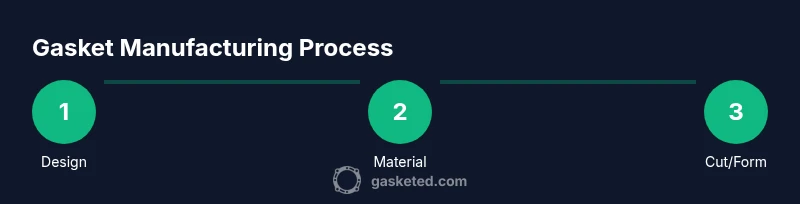
Choose a gasket material that meets chemical compatibility and temperature needs, then pick cutting or forming tools suitable for the material thickness. Align tooling with your chosen fabrication method (die-cutting, stamping, molding, or laser cutting).
Tip: Prefer materials with good recovery (elastomeric) for repetitive seals. - 3
Create pattern templates
Develop precise patterns from CAD drawings or templates. Ensure inner/outer diameters and any complex features are accurately represented. Print or mount patterns onto the material before cutting.
Tip: Double-check pattern scale against actual part size to avoid mismatches. - 4
Fabricate gasket blanks
Cut or mold blanks using the chosen process. Work slowly on minor features to maintain edge quality and avoid tearing the material. Keep parts flat and labeled by geometry.
Tip: Cut from a single sheet to reduce waste and ensure consistent thickness. - 5
Measure and verify
Inspect dimensions with calipers, verify thickness, and assess edge quality. Compare with your design tolerances and perform a dry fit in a test cavity to check alignment.
Tip: Use a controlled measurement approach; document any deviations. - 6
Test performance and iterate
Run a basic seal test using a mock setup to observe compression, leakage, and behavior under load. Adjust material, thickness, or pattern based on results and repeat until the seal meets your criteria.
Tip: Keep a simple test log to track changes and outcomes.
Common Questions
What is gasket manufacturing?
Gasket manufacturing is the process of designing and fabricating gaskets to seal joints, using materials and processes tailored to the application's temperature, pressure, and chemical exposure.
Gasket manufacturing is designing and making seals to fit specific conditions.
What materials are commonly used for gaskets?
Gaskets use rubber, silicone, PTFE, graphite, and composite materials depending on chemical exposure and operating temperature.
Common gasket materials include rubber, silicone, PTFE, and graphite.
What are the main production methods?
Typical methods include die-cutting, stamping, molding, extrusion, and laser cutting, chosen based on material and geometry.
Main methods are die-cutting, stamping, molding, extrusion, and laser cutting.
Can DIY projects be used for gaskets?
DIY gasket projects work for simple shapes and non-critical applications. For safety-critical seals, rely on certified gaskets or proper engineering guidance.
DIY work is okay for simple seals, but avoid safety-critical jobs.
How do I test gasket performance?
Test dimensional accuracy, compression, leak rate, and chemical compatibility using basic procedures and safe test setups.
Test fit, compression, leaks, and compatibility with safe methods.
Is 3D printing suitable for gaskets?
3D printing can prototype gaskets, but material properties and sealing performance may limit use in final assemblies.
3D-printed gaskets are good for prototypes, not always for final use.
Watch Video
Key Takeaways
- Define material and gasket type early
- Choose production method that matches batch size
- Maintain dimensional accuracy through checks
- Document results to guide iteration
- Safety comes first in every step