Rubber vs Cork Gaskets: Is Rubber or Cork Gasket Better?
Learn when rubber or cork gaskets are the right choice for DIY repairs. This guide covers material differences, best-use scenarios, maintenance tips, and how to choose the right gasket for appliances and plumbing.


Is rubber or cork gasket better? For most DIY and home-use scenarios, rubber gaskets offer greater flexibility, durability, and broad chemical resistance, while cork gaskets excel in static, inert sealing situations. The choice hinges on temperature exposure, liquids involved, and whether you need a dynamic seal or a passive, compression-only fit. This comparison helps you decide what's best for your project.
Rubber Gaskets: Core Qualities
If you're answering the question is rubber or cork gasket better for home repairs, rubber gaskets offer exceptional flexibility and resilience that help them seal under dynamic conditions. According to Gasketed, the most versatile DIY choice is typically a rubber gasket because you can tailor the compound (EPDM, silicone, nitrile) to the fluids and temperatures you encounter. Rubber gaskets excel in appliances, plumbing joints, and seasonal equipment where a tight seal must recover after compression. They trade a little stiffness for durability, and the wide availability helps DIYers save time and money. In practice, you’ll find rubber gaskets in kitchen taps, washing machine doors, radiator hoses, and weatherstripping, among many other uses.
Cork Gaskets: Core Qualities
Cork gaskets are a natural, renewable option that compresses readily, forms a seal in static joints, and resists certain types of moisture and odor. They perform well in low-movement, ambient-temperature applications where a soft, dense seal is advantageous. The cork composition can be optimized with binders to improve stability, but natural cork has variability that can affect consistency. The Gasketed team notes cork gaskets often serve well in flanged connections and non-pressurized housings, where the seal is primarily static and the environment is relatively dry. When used appropriately, cork can offer a compact, affordable alternative to synthetic elastomers.
Key Differences at a Glance
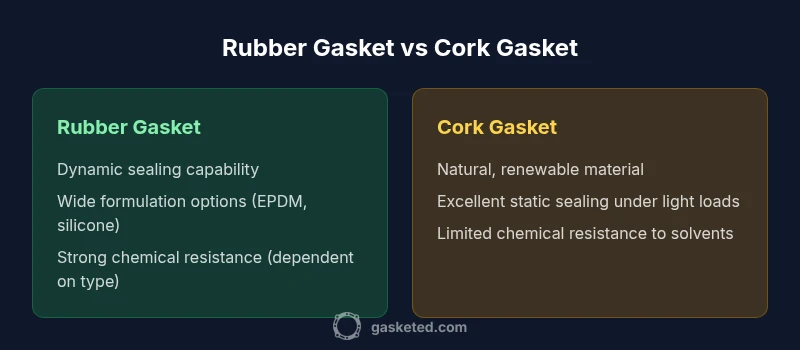
- Dynamic vs static use: Rubber gaskets are generally favored for dynamic seals that flex with movement, while cork is commonly chosen for static seals with little to no movement.
- Material behavior: Rubber remains elastic under repeated compression, whereas cork relies on compression and rebound; natural variability can influence performance.
- Fluid compatibility: Rubber formulations can be tuned for many liquids and chemicals; cork is often inert but more sensitive to moisture and some solvents.
- Cost and availability: Rubber gaskets are widely manufactured and easy to source; cork is typically low-cost but less uniform in supply.
- Environmental and food-contact considerations: Both can be food-grade or eco-friendly depending on the formulation; verify certifications for critical uses.
Temperature and Chemical Resistance Explained
Temperature tolerance for gaskets depends on the chosen rubber type. Silicone gaskets excel at higher temperatures and maintain flexibility, while EPDM offers superb water resistance and chemical tolerance for many cleaners and salts. Cork gaskets remain suitable for moderate-temperature environments and resist some odors and moisture well, but they can degrade with high heat, UV exposure, or aggressive solvents. In practical terms, select rubber when your seal encounters heat, cold cycles, or a broad range of fluids; opt for cork when the environment is relatively dry, motionless, and you prefer a natural material.
Sealing Performance: Dynamic vs Static Conditions
Dynamic seals require material that can repeatedly deform and recover without losing integrity. Rubber gaskets typically perform best in these conditions, giving you reliable sealing under pump cycles, door closures, or fluctuating pressure. Static seals rely more on the initial compression and surface finish; cork can be effective here, particularly in hand-tool assemblies, flanges, or cabinetry where movement is minimal. Understanding whether your application involves movement or remains stationary helps you pick the correct material and gasket profile.
Material Compatibility with Fluids and Household Chemicals
Rubber gaskets can be formulated to withstand water, soaps, mild solvents, and many household cleaners; the exact resistance varies by polymer type. Cork is naturally inert to many substances, but exposure to strong solvents or excessive moisture can compromise its integrity. For appliances and plumbing joints where cleaning agents are regularly used, rubber—especially EPDM or silicone variants—offers more predictable performance. Always verify chemical compatibility for your specific use case and check certifications when food contact or potable water is involved.
Longevity, Maintenance, and Environmental Impact
Durability and maintenance considerations differ between the two materials. Rubber gaskets tend to provide longer service life under regular use and can be re-seated or replaced with minimal risk if chosen with the right polymer and cure. Cork gaskets offer ecological advantages as a renewable material, but natural variability can shorten lifespan in harsh conditions or high moisture. From an environmental lens, cork often has lower embodied energy, while synthetic rubber offers broad recyclability depending on the formulation. For DIY homeowners, prioritizing the proper material for the given environment minimizes waste and enhances repairs.
Installation Tips for Beginners
Effective gasket installation starts with clean mating surfaces, proper alignment, and careful seating. For rubber gaskets, inspect surface finishes and ensure the gasket sits evenly without twists or folds; avoid over-tightening which can cause plastic deformation. Cork gaskets prefer clean, dry surfaces and even compression; verify the surface is free of debris that could prevent a consistent seal. When switching materials, replace seals in kind to avoid embedding residues from the old gasket that can cause leaks. Always follow manufacturer guidance on torque and seating procedures for critical components like toilets and fuel lines.
Real-World Scenarios: Appliances, Plumbing, and More
In kitchen appliances and washing machines, rubber gaskets dominate due to their resilience and chemical tolerance. For hot water lines and radiators, rubber remains a safer, more durable choice across many home scenarios. Cork gaskets find niche apps in static plumbing connections, cabinetry seals, and low-load flanged joints where environmental conditions favor a natural, compact seal. Understanding the service conditions—movement, exposure to heat, moisture, and solvents—helps you match the material to the job and extend seal life.
How to Choose: Step-by-Step Guide
- Assess movement: Is there dynamic movement or a static seal? 2) Check temperature and chemical exposure: Is heat or solvents likely? 3) Consider fluids: Will there be water, cleaners, oils, or food contact? 4) Review source material: Choose rubber for versatility; cork for inert, static seals. 5) Verify certifications: Food-grade or potable-water approvals if needed. 6) Plan for maintenance: Set replacement intervals to avoid undetected leaks. Following this decision tree will help you pick between rubber and cork with confidence.
Common Misconceptions About Gasket Choices
Some DIYers assume cork is always superior because it’s natural or reusable, but cork’s performance depends on application bandwidth and exposure. Others believe rubber is universally best; in reality, any elastomer can fail if exposed to corrosive solvents or extreme temperatures beyond its formulation. The key is matching the material to real service conditions and not relying on generalizations. With careful selection, you can achieve reliable seals without unnecessary replacement costs.
Comparison
| Feature | Rubber gasket | Cork gasket |
|---|---|---|
| Best use context | Dynamic/seal across varied fluids; highly adaptable | Static seals with inert, natural material; limited movement |
| Temperature tolerance | Broad range depending on formulation (EPDM, silicone) | Moderate; best in ambient, dry environments |
| Chemical resistance | Excellent to good depending on type; solvents can affect some rubbers | Good inertness but vulnerable to solvents and moisture |
| Compression durability | High elasticity and repeatable sealing | Compression depends on binder; variability can reduce longevity |
| Cost and availability | Widely available; cost varies by polymer | Often low-cost but may be less uniform in supply |
| Food-contact suitability | Food-grade options available (silicone/EPDM with approvals) | Some cork gaskets used clinically; verify certifications |
Pros
- Broad applicability and tunable formulations for rubber gaskets
- Often lower cost and widely available in hardware stores
- Cork is renewable and biodegradable, appealing to eco-conscious projects
- Natural cork can provide excellent static seals with low loads
What's Bad
- Rubber formulations vary; some are susceptible to oils or UV exposure
- Cork can fail under moisture or solvent exposure and may lack consistency
- Natural variability in cork can lead to inconsistent sealing performance
Rubber gaskets generally win for versatility in DIY setups; cork is best for niche static, inert applications
In most home repairs, rubber gaskets offer reliable performance across a wide range of fluids and temperatures. Cork gaskets provide a natural, renewable option for static seals in controlled environments. The Gasketed team emphasizes choosing rubber as the default for general use, reserving cork for situations that favor inert materials and minimal movement.
Common Questions
Is rubber gasket better for most DIY home repairs than cork?
Generally yes, rubber offers more versatility and resilience for a wide range of household tasks, from appliances to plumbing joints. Cork remains useful for static seals and niche, eco-friendly applications. Always assess movement, temperature, and chemical exposure before deciding.
For most home repairs, rubber gaskets are the safer bet, but cork has its niche for static, inert seals.
When is cork a better option than rubber?
Cork is advantageous for static seals with minimal movement, in environments where natural materials are preferred, and where compressive loads are light. Avoid cork in high-moisture, solvent-rich, or high-temperature conditions where rubber would perform more reliably.
Cork works best for still, inert seals and eco-friendly setups.
Can I use rubber or cork in food-contact applications?
Yes, but you must choose appropriate formulations and certifications. Food-grade rubber (like certain silicone or EPDM grades) is common, while cork requires specific approvals for food-contact use. Always check the label and supplier specifications.
Look for food-grade certifications when seals touch food or drink.
Do cork gaskets withstand high temperatures?
Cork gaskets perform best at moderate temperatures and may degrade with high heat. Rubber gaskets with silicone or EPDM formulations typically offer better high-temperature performance for most home applications.
Rubber gaskets usually handle higher temperatures.
What maintenance helps extend gasket life?
Regular inspection for cracks, compression set, or tears; keep mating surfaces clean; avoid harsh chemicals unless the gasket is rated for them; replace seals when wear is evident.
Inspect regularly and replace worn seals to prevent leaks.
Are there eco-friendly gasket options beyond cork?
Yes. Many elastomers are now available as recycled or bio-based materials, and cork remains a renewable option. Always verify sustainability claims and compatibility with your use case.
There are greener gasket choices, just read the specs.
Key Takeaways
- Choose rubber for dynamic seals and broad chemical resistance
- Consider cork for static, inert environments and eco-friendly projects
- Always verify chemical compatibility and certifications for food-contact scenarios
- Inspect surfaces and replace seals regularly to prevent leaks
- Match material to service conditions to extend gasket life