Gasket vs RTV: Practical DIY Sealant Comparison Guide
A detailed, objective comparison of gasket materials and RTV sealants for DIY gasket repairs. Learn when to use each, installation steps, costs, and a practical decision framework.


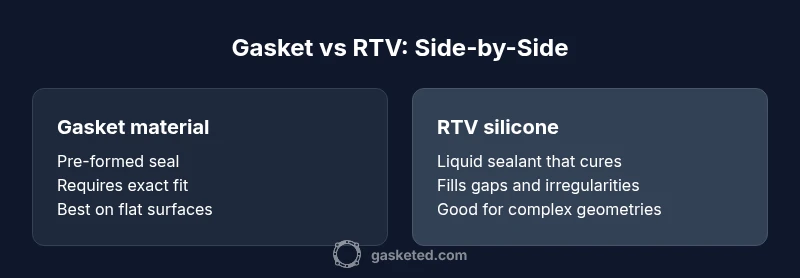
RTV sealants and solid gasket materials each solve a sealing challenge. In practice, gasket materials excel where a precise, repeatable seal is required, while RTV shines when irregular gaps exist or complex geometries must be sealed. This comparison helps DIYers decide between gasket or RTV for common home repairs, considering substrate, temperature, and maintenance needs.
Core Concepts: gasket vs RTV in practice
In DIY sealing projects, the choice between using a gasket and RTV sealant hinges on physical form, cure behavior, and maintenance expectations. According to Gasketed, the core difference is that gasket materials provide a pre-formed seal that compresses under clamping, while RTV is a liquid that cures to form a flexible bond that can fill minor surface imperfections. Understanding these fundamentals helps you forecast performance under vibration, thermal cycling, and chemical exposure. This knowledge translates to real-world outcomes, guiding you to map your task to the right approach without over- or under-sealing. Throughout, prioritize substrate compatibility and service conditions to avoid premature leaks. As you plan, document your joint geometry and available tooling—these factors often determine whether a gasket or RTV is the better fit for the job at hand.
When to choose gasket material
Gasket materials shine when you have a predictable joint with clean, flat mating surfaces. A pre-formed gasket provides a defined thickness and compression, which makes leaks unlikely if the torque and clamping load are correct. For typical home repairs like appliance rings, plumbing flanges, or automotive covers that are manufactured for gasket seals, a gasket is usually the simplest, most durable option. Gasket sets are available for common flange sizes, reducing guesswork during maintenance. However, the success of a gasket relies on accurate cut size, surface finish, and ensuring the flange remains clean and straight during assembly. In contrast, if the surface is chipped, uneven, or the joint geometry is non-uniform, a gasket can fail even with proper torque.
When RTV is appropriate
RTV silicone sealants are versatile when joints are irregular or cannot be machined to a precise gasket size. They fill gaps and adapt to non-flat surfaces, bridging minor misalignments that would otherwise cause leaks. RTV is particularly useful in plumbing traps, automotive coolant passages with slight deviations, and appliance housings where a gasket would be impractical. RTV cures to a flexible, adhesive bond that maintains elasticity over thermal cycles, helping to seal joints subjected to vibration and movement. Keep in mind that RTV requires surface preparation, an appropriate cure time, and compatibility with the fluids involved. For high-pressure, critical seals, RTV should be chosen carefully and tested to confirm performance.
Substrate compatibility and surface preparation
Before choosing gasket or RTV, assess substrate compatibility and surface cleanliness. Flat metal or plastic surfaces mate best with gaskets, provided they are clean and free of oil or residue. For RTV, ensure surfaces are dry, oil-free, and free of old sealant. Some RTV formulations require primers on certain substrates, while others bond directly to metal, glass, or ceramic surfaces. If you’re repairing a leak-prone joint, consider whether the surface will experience oil immersion, fuel exposure, or cleaning chemicals, and verify that the chosen product offers resistance to those fluids. Gasketed assemblies typically demand precise flange dimensions and torque specs; RTV assemblies require proper sealing geometry and careful application to avoid air pockets. In all cases, follow manufacturer guidelines and consider performing a test fit before final assembly.
Temperature, chemical exposure, and aging
Temperature and chemical exposure significantly influence seal performance. RTV silicone generally handles a wide temperature range and is compatible with many fluids, but formulations differ in chemical resistance, which can affect long-term performance in fuel or solvent-rich environments. Gasket materials also vary; elastomers like nitrile, fluorosilicone, or EPDM offer different resistance profiles. Aging, UV exposure, and solvent attack can degrade gasket materials over time, especially if the joint experiences cycling stresses. For DIY tasks, prioritize a gasket material that matches the expected service temperature, chemical exposure, and duty cycle. If in doubt, request data sheets, and confirm that the chosen gasket or RTV aligns with the operating environment.
Installation tips and best practices
For gasket installs, ensure a clean, dry flange surface and align bolt holes before tightening. Use the recommended torque pattern to avoid over-compression and potential gasket chilling. For RTV, apply the silicone bead evenly along the joint, assemble promptly to avoid shifting, and allow proper cure time in a dust-free environment. Keep sealants away from unintended surfaces to reduce cleanup later. When reusing parts, inspect for damage; do not reuse damaged flanges. Always test a small section for leaks before committing to the full assembly. Documentation and labeling help track which method was chosen for a given joint.
Common mistakes and how to avoid them
Common missteps include choosing RTV when a gasket would perform better, or using a gasket on surfaces that are not properly prepared. Avoid applying too thick a bead of RTV or neglecting cure time, which can leave gaps and incomplete sealing. Do not mix gasket materials with RTV on the same joint, as incompatibility can cause adhesion failure. Always verify the compatibility of sealants with fluids and materials involved. To prevent leaks, confirm the mating surfaces are smooth and free of burrs, and verify that all components are within tolerance before final assembly.
Costs and lifecycle considerations
Cost dynamics depend on material choice and service life expectations. Gaskets typically involve lower per-use costs and are straightforward for planned maintenance, while RTV can incur higher upfront material costs and extended cure times. In some cases, RTV extends the seal life by filling irregular gaps, potentially reducing maintenance intervals when surfaces are imperfect. Conversely, repeated maintenance or part replacements can favor gasket-based solutions for predictable performance. Evaluate total lifecycle costs, including downtime for disassembly, when choosing between gasket or RTV.
Decision framework in real-world scenarios
Build a simple decision framework: if your joint is flat, well-machined, and typically torqued to a known specification, start with a gasket. If the joint has irregularities, curved surfaces, or limited access that precludes precise gasket sizing, opt for RTV. Always check fluid compatibility, temperature ranges, and the expected service life. A quick pilot test, followed by a leak check under working conditions, can save time and material when selecting gasket vs RTV in a home workshop setting. For complex cases, consult product data sheets and consider a small-scale field test before full-scale repair.
Summary and next steps
By understanding when to use gasket material versus RTV sealants, DIYers can reduce leaks and downtime while extending the life of repairs. The decision should hinge on surface geometry, service conditions, and maintenance expectations. Document your decision-making notes to streamline future repairs and create a reference for future projects. Remember, both options have a place in a well-equipped toolbox, and selecting the right approach is a key skill for successful gasket repairs.
Comparison
| Feature | Gasket material | RTV silicone sealant |
|---|---|---|
| Physical form | Pre-formed gasket (solid sheet) | Liquid sealant that cures to a flexible seal |
| Installation steps | Cut/fit gasket, tighten to spec, inspect leaks | Apply bead, assemble, allow cure |
| Cure/setting timing | No curing time; seals immediately under load (subject to gasket type) | Requires cure time for full seal |
| Temperature range | Depends on gasket material; some handle high temps | Broad range; dictated by RTV formulation |
| Chemical resistance | Material-dependent | High resistance for silicone RTV in many fluids |
| Cost and lifecycle | Lower upfront cost, reliable lifetime with proper torque | Higher upfront material cost and potential cure-time impact |
Pros
- Gasket materials offer reliable, repeatable seals when properly sized and torqued
- RTV sealants fill gaps and irregular surfaces, enabling seals on non-perfect joints
- Standardized gasket sets reduce guesswork during maintenance
- Wide availability of gasket materials and RTV products keeps options open
What's Bad
- RTV can deteriorate with specific oils or solvents depending on formulation
- Gasket replacement requires disassembly and accurate torque to prevent leaks
- Sealant can smear, cure incompletely, or require cleanup before reassembly
- Using the wrong type of RTV may lead to slower cure or leakage under stress
Gasket and RTV each have a clear role; choose gasket for a clean, repeatable seal and RTV for irregular gaps or tricky geometries
In most DIY projects, start with a suitable gasket when possible for reliability. Reserve RTV for joints that cannot be perfectly mated or where quick reassembly is essential.
Common Questions
What is the main difference between gasket materials and RTV sealants?
Gasket materials are pre-formed shapes that compress between mating surfaces to create a seal, offering repeatable performance. RTV sealants are liquids that cure to a flexible, bonded layer, filling gaps and adapting to irregular surfaces.
Gasket materials are pre-made and compress to seal, while RTV is a liquid that cures to fill gaps. The choice depends on surface finish and gap irregularities.
Can RTV replace a gasket in all cases?
No. RTV is ideal for gaps and irregularities, but it may not perform as well as a properly sized gasket in steady, high-pressure applications. Always evaluate the service environment.
RTV can fill many gaps, but it's not a universal replacement for a gasket in every situation.
What substrates are best for RTV vs a gasket?
Gaskets work best on flat, well-mated surfaces, while RTV can seal imperfect or curved surfaces where a gasket cannot be cut precisely. Check compatibility with the substrate and fluid.
Flat surfaces pair well with gaskets; RTV helps with imperfect surfaces.
How do temperature and chemical exposure affect longevity?
Both choices depend on the specific material. RTV silicone typically tolerates a broad temperature range and many chemicals, but formulations differ in chemical resistance and aging behavior.
Temp and chemical exposure matter; pick materials rated for your environment.
Is there a cost difference between gasket replacements and RTV sealing?
Gaskets usually cost less per unit and are quicker to install in planned maintenance, while RTV requires curing time and may involve ongoing maintenance if rework is needed.
Gaskets cost less upfront; RTV adds curing time and potential maintenance considerations.
How do I choose when to use RTV vs a gasket?
Use a gasket when you need a repeatable seal with a defined compression and torqued clamping. Use RTV when surfaces are irregular or the joint cannot be truly flat. Always follow manufacturer guidance.
Choose gasket for repeatable seals; RTV for irregular joints.
Are there safety considerations unique to gasket materials or RTV?
Both products require good ventilation when applying solvent-based sealants and proper hand protection. Read the material safety data sheet and follow local regulations for disposal.
Ventilate when using sealants and wear protection; follow safety data.
Key Takeaways
- Choose gasket for predictable, repeatable seals under clamp load
- Use RTV when surfaces are irregular or have complex gaps
- Always confirm substrate compatibility and follow manufacturer recommendations
- Practice proper cleanup and curing guidelines to avoid leaks