Fix Head Gasket or Replace Engine: A Practical Comparison
An in-depth, analytical comparison guiding whether to fix head gasket or replace engine, covering cost ranges, timelines, reliability, and practical DIY tips.


To fix head gasket or replace engine, start by assessing damage, cost, and reliability. If the engine otherwise runs well with a localized head gasket leak, a professional gasket repair can be cost-effective and preserve value. But for engines with multiple failures, significant corrosion, or warped heads, replacement often delivers greater long-term reliability and resale value.
Why this decision matters in practice
When you consider whether to fix head gasket or replace engine, you’re balancing cost, downtime, and long-term reliability. A localized gasket failure in a healthy engine can often be addressed without a full engine swap, preserving performance and resale value. Conversely, a blown gasket in an engine with other failures or signs of excessive wear points toward replacement as the more sensible long-term option. In this guide, we compare the two paths with a practical lens, focusing on what matters most to homeowners and DIY enthusiasts who want a sound, data-driven decision. The core question to keep returning to is fix head gasket or replace engine, because the path you choose will shape maintenance costs for years to come.
Key factors that determine the best option
Choosing between a gasket repair and an engine replacement depends on several interrelated factors. First, assess the engine’s overall health beyond the gasket: compression results, cylinder-wall wear, and cooling-system integrity all matter. Second, gauge the leak’s scope: a single local leak may be repairable, while multiple leaks or signs of head warping raise the odds of future problems. Third, weigh vehicle value and usage: a low-mileage family car may benefit more from a repair, while a high-mileage beater with frequent failures may justify replacement. Fourth, consider parts availability, labor costs, and your willingness to tolerate downtime. Finally, factor in warranties and the likelihood of recurrence after repair. These criteria help structure a rational decision rather than an emotional one.
Cost considerations: upfront vs long-term value
Costs can be the deciding factor for many owners. A gasket repair or local head gasket job typically falls in the lower tier of price ranges, often cited as a fraction of a full engine replacement. In broad terms, expect gasket repair to run roughly in the vicinity of $1,000–$3,000, depending on vehicle complexity, machining needs, and labor rates. Engine replacement, on the other hand, can reach higher ranges, commonly $4,000–$8,000 or more when you account for the engine itself, removal, installation, parts compatibility, and shop labor. Don’t forget ancillary costs like coolant flushing, timing components, and gaskets for ancillary seals. Budget for potential machining if the block or head needs resurfacing, and always obtain a written estimate with a clear scope of work.
Reliability and longevity after repair vs replacement
Repairing a head gasket can restore function and longevity if the rest of the engine is healthy. When a leak is isolated and the bottom end shows minimal wear, a quality gasket repair can deliver reliable performance for years. Yet the risk of future head gasket failures remains if there is underlying distortion, warped heads, or improper reassembly. A full engine replacement shifts the risk profile: you typically gain a fresh long-term baseline and can often expect more predictable performance, especially if the existing engine had multiple failures or significant overheating events. The trade-off is higher upfront cost and longer downtime. In both paths, proper cooling-system maintenance and trustworthy repair practices are essential to maximize reliability.
Labor, skill, and downtime
Labor demands for head gasket repairs are substantial. Technicians must disassemble the cylinder head, inspect for warping, replace the gasket, reseal all components, and perform rigorous tests. Expect 1–3 days of shop time for a skilled technician if there are no complications, and longer if machining or additional repairs are needed. Engine replacement is more invasive and time-consuming: it involves engine removal and installation, alignment checks, additional parts procurement, and a rigorous break-in procedure. Downtime can range from several days to a full workweek depending on scheduling, availability of a remanufactured or used engine, and the vehicle’s electronics compatibility. Planning for a loaner vehicle or alternate transport becomes practical in many scenarios.
Practical scenarios by vehicle type and age
Consider a compact sedan with moderate mileage and a single unit head gasket leak. In this scenario, a gasket repair is often the most sensible route, especially if the engine otherwise shows healthy compression and no extensive cooling-system damage. For a high-mileage SUV with a history of overheating and rising cylinder wear, engine replacement may provide a longer-lasting solution and reduce the risk of repeated failures. If the vehicle is rare, expensive to repair, or has strong resale value, replacement with a modern remanufactured engine could deliver better long-term ownership experience. In all cases, obtain multiple professional assessments to compare diagnostic findings and warranty terms.
What a head gasket repair involves
A typical head gasket repair begins with a diagnostic evaluation: compression testing, leak-down checks, and cooling-system pressure tests. If a leak is confirmed and the engine block and head are within serviceable tolerances, the technician will remove the cylinder head, inspect for warping, clean mating surfaces, and replace the head gasket along with any needed seals, o-rings, and sometimes the water pump. The head is machined if necessary, then reassembled with careful torque sequencing to spec. Finally, the cooling system is flushed, the engine re-torqued after a heat cycle, and a pressure test is performed to ensure no further leaks. The process requires precision and appropriate tools, and even a successful gasket repair may require ongoing monitoring for future cooling issues.
What engine replacement involves
Engine replacement involves selecting a compatible engine (new, remanufactured, or used), removing the old unit, and installing the replacement with correct mounting, wiring, and engine management integration. The job requires substantial space, heavy lifting equipment, and careful alignment of transmission, exhaust, and cooling connections. Post-installation steps include priming the lubricating system, performing a thorough leak check, and a careful engine break-in procedure. Warranty terms on a replacement engine can differ from repairs, and some shops offer bundled warranties that cover labor or parts for a defined period. This path generally delivers a clean slate in terms of future reliability, but it demands significant planning, parts availability, and downtime.
Maintenance after repair or replacement
Regardless of path, maintenance is essential to maximize the longevity of your decision. Regular coolant changes, thermostat and radiator checks, and proper oil changes with the correct specification are crucial. If you chose replacement, monitor oil pressure and ensure the cooling system remains at optimal temperature to prevent overheating. For repairs, keep an eye on the head gasket area for any signs of recurring leaks, verify that the head has not warped, and schedule follow-up compression checks as a precaution. Proactive maintenance reduces the likelihood of imminent failures and extends the life of your chosen path.
How to choose the right shop and protect yourself
Start with researching local shops that specialize in engine work and head gasket services. Request multiple written estimates, and ask for a clear breakdown of parts, labor, and any additional procedures (machining, timing belt, water pump). Inquire about warranties on both parts and labor, and whether the shop covers reassembly or re-tightening after a heat cycle. Check reviews for consistency and ask whether the shop uses OEM or reputable aftermarket gaskets. Finally, insist on test results after the repair or replacement, including a cooling-system pressure test, a leak test, and a short run to confirm proper heat cycling. A trusted, well-documented process reduces risk and builds confidence in your decision.
Authority sources and further reading
For further reading and authoritative guidance on head gasket procedures and engine replacement considerations, consult these sources:
- https://www.nhtsa.gov
- https://www.consumerreports.org
- https://www.edmunds.com
These sources offer high-level guidance on vehicle maintenance, reliability considerations, and consumer tips for major repairs. Note that specific repair recommendations should come from a qualified technician based on your vehicle’s make, model, and condition.
Ready to decide: a quick decision framework
Use this framework to guide your next steps. If the engine shows strong compression, the leak is localized, the cooling system is healthy, and the repair quote is substantially lower than engine replacement, repairing the gasket is a sensible first choice. If the engine has multiple failures, persistent overheating, or significant wear that would otherwise require extensive machining, replacement is often the more robust long-term option. In all cases, compare warranties, opt for a transparent quote, and consult multiple shops before making a final decision.
Comparison
| Feature | Fix head gasket repair | Engine replacement |
|---|---|---|
| Estimated cost | $1,000-$3,000 | $4,000-$8,000+ |
| Time to complete | 1-3 days | 3-7+ days |
| Downtime impact | Moderate downtime; quicker return | Longer downtime; vehicle out for longer |
| Reliability after repair | Can be long-lasting if engine is healthy | Often very reliable; depends on replacement quality |
| DIY feasibility | Unlikely for most DIYers; requires machineries | Unlikely; professional installation advised |
| Warranty implications | Repair warranty; limited coverage | Engine replacement warranty; often broader coverage |
| Best for | Localized leak in a healthy engine; budget-conscious | Severely damaged engine; long-term reliability |
Pros
- Lower upfront cost when damage is localized
- Preserves existing engine if bottom end is solid
- Quicker resolution in many cases
- Maintains original vehicle configuration and feel
- Potentially faster return to service
What's Bad
- Uncertain long-term reliability if underlying issues exist
- Risk of recurrence if head or block is warped
- May require machining and additional parts
- Not suitable for severely damaged engines
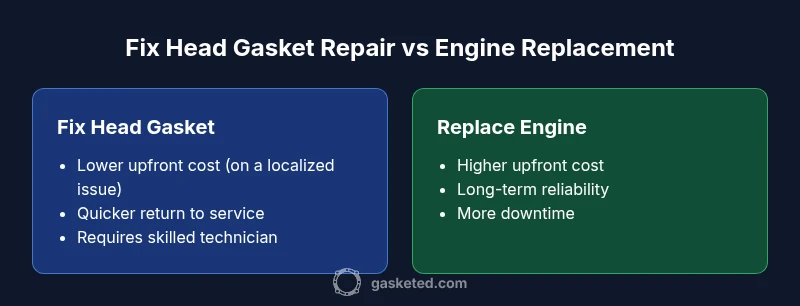
Repair if the engine is otherwise sound and the leak is confined
When the bottom end is healthy and the leak is localized, gasket repair offers good value and shorter downtime. If there are multiple failures, overheating history, or significant wear, replacement delivers a more predictable long-term outcome, justifying the higher initial cost.
Common Questions
What are common signs of a head gasket issue?
Common signs include coolant loss without a leak, white exhaust smoke, milky oil, engine misfires, and frequent overheating. A compression test or leak-down test can confirm whether the head gasket is compromised. If you notice several of these together, seek a diagnostic from a qualified mechanic.
Look for coolant loss, white smoke, or milky oil. A compression test can confirm a head gasket problem. If you see these signs, get a professional diagnostic.
Is a DIY head gasket repair feasible for a home mechanic?
Head gasket repairs are advanced jobs that require precise torque specifications and head resurfacing when needed. For most DIYers, professional service is recommended. If you have extensive experience, you can attempt only after reviewing service manual and specialized tools.
It's a complex task. Most DIYers should hire a pro unless you have formal training and the right equipment.
How long does a head gasket repair typically take?
With experienced technicians and no complications, a repair can take around a day or two. Delays occur if the head needs resurfacing or if there are additional leaks. Timelines extend when a replacement engine is pursued.
Typically one to a few days for a repair; longer if extra work is needed.
When should engine replacement be considered over a repair?
Replacement is often sensible when the engine has multiple failures, significant overheating history, warped heads, or when repair costs approach or exceed the value of the vehicle. In such cases, replacement can provide longer-term reliability and peace of mind.
Choose replacement if the engine shows widespread damage and repair costs rise high.
What warranties apply to gasket repairs vs engine replacement?
Gasket repairs typically come with limited parts-and-labor warranties that vary by shop. Engine replacements often include longer warranties on the engine itself and sometimes on labor. Always confirm warranty terms in writing before agreeing to work.
Warranties vary; replace with a longer engine warranty if possible and read the terms carefully.
How do I determine if my vehicle is worth replacing the engine?
Evaluate the vehicle’s current market value, maintenance history, and how much you rely on it. If the cost of repair or multiple future failures eclipses a replacement, a new engine or remanufactured unit may be more economical in the long run.
If the total cost of ongoing repairs nears or exceeds the car’s value, replacement is worth considering.
Key Takeaways
- Assess overall engine health before deciding
- Weigh cost ranges and downtime for each path
- Repair works best with localized leaks and healthy bottom end
- Replacement suits engines with broader damage or high mileage
- Always compare warranties and get multiple quotes