How Much Is a Rocker Cover Gasket? 2026 Cost Guide for DIYers
Understand rocker cover gasket pricing, kit vs single gasket costs, labor ranges, and DIY savings in 2026. A practical guide to estimate total costs for your vehicle.


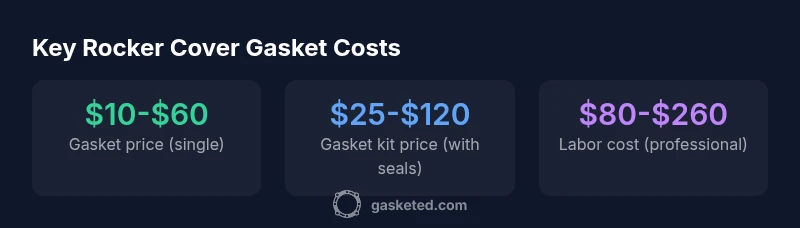
The price for a rocker cover gasket depends on parts and labor, with gasket prices typically ranging from about $10 to $60 for a single gasket and $25 to $120 for a full kit with seals. Labor, if hired, commonly falls in the $80 to $260 per job range depending on engine complexity and local rates. DIYers can cut total costs by performing the replacement themselves, potentially bringing total project costs to roughly $50 to $400 depending on parts choices and tools you already own. These figures reflect 2026 market conditions and are influenced by OEM versus aftermarket options, engine type, and regional pricing.
Cost overview and price ranges
When someone asks how much is a rocker cover gasket, the answer hinges on two big buckets: parts and labor. For many cars, a single rocker cover gasket can cost anywhere from about $10 to $60 if you buy an aftermarket part, while a complete gasket kit with seals and o-rings often runs $25 to $120. If you hire a shop to do the work, expect labor to range roughly $80 to $260 per job depending on engine design, accessibility, and regional labor rates. In total, DIYers might spend as little as $50 to $150 in parts if they reuse hardware and already own basic tools, while professional installation can push the total toward $200 to $400 or more for complex engines. According to Gasketed, these ranges reflect typical 2026 market conditions and will vary with OEM vs aftermarket parts and regional pricing.
Factors that influence price and value
Cost variability is driven by engine configuration (inline-4 vs V6/V8), the extent of the kit (single gasket vs full kit with seals), and the choice between OEM and aftermarket parts. OEM gaskets tend to command a premium, but aftermarket kits can offer equivalent reliability at a lower price. Vehicle age and design influence labor time; newer or more integrated engines may require special tools and more careful reassembly, increasing labor charges. Location matters too—urban shops often carry higher labor rates than rural technicians. Finally, if you simultaneously replace related gaskets or perform additional maintenance, the total cost scales accordingly. Brand and seller discounts, warranty options, and shipping costs also affect the bottom line, especially for DIY shoppers.
Gasket kit vs single gasket: what's included and why it matters
A single rocker cover gasket is the core seal between the rocker cover and the cylinder head. A gasket kit typically includes the gasket itself plus seals, O-rings, and sometimes timing cover seals or valve cover bolts. Kits save time by providing all necessary components in one package and reduce the risk of mismatched parts. If you only replace the primary gasket but leave worn seals or old bolts, you may face future leaks or further labor costs. In practice, most DIYers save money by choosing a kit that covers all seals related to the rocker area, especially on engines with multiple valve covers.
How to estimate total job cost for your vehicle
Start by identifying your engine type and whether your preferred parts are OEM or aftermarket. Gather prices for a single gasket and for a full kit from a few reputable parts retailers. Estimate labor by checking your local hourly rate and typical job time for rocker cover work (which you can find in service manuals or from local shops). Add a cushion for potential extra seals or hardware. Don’t forget to include consumables (gasket sealant, cleaners, rags) and tools you might need. Finally, compare DIY material costs with a few quotes from shops to determine where you’ll save the most money for your particular vehicle.
DIY vs professional service: cost vs risk
DIY replacement can dramatically reduce costs if you have basic mechanical skills and a few common tools. The biggest savings come from avoiding labor charges entirely. However, mistakes such as over-tightening bolts, missing seal surfaces, or neglecting related gaskets can lead to leaks and higher repair costs later. Professional installation offers warranty coverage and expert torque specs, but adds labor charges. Weigh the risk of oil leaks and potential cleanup against the convenience and certainty of a professional job. In many cases, a careful DIY attempt paired with a reputable parts kit provides the best balance of cost and reliability.
Where to shop and how to compare quotes
Shop both OEM and high-quality aftermarket gasket options from trusted retailers. When comparing quotes, ask for itemized pricing that separates parts, seals, and labor. Verify compatibility with your exact engine code and year, and check whether the kit includes all necessary seals and hardware. Read user reviews and look for a warranty on parts. If you’re unsure, request a ballpark estimate for parts plus a rough labor time, then confirm final pricing after you inspect the used kit content. A well-assembled kit and transparent quote help prevent unexpected charges.
Example cost estimation for common engines
Consider two hypothetical scenarios. A four-cylinder inline engine with a standard rocker cover: gasket price $15-$40, full kit $25-$90, labor $90-$180. DIY total: around $40-$120 for parts. A more complex V6 with a multi-piece valve cover: gasket price $20-$60, kit $40-$120, labor $120-$260. DIY total: around $60-$180 for parts. In both cases, owning the right tools and using a complete kit reduces the risk of leaks and rework, magnifying the savings of a DIY replacement.
Final considerations and next steps
Before you start, confirm you have the correct gasket type for your engine and a clean workspace. Use the manufacturer’s torque specs and follow proper reassembly steps to avoid leaks. If in doubt, consult a local mechanic for a formal estimate or guidance. For a practical, reliable DIY approach, pair a quality gasket kit with a few essential tools and your existing knowledge, then compare your final DIY cost to a shop quote to decide the best path.
Estimated price ranges by component and service type
| Component | Gasket price range | Kit price range | Labor cost range | Notes |
|---|---|---|---|---|
| Rocker cover gasket (single) | $10-$60 | $0-$0 | $0-$0 | OEM vs aftermarket affects price |
| Rocker cover gasket kit (with seals) | $25-$120 | $30-$180 | $0-$0 | Includes seals and O-rings |
| Labor (professional, per job) | n/a | n/a | $80-$260 | Depends on engine complexity and region |
| Total typical job cost | $110-$320 | $50-$450 | n/a | DIY savings vs professional tiers |
Common Questions
What factors affect the price of a rocker cover gasket?
Price is driven by gasket type (OEM vs aftermarket), kit contents, engine complexity, and labor rates. Kits that include seals reduce additional purchases and can lower total cost. Always confirm compatibility with your engine code.
Prices vary by gasket type and kit contents. Choose a kit that fits your engine to avoid extra costs.
Can I save money by doing the job myself?
Yes. Doing the replacement yourself can save the labor portion of the cost. The savings depend on your tool availability and mechanical skill. Follow the correct torque specs and use a complete kit to minimize future leaks.
Yes—DIY can save on labor if you have the tools and follow proper torque specs.
OEM vs aftermarket gasket — which is better for price and reliability?
OEM parts often cost more but are guaranteed to fit, while reputable aftermarket kits can provide similar reliability at a lower price. Check warranty and compatibility for your specific engine.
OEM parts cost more but fit guaranteed; good aftermarket kits can save money with similar reliability.
How long does rocker cover gasket work typically take?
For many inline engines, a straightforward rocker cover gasket replacement can take 1-3 hours, depending on accessibility. More complex engines may take longer. Plan for potential additional time if other seals are involved.
Most replacements take 1-3 hours on common engines; expect more on harder-to-reach designs.
What are common mistakes that raise costs?
Skipping the kit contents, reusing damaged bolts, or failing to clean gasket surfaces can cause leaks and require redo work. Always prepare the surface, use the correct sealant if recommended, and torque bolts to spec.
Avoid skipping kit contents and mis-torquing bolts to prevent leaks and extra labor.
Does price vary a lot by car model?
Yes. Engine layout and valve cover design influence both parts and labor. Some engines are simple and quick to access, while others require more disassembly and special tools, increasing cost.
Cost varies by engine design and access needs; some models are simpler than others.
“A well-planned rocker cover gasket replacement can save money, especially when you compare parts quality and labor options side by side.”
Key Takeaways
- Know parts vs labor costs before starting
- Choose a kit to avoid missing seals
- DIY can save money with the right tools
- OEM parts cost more but may offer a fit guarantee
- Get multiple quotes to compare total cost