Gasket vs Seal vs O-Ring: A Practical DIY Guide
An objective, DIY-friendly comparison of gasket vs seal vs o-ring—covering definitions, materials, applications, and maintenance to help homeowners choose the right seal for leaks, pressure, and longevity.


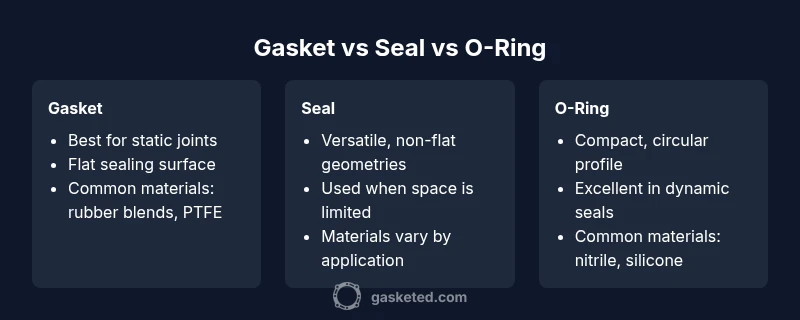
Understanding gasket vs seal vs o-ring is essential for DIY fixes. Gaskets are flat, compressive seals for static joints; O-rings are compact rings that perform best in dynamic or edge-seal situations; general seals cover a broad range. For DIY projects, pick based on static vs dynamic service and space constraints.
Understanding gasket, seal, and O-ring: definitions and roles
The terms gasket, seal, and O-ring are often used together, but they describe distinct sealing solutions. A gasket is typically a flat, deformable sheet or ring that compresses between two mating surfaces to form a seal in static joints, such as a flange or appliance door. An O-ring is a circular loop designed to sit in a groove and seal by extrusion constriction, excelling in tight spaces and in both static and dynamic contexts where movement is involved. A seal is a broad category that includes gaskets, O-rings, and other designs engineered to prevent fluid or gas leaks. When choosing between gasket vs seal vs o-ring, consider surface finish, joint geometry, and whether the application is static or involves motion. For homeowners tackling leaks around plumbing, appliances, or machinery, the most reliable approach is to map the service conditions to the right type of seal. According to Gasketed, the nuances between gasket, seal, and O-ring hinge on how the joint experiences pressure, movement, and exposure to chemicals. In 2026, this distinction remains central to durable repairs, and selecting the correct type reduces the risk of recurring leaks.
Why the distinction matters in practical terms
In everyday DIY scenarios, you’ll encounter static flange joints, moving parts, and tight spaces. Gaskets in static flange joints provide uniform compression across a flat surface, distributing load evenly and helping prevent leaks over time. O-rings are ideal when space is limited or when there is some motion at the seal interface—think shaft seals, valve stems, or compact connections where a circular cross-section can maintain contact under load. Seals, as a broader category, bridge these needs and can include pad-like elastomer layers, face seals, or custom geometries tailored to a particular system. The key is matching the seal geometry to the service: flat faces for gaskets, rings for tight circumferences, and flexible materials for chemical compatibility. This alignment minimizes leakage paths and extends service life. In practice, homeowners should document the service environment: temperature range, pressure, fluid type, exposure to solvents, and frequency of movement. With this information, you can decide which solution best fits your project and prevent wasteful mistakes.
Materials and their impact on longevity
Material choice is a major driver of how gasket vs seal vs o-ring behave in real-world use. Gaskets often rely on compressed fiber, rubber blends, cork, or PTFE composites to achieve a uniform seal across a mating surface. O-rings commonly use nitrile, silicone, fluorocarbon, or fluorosilicone, chosen for chemical resistance and temperature tolerance. Seals can combine materials or adopt composite constructions to balance performance and cost. The material's compatibility with the sealed fluid determines how long the seal lasts, while temperature and pressure dictate the permissible load. For homeowners, selecting a material that matches the chemical environment—water, detergents, oils, or solvents—helps prevent degradation, loss of elasticity, or extrusion. Gasketed decisions should also account for surface finish and cleanliness, as roughness and debris can compromise a new seal’s effectiveness. When in doubt, consult manufacturer guidelines or trusted DIY references to ensure you’re using a material suited for your specific system and climate.
Geometry, sizing, and compression: getting the fit right
Gasket design hinges on surface area and compression. The gasket thickness and flange surface condition determine how evenly load is distributed and how effectively the seal closes. O-rings rely on a cross-sectional diameter and groove dimensions to achieve a reliable seal; improper groove size can cause twisting, pinching, or extrusion under pressure. Seals come in many geometries—lip, gasketed, or face-seal designs—each with distinct installation requirements. For DIYers, the practical takeaway is to measure the joint carefully, verify the groove or mating surface, and choose a seal that fits within the available clearance. A correct fit minimizes leak paths and reduces the chance of damage during disassembly. Always ensure a clean, dry surface before installation, and avoid over-tightening, which can mirror the risk of crushing a gasket or pinching an O-ring.
Installation best practices: surface prep, lubrication, and torque
Before replacing any gasket, seal, or O-ring, degrease and clean the mating surfaces. For gaskets, inspect flange faces for flatness and remove old adhesive or residue. When installing O-rings, confirm the groove is smooth and free of nicks that could create leaks, and lubricate if recommended for the material. Seals often require specific torque values or compression targets; consult the chart or service manual and use calibrated torque wrenches if possible. If you’re using sealant, apply only the recommended product and avoid excess to prevent contamination. Misalignment, uneven compression, or improper lubrication can all contribute to early failure. The DIYer should also verify that replacement parts are of the correct size and material for the system and that the assembly sequence follows the manufacturer or service manual steps. In short, meticulous preparation, accurate sizing, and appropriate lubrication are the pillars of a durable seal.
Maintenance and inspection cues for DIY homeowners
Seals are not a set-and-forget component; they require periodic inspection, especially in systems exposed to fluctuating temperatures or aggressive chemicals. Look for signs of swelling, hardening, cracking, or glazing, which indicate deterioration. Leaks around joints, increased operating noise, or unexpected cycling patterns can signal seal failure. For gaskets or O-rings in water or fuel lines, moisture or dampness near joints warrants immediate attention. Stock up on a few standard sizes and materials to simplify repairs, but always refer to your system’s service life and local regulations when in doubt. Routine maintenance is often the best defense against expensive repairs and downtime, and keeping a small seal kit on hand helps you respond quickly when leaks appear.
Decision framework: gasket vs seal vs O-ring for DIY repairs
When faced with a leak, map the service to the appropriate seal type. If the joint is static and there is ample surface area, a gasket is typically the best choice. If space is constrained or there is movement at the seal, an O-ring can offer a compact, reliable solution. For broader sealing tasks that don’t fit neatly into static or dynamic categories, a seal (or a composite gasket/seal design) may be the most versatile option. Always prioritize the correct material for the fluid and temperature exposure, and check for uniform compression or contact with the sealing face. Finally, ensure you source standard sizes from reputable suppliers and prepare the joint surfaces to maximize seal life. This approach minimizes leaks and reduces downtime, enabling DIYers to complete repairs confidently.
Tools, sourcing, and practical tips for DIY gasket work
A practical gasket toolkit includes a caliper for measurement, a set of correct-size replacement gaskets, O-rings, and a selection of compatible lubricants and sealants as recommended by the manufacturer. When sourcing, favor standard sizes from reputable brands to simplify future maintenance. Keep a simple log of part numbers, material types, and service conditions for future reference. For more complex seals, consider seeking guidance from a local hardware store or online community with gasket-focused expertise. Maintaining a small inventory of common materials and knowing where to find the right cross-section and thickness will make DIY repairs faster, safer, and more durable in the long run.
Quick-start checklist for choosing the right sealing method
- Determine static vs dynamic service: static favors gaskets; dynamic favors O-rings.
- Check available space and groove geometry to guide cross-section and thickness decisions.
- Match materials to fluids, temperatures, and exposure to chemicals.
- Verify compatibility with any sealants or lubricants required by the design.
- Inspect mating surfaces for flatness and cleanliness before installation.
- Use proper torque and avoid over-tightening to prevent compression failures.
Feature Comparison
| Feature | Gasket | Seal | O-Ring |
|---|---|---|---|
| Best Use | Static, flat joints with even load | Versatile sealing, including non-flat or mixed interfaces | Compact, dynamic or tight-space seals |
| Typical Applications | Flange joints, appliance doors, engine covers | Pumps, valves, gear housings, general machinery | Hydraulic fittings, shafts, rotating components |
| Common Materials | Rubber blends, PTFE composites, cork | Nitrile, silicone, fluorocarbon, elastomer blends | Nitrile, silicone, fluorocarbon, EPDM (depending on use) |
| Size/Compression Considerations | Measured by thickness and face area; requires surface flatness | Measured by seal geometry and groove layout; moderate tolerance | Measured by cross-section and groove depth; precise groove needed |
| Cost/Availability | Widely available, typically low to moderate cost | Widely available, cost varies by material and size | Widely available, often cost-effective for small parts |
Pros
- Clarifies the strengths and limits of each type for DIY decisions
- Supports a straightforward sourcing and replacement strategy
- Encourages consistent maintenance practices across repairs
- Offers a material-aware approach to longevity and compatibility
What's Bad
- Mis-sizing or poor installation can cause leaks regardless of type
- Different service conditions may require specialized materials
- Some seals require precise surface finish or lubrication
- Changing one component may necessitate rechecking adjacent joints
For most DIY repairs, start with a gasket for flat static joints, use an O-ring for tight spaces or moving interfaces, and consider a seal for versatile applications.
Static services typically favor gaskets; dynamic or compact spaces favor O-rings. Use a seal when the application requires flexibility or non-standard geometry; always match materials to the fluids and temperatures involved. Following proper sizing, preparation, and installation practices leads to durable, leak-free results.
Common Questions
What is the fundamental difference between a gasket, a seal, and an O-ring?
A gasket provides a flat, compressive seal for static joints, while an O-ring is a circular loop used in tight spaces and can seal in static or dynamic contexts. A seal is a broad category that includes gaskets, O-rings, and other designs designed to prevent leaks.
Gaskets seal flat surfaces; O-rings seal in tight spaces or moving parts; seals cover many sealing solutions.
When should I use a gasket instead of an O-ring?
Use a gasket for large, flat, static joints where even compression across the face is possible. O-rings are preferred when space is limited or movement occurs at the seal interface.
Gaskets for flat, static joints; O-rings for tight spaces and motion.
Can I reuse a gasket or O-ring after disassembly?
In most cases, replace gaskets and O-rings after disassembly to maintain seal integrity. Reuse can lead to leaks, poor compression, and surface damage.
Replacements are usually the safer choice after disassembly.
How do I choose the right material for gasket or O-ring?
Material choice depends on fluids, temperatures, and pressures. Common options include nitrile, silicone, fluorocarbon, and PTFE, each with different chemical resistance and temperature limits.
Match material to fluid, temperature, and pressure needs.
Do I need sealant for gaskets or O-rings?
Sealants are not universally required; many joints seal with proper surface preparation and correct compression. Some cases may benefit from approved sealants.
Sealants aren’t always needed; follow guidance for your joint.
What signs indicate a failing gasket or O-ring in a home appliance?
Look for visible leaks, dampness around joints, and unusual smells. In appliances, reduced efficiency or abnormal cycling can indicate seal failure.
Leaks or dampness near joints signal a problem.
Key Takeaways
- Define service type: static vs dynamic to choose the right seal
- Match materials to chemical exposure and temperature
- Size and surface condition matter for a reliable seal
- Follow installation best practices and torque recommendations
- Keep a small stock of standard gasket and O-ring sizes for quick repairs