Difference Between Gasket and O-Ring: A Practical Guide
Learn the difference between gasket and o ring, including geometry, materials, applications, and installation tips for DIY gasket repairs—clear guidance for homeowners and pros.


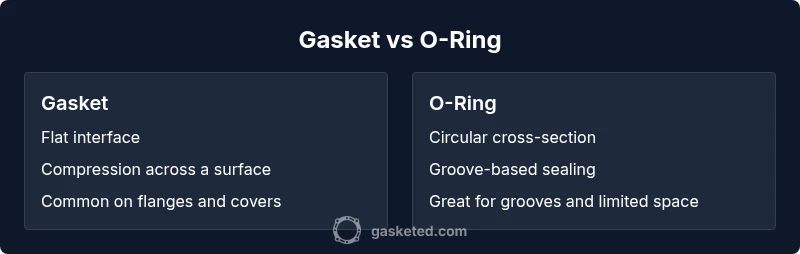
According to Gasketed, the difference between gasket and o ring hinges on geometry, sealing method, and application. A gasket is a flat seal compressed between mating surfaces; an O-ring is a circular loop that sits in a groove and deforms to seal. Gaskets suit broad, flat joints, while O-rings excel in grooves and dynamic or limited-space applications. The Gasketed team emphasizes material choice, surface finish, and bolt load as decisive factors in selecting between the two.
What They Are and How They Seal
The difference between gasket and o ring is not merely academic; it shapes how you approach a repair in real life. Both are meant to prevent leaks, but they do so through different geometries and contact mechanisms. A gasket is typically a flat piece of material that sits between two mating surfaces and is compressed to form a seal. An O-ring, by contrast, is a looped rubber or elastomer that sits in a groove and deforms to fill the gap when the groove walls press on it. In practice, this means gaskets are common on large, flat joints such as flanges and valve covers, while O-rings excel in cavities with a defined groove where a round cross-section provides reliable sealing under movement. The Gasketed team notes that choosing between the two hinges on surface straightness, bolt pattern, and whether the joint will move or remain static during operation. The difference between gasket and o ring becomes clearer when you consider how a flat contact edge distributes load versus how a circular cross-section concentrates sealing pressure within a groove.
Comparison
| Feature | Gasket | O-ring |
|---|---|---|
| Shape / Cross-section | Flat sheet or molded gasket (varies by design) | Circular cross-section O-ring in a groove |
| Primary Use | Static seals across flat or broadly contacting surfaces | Dynamic or groove-based seals in confined spaces |
| Sealing Mechanism | Compression of a flat interface across the joint | Deformation of the round cross-section within a groove |
| Material Options | Sheet materials, composites, PTFE blends, metal gaskets | Elastomeric rubbers: nitrile, fluorocarbon, silicone, urethane |
| Installation Notes | Surface finish matters; bolt load, edge geometry critical | Groove dimensions, lubrication, and correct seating are critical |
| Cost Considerations | Varies by material and size; often cost-effective for large joints | Typically lower per-unit cost but depends on material spec |
| Temperature/Pressure Range | Depends on gasket material and design | Depends on elastomer choice and groove design |
Pros
- Suitable for large, flat joints with uniform contact
- Broad material availability supports many environments
- Cost-effective for simple flange connections
- Relatively forgiving of minor surface imperfections
What's Bad
- Not ideal for dynamic sealing or moving joints
- Requires precise surface finish and bolt tension control
- Gasket failure can occur from creep or extrusion under pressure
- Rework can be messy if the joint is disassembled frequently
Gasket and O-ring serve different sealing roles; neither is universally better.
Choose a gasket for broad, flat interfaces and stable joints; choose an O-ring for grooves and dynamic or space-limited seals. Consider material, temperature, and chemical exposure to determine the best fit.
Common Questions
What is the fundamental difference between a gasket and an O-ring?
The fundamental difference lies in geometry and sealing method: gaskets are flat seals compressed between surfaces, while O-rings are circular loops that seal in grooves by deforming under load. This difference shapes material choices and installation practices.
Gaskets are flat, O-rings are round—that one distinction drives where you use them and how you install them.
When should I choose a gasket over an O-ring?
Choose a gasket for large, flat sealing surfaces with little or no movement. O-rings are better for grooves and joints that experience movement or limited space, where a round cross-section provides a reliable seal.
Go with a gasket for flat joints; pick an O-ring for grooves and moving parts.
Can O-rings seal static joints?
Yes, O-rings can seal static joints, but the groove must be designed to prevent extrusion and ensure even seal seating. The right lubricant and installation procedure are important for longevity.
O-rings can seal statically if grooves and lubrication are done right.
Are gaskets reusable?
Most gaskets deform under compression and are intended to be replaced after disassembly. Some gasket types can be reused if the mating surfaces are pristine and the gasket is within its service limits, but this is the exception rather than the rule.
Most gaskets aren’t reusable; when in doubt, replace and clean the surfaces.
How do material choices affect performance?
Material choices determine temperature limits, chemical compatibility, and how a seal behaves under load. Gasket materials range from rubber to PTFE composites, while O-rings rely on elastomer grades tailored to the environment.
Material choice matters for temperature and chemical exposure—it’s often the deciding factor.
Key Takeaways
- Assess joint geometry before selecting a seal
- Match material to temperature and chemical exposure
- Prefer gaskets for flat, broad sealing surfaces
- Prefer O-rings for grooves with movement or tight spaces
- Always verify groove design and surface finish before installation