Gasket or Gasket Maker: A Practical Comparison for DIYers
An objective, detailed comparison of traditional gaskets and gasket makers for DIY repairs. Learn when to use each, surface prep tips, installation nuances, and maintenance guidance from the Gasketed team.


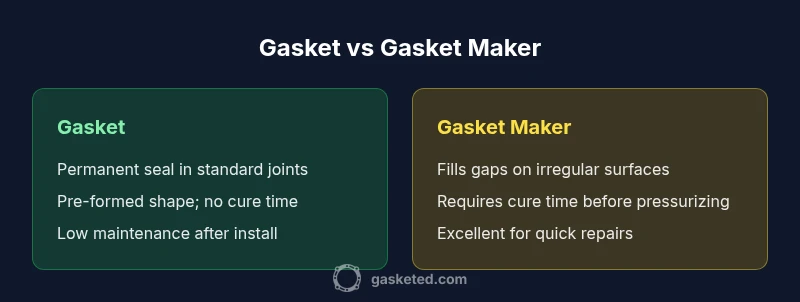
gasket or gasket maker: the choice hinges on permanent seals versus repair flexibility. In most DIY contexts, a traditional gasket provides durable, long-lasting seals for engines, appliances, and plumbing. Gasket maker is ideal for irregular surfaces, temporary fixes, or areas where a custom-fit is difficult. This quick comparison highlights when to trust pre-formed gaskets and when to apply sealant-based solutions.
Overview: gasket or gasket maker in DIY repairs
According to Gasketed, the decision between a gasket and a gasket maker is not merely a matter of price. It is about how you intend the component to perform over time, under load, and in varying conditions. For many DIYers, the core question reduces to: will this seal be permanent and serviceable for years, or should I lean toward a flexible, fill-it-as-you-go solution? The phrase gasket or gasket maker captures the spectrum from rigid, pre-formed seals to liquid or paste sealants that cure and accommodate imperfect mating surfaces. In this guide, you’ll see how to assess surfaces, chemical exposure, temperature range, and maintenance needs to pick the right approach. This framing helps homeowners and hobbyists approach gasket repair with confidence and reduce the risk of leaks after a fix.
What is a gasket?
A gasket is a pre-formed, shape-specific seal that sits between mating surfaces. It is typically manufactured to exact thickness, compressibility, and material properties for a given application. Gaskets excel when the bonded joint endures steady loads, modest movement, and predictable temperatures. Materials range from flexible elastomers to high-strength composites, each chosen for compatibility with the fluids and environment. For the DIYer, pre-cut or stock gaskets offer quick, reliable results when the mating surfaces are clean, flat, and torqued to spec. The key advantage is durability and consistent sealing without curing time. The main caveat is geometry: if the surfaces are uneven or damaged, a standard gasket may not seal properly without remediation.
What is a gasket maker?
Gasket maker refers to sealants or sealant-based products that you apply as a liquid or paste to fill gaps and irregularities. They cure to form a flexible, robust seal and are especially useful when the mating surfaces are imperfect, corroded, or nonstandard in shape. Common formulations include silicone, anaerobic, and polyurethane types, each selected for temperature resistance, exposure to fuels, or chemical compatibility. Gasket makers add versatility for DIY projects like repairs on appliances, plumbing, or automotive components where a custom-fit gasket is impractical. The trade-off is cure time and sometimes a longer setup window before the joint is put under pressure.
Surface prep and material compatibility
Successful sealing starts with surface prep. Whether you choose a gasket or gasket maker, begin with clean, dry mating surfaces free of old gasket remnants, oil, and gasket adhesive residue. If you are using a gasket, inspect threads and bolt holes for debris; align the gasket correctly to avoid misfits. When applying gasket maker, mask off adjacent areas to prevent squeeze-out and ensure even application. Material compatibility is crucial: some sealants pair well with plastics and metals; others resist brake fluid, fuel, or coolant. Always verify the manufacturer’s recommendations for temperature limits, exposure, and cure times. A poor surface condition is the most common reason for early leaks, regardless of the sealing method.
Application domains: automotive, plumbing, appliances
In cars, engine gaskets and valve covers rely on resilient, heat-tolerant materials but often require precise torque to avoid distortion. For plumbing, water-temperature and pipe material compatibility govern gasket choice, with silicone or rubber options commonly used in household joints. Appliances such as dishwashers and washing machines may benefit from gasket makers when you face gaps caused by age or deformation. In all domains, the decision hinges on reliability versus flexibility. A well-chosen gasket offers a stable, maintenance-free seal, while a gasket maker provides adaptability for imperfect mating surfaces and emergency repairs.
Temperature, chemical resistance, and cure considerations
Temperature and chemical exposure strongly influence gasket selection. Gaskets perform best when the operating range aligns with the material’s spec; high heat, aggressive solvents, or fuels may require specialized composites. Gasket makers come in variants designed for high temperature, chemical resistance, or food-grade safety. Cure times vary: some gasket makers set quickly, while others require several hours or a full cure cycle before system pressure is introduced. Always follow label instructions for mixing, application thickness, and cure windows. This knowledge helps you avoid failures due to premature loading or inadequate curing.
Durability vs flexibility: when to choose
Durability and long-term reliability favor traditional gaskets in static or high-load joints. If the joint will experience constant pressure, vibration, or thermal cycling, a proper gasket is often preferable. Gasket makers excel in flexibility; they can fill minor imperfections and are forgiving when you cannot achieve perfect mating surfaces. In mixed-material assemblies, tempo and service life matter: temporary fixes or field repairs benefit from gasket makers, while factory-assembled components benefit from pre-formed gaskets. The final choice should balance durability, repair speed, and the cost of potential rework.
Installation steps: gasket vs gasket maker
Installing a gasket generally involves aligning the pre-cut seal with the bore or flange, applying a thin film of lubricant as recommended, and torquing bolts to spec in a crisscross pattern. As soon as the joint is tightened, the gasket compresses to seal. When using a gasket maker, you apply a continuous bead or a defined pattern, then assemble parts within the open work time. After assembly, allow the recommended cure period before pressurizing or loading the joint. In both cases, test for leaks with a controlled pressure or fluid test and inspect after the first test run.
Safety, storage, and handling
Sealants and adhesives require proper ventilation and protective gear. Store gasket materials in a cool, dry place away from direct sunlight; some products have shelf-life considerations. When handling gasket makers, avoid skin and eye contact, and use recommended curing containers and removal tools to prevent skin bonding or surface contamination. After use, reseal containers tightly and follow disposal guidelines for chemical products. Safety data sheets (SDS) provide critical information for your specific product. Adhering to safety guidelines reduces risk during DIY repairs and longer-term sealing integrity.
Costs, value, and availability
Gaskets and gasket makers come at different price points, influenced by material complexity, heat resistance, and application. In many DIY contexts, gasket sets offer predictable pricing, while gasket makers may incur slightly higher upfront costs per use but can reduce waste on imperfect surfaces. Availability varies by region and retailer, so having a short list of compatible products helps with quick decisions. When budgeting, consider not just initial cost but replacement frequency, potential rework, and downtime caused by leaks. This holistic view supports a smarter choice for long-term value.
Comparison
| Feature | Gasket | Gasket Maker |
|---|---|---|
| Best Use Case | Permanent, pre-formed seal for standard joints | Filling gaps on irregular or damaged surfaces; quick repairs |
| Installation Profile | Install, torque to spec; no curing time | |
| Surface Requirements | Requires clean, flat mating surfaces | |
| Typical Maintenance | Low maintenance if installed correctly | |
| Cost Consideration | Moderate upfront cost; durable long-term seal | |
| Typical Applications | Automotive, plumbing, appliances with standard geometries | Irregular surfaces, legacy joints, temporary fixes |
Pros
- Clear performance difference: gaskets favor durability in standard joints
- Gasket makers offer adaptability for imperfect surfaces
- Both options support DIY repairs with proper prep and guidance
- Stock gaskets provide fast, predictable replacements
What's Bad
- Gasket replacements require precise geometry and torque specs
- Gasket makers need cure time and careful handling before pressurizing the joint
- Wrong material choice can lead to leaks or contamination
- Overreliance on sealants can complicate future disassembly
Gasketed guidance favors traditional gaskets for permanent, high-load joints and gasket makers for irregular or repair-focused scenarios
Use a gasket when you can achieve a clean, flat seal that will endure loads and temperatures. Use a gasket maker when surfaces are imperfect or you need a quick, flexible repair. The best DIY practice combines careful surface prep, correct material selection, and adherence to application instructions.
Common Questions
What is the key difference between a gasket and a gasket maker?
A gasket is a pre-formed seal designed for a specific joint, offering durability and a straightforward install. A gasket maker is a sealant that fills gaps and irregularities, providing flexibility and adaptability for imperfect surfaces. The choice depends on surface condition and whether a permanent seal is required.
A gasket is a ready-made seal for a specific joint, while a gasket maker fills gaps and works when the surface isn’t perfect.
When should I reach for a gasket maker instead of a gasket?
Use a gasket maker when surfaces are deformed, damaged, or nonstandard, or when a quick repair is needed and a perfect gasket isn’t available. It is less ideal for high-heat, high-pressure, or long-term reliability in heavily loaded joints.
Choose gasket maker for irregular surfaces or quick fixes, not for every high-load joint.
Are gasket makers safe for food-contact surfaces?
Some gasket makers are rated for food-contact applications; always check the product label or SDS to confirm suitability before use in food processing or beverage environments.
Check the label to be sure if you’re sealing something that touches food.
Can I reuse a gasket after applying a gasket maker?
Typically, joints sealed with gasket maker are less easily disassembled and re-sealed compared to pre-formed gaskets. If you need disassembly, plan for potential resealing steps and replace parts as needed.
If you don’t plan to disassemble often, gasket maker can be fine; otherwise, a gasket is easier to reuse.
What surfaces are inappropriate for gasket makers?
Some gasket makers can react with certain plastics or incompatible metals; always verify compatibility with the substrate and fluids involved before application.
Always double-check the materials you’re sealing against the sealant’s compatibility chart.
How do I test a new seal after installing with a gasket or gasket maker?
After installation and curing, perform a controlled leak test at low pressure. Inspect for seepage around joints and re-torque or reseal if needed before putting the system under full load.
Leaky joints are not acceptable—test at low pressure first and fix before full operation.
Key Takeaways
- Assess the joint: static/high-load vs flexible/irregular
- Prefer gaskets for durability; gasket makers for repairs and gaps
- Match material to temperature and chemical exposure
- Follow manufacturer guidelines and cure/torque specs