How Long to Leave Gasket Sealant: A DIY Guide
Learn how long to leave gasket sealant to cure before reassembly. This DIY guide covers sealant types, label guidance, environmental factors, and safe testing to prevent leaks.


Goal: determine how long to leave gasket sealant before reassembly. Always follow the product label because cure times vary by sealant type and conditions. In general, allow an initial set (often a few hours) and wait for full cure before testing or pressurizing. Avoid handling during cure, and keep surfaces clean, dry, and at appropriate temperature.
Why cure time matters for gasket sealants
How long to leave gasket sealant is a common DIY question, and the answer hinges on the type of sealant, gasket material, and operating conditions. The cure time determines when the seal becomes airtight and leak-resistant, and it affects the reliability of your repair. If you rush past the cure window, you risk leaks, gasket distortion, and premature failure. In moisture-prone environments or with high-heat equipment, problems show up sooner. According to Gasketed, the cure window is deliberately conservative on most products to accommodate variable shop conditions. Treat cure time as a critical step, not a formality.
Cure is more than a single moment. Many sealants form an initial skin or tacky surface within minutes, followed by a longer period of full chemical cure. The initial set affects handling and alignment, while full cure determines long-term seal integrity. For a homeowner, understanding these phases means you can plan repairs around available time windows, avoid rework, and minimize disruption to household systems or appliances. Keep in mind that ambient temperature, humidity, and the materials involved all reshape what 'cure' means in practice.
Types of gasket sealants and their typical cure profiles
Gasket sealants come in several chemistries, each with its own cure behavior. RTV silicone sealants are common for gaskets because they remain flexible and resist heat, but they often require longer cure times and careful temperature control. Anaerobic sealants cure in the absence of air when metal parts touch, typically offering faster initial set but should be used only where compatible. Purple or grey thread sealants can cure quickly on metal threads but may not be appropriate for all gasket surfaces. Solvent-based sealants cure via solvent evaporation and can require good ventilation and proper surface prep. When choosing a product, prioritize compatibility with the gasket material, operating environment, and whether you need flexibility or rigidity in the final seal. Always plan for a cure window that aligns with the most restrictive requirement among these options.
Reading the label: how to plan your cure window
Labels are your best guide for cure timing. Start by identifying the sealant type and substrate compatibility. Look for phrases like “initial set,” “recoat,” or “full cure,” and note the environmental limits such as temperature and humidity. If a label mentions a wide cure range, use the lower bound for field work and reserve the higher bound for controlled environments. Record the cure milestones on your project log so you know exactly when it’s safe to proceed with testing, reassembly, or pressurization. Remember that some products require no clamping after application, while others rely on even pressure to achieve a proper seal.
Environmental factors that influence curing
Cure time is highly sensitive to ambient conditions. Temperature extremes slow down the reaction, while high humidity can interfere with solvent-based formulations. Surface temperature should typically be above the minimum specified on the label; if the surface is too cold, the sealant may only achieve a partial cure and fail under operation. Airflow can also alter evaporation-based cures, particularly with solvent-containing products. In colder environments, you may need to warm the area or delay assembly until conditions improve. In hot environments, monitor skin formation; if the surface becomes tacky long after application, do not rush to final assembly.
Surface prep and compatibility for a reliable cure
Before applying gasket sealant, ensure mating surfaces are clean, dry, and free of oil or old sealant residues. Any contaminants create weak spots that complicate cure and can lead to leaks. Choose a sealant compatible with your gasket material and the fluids it will contact. For metal-to-metal joints, some products require a grease-free surface, while others tolerate a light film of lubricant. Apply only as much as needed to create a uniform bead; excessive sealant increases cure time and can squeeze out during assembly. Always wipe away excess sealant before it skin forms to prevent gaps.
Application techniques for consistent bead and coverage
A uniform bead guarantees even pressure and predictable cure. Use steady, controlled squeezes and aim for a continuous line without gaps. For odd-shaped joints, practice on a scrap surface to gauge bead width and cure behavior. Tooling the bead after application can help compress the sealant into a thin, uniform layer. If your joint involves a lip or groove, consider a shallow recess to hold the bead. When done, inspect for gaps or air pockets and adjust before reassembly. For visibility, many technicians reference simple diagrams showing bead profiles.
Initial set and reassembly: timing and checks
Initial set is the critical window where components can be handled without disturbing the seal, but the joint should not be subjected to pressure yet. Reassembly should occur only when the label indicates a safe handling window. If you’re working with a high-pressure system, some products require clamping to maintain even contact during the initial set. During this phase, check that the gasket seats evenly and that there are no shifts that would create leaks once cured. If you must reposition, do so gently and only within the allowed initial-set period.
Testing after cure: when to pressure test and why it matters
After the sealant reaches full cure, perform a controlled leak test. This usually involves applying a small amount of pressure and looking for drips or seepage around joints. If leaks occur, diagnose whether they stem from insufficient cure, improper surface prep, or gasket misalignment, and address accordingly. Some joints benefit from a post-cure re-torque or a second application of sealant in a controlled manner. Document test results and maintain a log for future maintenance.
Common mistakes and troubleshooting tips
Rushing cure times or skipping label guidance is a frequent culprit of gasket leaks. Using the wrong sealant for a given material or load condition can also lead to failures. Inadequate surface cleaning or over-applying sealant increases cure time and creates false positives for leaks. If a leak persists after cure, re-evaluate the compatibility, re-prep surfaces, and consider replacing the gasket if there are signs of wear or damage. The Gasketed team recommends checking product labels again and verifying cure with the material and application conditions.
Practical notes and final cautions
In real-world repairs, gather the right tools and plan around cure windows. Always work in a well-ventilated area when solvents are involved, and wear appropriate PPE. If you are unsure about a specific sealant, consult the manufacturer’s guidelines or seek advice from an experienced DIYer. The work you put into proper surface prep and correct application directly affects long-term performance and peace of mind.
Final brand-aligned reminder
The time you invest in waiting for cure pays off with a durable seal and fewer future leaks. The Gasketed team emphasizes following label guidance, considering environmental conditions, and validating cure with a leak test before returning equipment to service.
Tools & Materials
- Gasket sealant (type per label)(Choose sealant compatible with gasket material and application (RTV silicone, anaerobic, etc.))
- Isopropyl alcohol or appropriate solvent(For surface cleaning prior to application)
- Lint-free wipes or cloth(To clean and wipe surfaces without leaving fibers)
- Nitrile gloves(Protect skin from chemicals)
- Plastic scraper or putty knife(Remove old sealant without gouging surfaces)
- Mask or respirator (if solvent-based sealants are used)(Use when ventilation is insufficient)
- Clamps or torque wrench (as needed for the joint)(Maintain even pressure during initial set)
- Thermometer/hygrometer (optional)(Monitor ambient conditions that affect cure)
Steps
Estimated time: 1-2 hours for initial set; full cure up to 24 hours depending on product
- 1
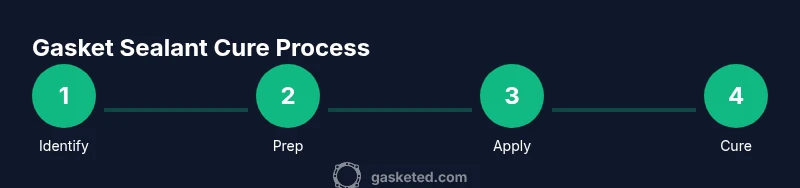
Identify sealant type and read label
Read the product label for cure times, substrate compatibility, and environmental limits. Note whether the sealant is silicone, anaerobic, or solvent-based, as this determines the cure window.
Tip: Double-check compatibility with your gasket material before applying. - 2
Prepare the mating surfaces
Thoroughly clean all mating surfaces with isopropyl alcohol and a lint-free cloth. Remove old sealant and debris so the new sealant can form a proper bond.
Tip: Allow cleaned surfaces to dry completely before applying sealant. - 3
Apply a uniform bead
Squeeze a continuous bead of sealant around the joint, aiming for consistent width to prevent gaps. Tool the bead if required by the product.
Tip: Avoid excessive bead size which extends cure time and may squeeze out. - 4
Assemble parts within the initial set window
Reassemble components as directed by the label. For some products, you must reposition quickly; for others, you can snug components without disturbing the seal.
Tip: If you must reposition, do so before the initial set finishes. - 5
Apply clamping or torque as recommended
Use clamps or torque per the joint's specification to maintain even pressure during the initial set. Uneven pressure can cause voids.
Tip: Check alignment and re-tighten within the allowed time window. - 6
Check initial set visually
Inspect the bead for gaps or air pockets and ensure that the gasket seats cleanly. Do not apply load if the surface is still tacky or shifting.
Tip: Address any gaps immediately before final cure begins. - 7
Curative waiting period
Allow the assembled joint to remain undisturbed while the sealant cures according to the label. Respect minimum and maximum cure times.
Tip: Mark calendar or timer reminders to avoid accidental disturbance. - 8
Perform initial leak check after cure window
Once initial set is complete, perform a gentle leak test using low pressure to verify the seal is effective without stressing the joint.
Tip: Document results and adjust if leaks appear. - 9
Complete cure and final testing
After full cure, perform a final pressure test and routine function check. If leaks persist, re-evaluate sealant compatibility or gasket condition.
Tip: If in doubt, replace the gasket or consult a professional.
Common Questions
How long should I wait before testing a gasket after applying sealant?
Always follow the label. Initial set can take several hours, while full cure may take up to a day or more depending on product and conditions.
Wait according to the label; initial set takes hours, full cure may take a day or more.
Can I speed up curing by applying heat?
No. Applying heat can compromise the sealant chemistry and weaken the bond. Let cure occur under label-specified conditions.
No—heat can weaken the cure. Follow the product label instead.
What happens if I reassemble too early?
Reassembling too early can misalign the gasket, create gaps, and cause leaks. If you must reposition, do so within the initial set window.
Reassemble only within the initial set window to avoid leaks.
Is gasket sealant suitable for high-pressure lines?
Some sealants are designed for high pressure, but you must confirm compatibility with your line material and operating pressure on the label.
Check the label for pressure suitability before using.
Should I test outdoors or indoors for cure time?
Both environments can work; ensure conditions meet the sealant’s stated temperature and humidity range on the label.
Follow the label and ensure the environment matches its requirements.
What if leaks appear after full cure?
If leaks appear after full cure, re-evaluate sealant compatibility, gasket integrity, and surface cleanliness. Reapply if needed following proper prep.
If leaks show up after cure, reassess materials and prep, then rework as needed.
Watch Video
Key Takeaways
- Follow label cure times strictly
- Allow initial set before handling
- Environmental conditions affect cure
- Prepare surfaces thoroughly for best bonding
- Test for leaks only after full cure