Difference Between Gasket and Grommet: A Practical Guide
Explore the difference between gasket and grommet, including uses, materials, and installation tips for reliable seals and protected openings.


In the simplest terms, the difference between gasket and grommet lies in purpose and placement: a gasket seals a joint between two stationary parts, while a grommet sits in a hole to protect a passing object or cable and can also seal in some cases. For DIY repairs, choosing the right seal reduces leaks, vibration, and wear.
What Are Gaskets and Grommets?
Gaskets and grommets serve overlapping but distinct roles in sealing, protection, and maintenance. In everyday DIY tasks, understanding the difference between gasket and grommet helps prevent incorrect choices that can lead to leaks, noise, or premature wear. A gasket is typically a flat or shaped sealing element placed between two mating surfaces to create a tight seal when compressive force is applied. Gaskets are designed to fill irregularities and provide a leak-proof interface across a joint, whether that joint carries liquids, gases, or steam. Grommets, by contrast, are protective rings inserted into a hole to shield cables, hoses, or fittings from abrasion and wear. Some grommets also incorporate sealing features, but most are primarily about protection and alignment rather than creating a high-integrity fluid seal. In many home repairs, you will encounter both components in different contexts: a gasket in a toilet flange or shower valve, and a grommet in a power cord opening through a metal panel. The essential point is to match the component to the function: true sealing versus protective, guiding, and wear resistance.
Core Differences at a Glance
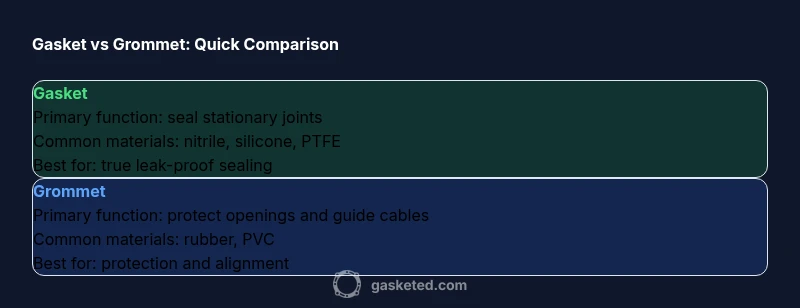
- Function: Gaskets are designed to seal stationary joints; grommets protect openings and can aid in sealing in some cases, but are not primarily sealing devices.
- Placement: Gaskets sit between two mating surfaces; grommets sit in a hole to shield an opening and support wires or fittings.
- Materials: Both use elastomers or metals, but gasket materials are selected for compression and chemical compatibility; grommets emphasize abrasion resistance and edge protection.
- Shape and fit: Gaskets are flat or custom-shaped to the joint; grommets are ring-like with a hole and often a flange for seating.
- Installation impact: A gasket relies on precise mating surfaces and uniform compression; a grommet relies on a proper hole size and secure seating to protect the opening.
- Performance expectations: Gaskets aim for a high-integrity seal under pressure; grommets aim for protection, alignment, and sometimes secondary sealing.
- Best practice: For leaks and fluid containment, choose a gasket; for cable protection and opening durability, choose a grommet.
Materials and Manufacturing Considerations
Gaskets and grommets are made in a wide range of materials tailored to their job. Common gasket materials include nitrile (NBR), silicone, fluorosilicone, neoprene, and PTFE, each chosen for elasticity, chemical resistance, and temperature tolerance. Metallic gaskets (copper, aluminum, stainless steel) appear in high-pressure or high-temperature environments where metal-to-metal seals are needed. Grommets use elastomeric rubbers (natural rubber, nitrile, EPDM) or plastics (PVC, polycarbonate) and may include fabric-reinforced sections for strength. The manufacturing approach influences flexibility, reusability, and sealing performance. For DIY projects, material choice should consider exposure (water, oil, solvents), temperature range, and potential for corrosion. A well-chosen gasket or grommet then supports a longer service life by maintaining integrity under vibration, movement, and environmental stressors.
Design and Shape Implications
Shape and seating geometry directly affect how a gasket or grommet performs. Gaskets often feature profiles such as spiral-wound, formed-in-place, or pre-formed shapes to match irregular joint surfaces. They compress to fill gaps and create a tight seal. Grommets are typically circular rings with an inner bore and may include a flange or washer to anchor them in the mounting hole. The bore size, flange diameter, and lip geometry determine how well the grommet protects the opening and integrates with fasteners or housings. In some cases, devices use composite designs that combine a gasket with a grommet in a single assembly to address sealing and protection simultaneously. Understanding these design nuances helps prevent under-sizing (leading to leaks) or over-sizing (causing mechanical interference).
Sealing Performance and Environmental Resistance
Effectiveness hinges on the material and fit. Gaskets provide high seal integrity for steady pressures and can resist chemicals, heat, or solvents when selected correctly. They must maintain a uniform compression across the joint, even as surfaces flex or the system experiences temperature changes. Grommets primarily protect openings from abrasion, moisture ingress, and mechanical wear; some sealing is achievable with the right gasketed grommet designs, but the primary goal is protection and alignment rather than guaranteed fluid sealing. Environmental considerations include exposure to oil, solvents, UV light, ozone, and temperature extremes. The best results come from pairing the material with the environment: for outdoor or automotive duties, choose weather- and UV-resistant gaskets or grommets; for food-grade or clean environments, select compliant elastomers such as silicone or EPDM.
Installation and Maintenance Realities
Installation quality matters more for gaskets than many homeowners realize. Surfaces must be clean, flat, and free of debris; misaligned clamping or uneven torque creates leaks. For grommets, the critical steps are ensuring the hole is properly sized, the grommet seats evenly, and any flange or grommet collar is correctly anchored to prevent movement. Maintenance involves periodic inspection for cracking, deformation, or wear, especially after exposure to heat, chemicals, or vibration. Replacement intervals depend on material, exposure, and load; a worn gasket or damaged grommet is often noticeable through leaks, looseness, or misalignment. When replacing, always use the exact compatible material and verify that the joint or opening remains within design tolerances.
Typical Applications by Industry
Gaskets are prevalent in plumbing, automotive engines, HVAC, food processing, and energy equipment where reliable seals are essential. Grommets appear in electrical panels, cabinetry, automotive harnesses, and machinery housings, where protection and clean openings matter. In DIY projects around the home, expect gaskets in toilets, faucets, and appliance doors; grommets in kitchen appliances with cord passes, electronics enclosures, or metal panels. While overlaps exist, identifying the scenario—leak-prone joint vs protected opening—will guide you to the correct component. Matching the duty cycle, material compatibility, and environmental exposure reduces the risk of leaks, corrosion, or abrasion.
Costs, Availability, and Procurement
Cost and availability depend on size, material, and supplier type. Gaskets tend to be widely available in standard sizes from hardware stores and industrial suppliers, with price variation driven by material and pressure ratings. Grommets are similarly accessible, with a broad range of diameters and bore sizes. Specialty materials or non-standard shapes can increase cost and lead time. For DIYers, it makes sense to source common sizes locally and reserve custom orders for unique applications. Always verify compatibility with chemicals, temperature, and mounting hardware to avoid rework.
Alternatives and Hybrids
In some cases, designers use hybrids like gasketed grommets or flange seals that combine protective features with reliable sealing. These hybrids can simplify assemblies and reduce the number of components, but they require careful specification to ensure the combined part performs as intended under load and environment. Modern designs may integrate O-rings, lip seals, or gasket profiles into a single unit to address multiple needs. When comparing options, consider whether a separate gasket and grommet or a dedicated gasketed solution offers better reliability, service life, and ease of replacement.
Step-by-Step Guidance for Choosing
- Define the primary function: true seal vs protection and alignment.
- Analyze the environment: chemicals, temperature, UV exposure, moisture.
- Check hole size, surface finish, and mating components for gasket use; ensure proper bore size and seating for grommets.
- Select material with the right resistance and compatibility.
- Consider installation constraints and maintenance expectations.
- Validate whether you need a standard off-the-shelf part or a custom solution, and plan for replacement intervals.
Common Mistakes to Avoid
- Using a gasket when a grommet is needed for protection and clearance, and vice versa.
- Ignoring surface finish or joint surface irregularities that prevent uniform compression.
- Overlooking temperature or chemical exposure that can degrade the material.
- Skipping manufacturer guidance on torque, seating, and installation tolerances.
- Choosing a size based on bore alone without confirming overall seating and flange geometry.
Comparison
| Feature | Gasket | Grommet |
|---|---|---|
| Primary function | Seal joints between stationary surfaces to create a leak-proof interface | Protect openings and pass-throughs, often for cables or fittings; sealing is situational |
| Typical materials | Elastomers, PTFE, or metals selected for compression and chemical resistance | Elastomeric rubbers or plastics; may include fabric backing for strength |
| Common shapes | Flat sheets, formed profiles, or irregular shapes matching joints | Circular rings with inner bore; may have flange or lip for seating |
| Installation approach | Placed between two mating faces and compressed with fasteners | Inserted into a hole and seated; may require a flange or collar |
| Sealing performance | High-integrity seals for static joints; designed for fluid/gas leaks | Protection and alignment; sealing is secondary in most designs |
| Environmental resistance | Wide options for heat, chemicals, and weather exposure | Abrasion resistance; environmental rating depends on material |
| Cost and availability | Widely available; cost varies with material and size | Often inexpensive for common sizes; specialty sizes vary |
| Best for | Static joints requiring a reliable seal | Openings and edges requiring protection and wear resistance |
Pros
- Clear functional distinction aids correct selection
- Wide availability across sizes and materials
- Relatively low cost and easy to replace
- Material choices tailored to environment and performance
What's Bad
- Misapplication can still occur if dimensions are not checked
- Not all gaskets or grommets are interchangeable
- Specialty materials or sizes may have longer lead times
- Some designs require precise torque or seating to perform
Gasket is preferred for reliable, high-integrity seals; grommet excels at protection and movement accommodation.
For static joints where leakage is a primary concern, use a gasket. For openings that need protection or cushioning, a grommet is preferable. In many DIY tasks, selecting the correct type from the outset reduces leaks, wear, and maintenance over time.
Common Questions
What is the difference between gasket and grommet?
The gasket is a sealing component placed between stationary parts to prevent leaks, while a grommet protects an opening and supports or guides passing objects. Some grommets offer sealing features, but their primary role is protection and alignment, not guaranteed fluid sealing.
A gasket seals joints; a grommet protects openings. Use a gasket for leaks, a grommet for protection.
When should I use a gasket instead of a grommet?
Use a gasket when the goal is a high-integrity seal for a stationary joint under pressure or flow. Use a grommet when protecting cables, hoses, or fittings through a hole, especially where movement or vibration occurs.
If you need a seal, choose a gasket; for protection and fit, choose a grommet.
Can a grommet seal like a gasket?
Some grommets are designed with sealing features, but most do not provide the same level of leak containment as a dedicated gasket. For reliable sealing, rely on a gasket unless the design specifies a gasketed grommet.
Grommets can seal in some cases, but usually not as reliably as gaskets.
Are gaskets reusable after deformation?
Many elastomer gaskets deform after compression and may not reseal well once removed. Some metal or composite gaskets are reusable, but most DIY projects assume a new gasket for a reliable seal.
They may not seal well after removal; replace with a new gasket.
What materials are common for gasket and grommet?
Gaskets often use nitrile, silicone, EPDM, or PTFE, with metal variants in high-heat contexts. Grommets use rubber, PVC, silicone, or fabric-backed variants for protection and durability.
Nitrile, silicone, and EPDM are common gasket materials; grommets use rubber or PVC.
Where can I buy gasket and grommet components?
Gaskets and grommets are widely available at hardware stores, plumbing supply shops, and online industrial retailers. Ensure you select the correct size, material, and rating for your application.
You can buy both at hardware stores or online; check the size and material.
Key Takeaways
- Define whether you need sealing or protection first
- Choose gasket for true seals in static joints
- Choose grommet for openings and abrasion protection
- Match material to environment (chemicals, temperature, UV)
- Check dimensions and seating to avoid leaks or gaps