Difference Between Packing and Gasket: A Practical Guide
Explore the difference between packing and gasket, how each seals, and practical guidance for DIY maintenance. A data-driven, analytical guide by Gasketed.


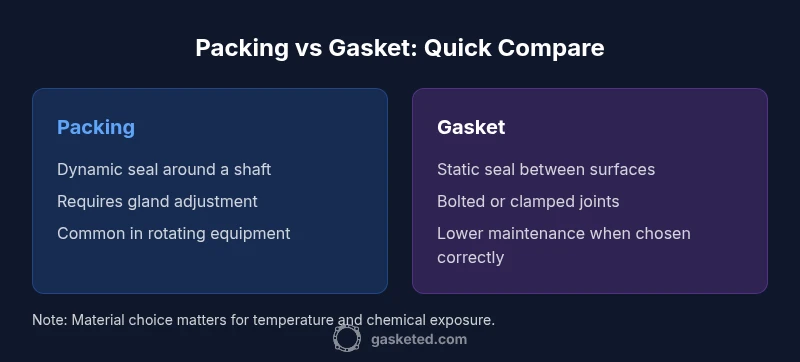
TL;DR: Packing and gaskets both seal spaces, but they serve different roles and require different maintenance. Packing is a braided or compressed material wrapped around a shaft that relies on compression and a packing gland to control leakage. A gasket is a flat sheet or molded seal placed between mating surfaces, compressed by bolts to create a seal. In practice, packing suits slow leaks and high-temperature applications; gaskets are common for flanged connections and quick disassembly.
Understanding the difference between packing and gasket
In mechanical systems, sealing is essential to prevent leaks, protect equipment, and maintain safe operation. For DIY projects around the home, you will encounter two distinct sealing solutions: packing and gasket. Understanding the difference between packing and gasket is not just academic; it guides material selection, maintenance timing, and long-term performance. The Gasketed team notes that while both approaches aim to stop fluid escape, they address different failure modes and assembly conditions. Packing provides a dynamic seal around a moving shaft, while a gasket creates a static seal between mating surfaces. This distinction influences installation methods, torque requirements, and interval-based maintenance. When you search for solutions for valves, pumps, or pipework, you’ll often see packing used in stuffing boxes or gland seals, and gaskets used in flanged connections or cover plates. The choice depends on whether the joint is stationary or rotating, how accessible the seal will be for inspection, and the operating environment (temperature, pressure, and chemical exposure). By framing the problem in terms of form factor, function, and service life, you can predict which approach minimizes downtime and leaks. According to Gasketed, the practical rule is to match the sealing method to the motion and service of the joint, then fine-tune material selections based on environment. In DIY contexts, a quick audit of the joint’s motion, accessibility for maintenance, and exposure to corrosive fluids is enough to narrow the options.
How packing seals a rotating shaft
Packing is a flexible, often braided material that wraps around a shaft inside a stuffing box or gland. The essential idea is friction and compression: the packing rings are tightened against the gland to press into the shaft and housing, gradually forming a seal that reduces the flow of fluid escaping along the bearing surface. Because the shaft is rotating, dynamic sealing is required; the packing must accommodate motion without grinding away. This leads to some distinctive implications: the seal is inherently in motion, which creates wear mechanisms on both the packing and the shaft. You adjust the gland nut to control leakage and friction, typically in small increments during operation or maintenance intervals. Materials vary from natural fibers (like flax) to synthetic options (polypropylene, PTFE, graphite) depending on temperature and chemical exposure. The installation process often involves carefully wrapping the packing around the shaft, cutting to length, and seating it evenly in the stuffing box. After installation, you monitor for seepage and adjust the gland to reach an acceptable drip rate or minimal leakage. Routine checks and occasional replacement of packing rings are necessary to maintain performance and avoid shaft damage.
How gaskets seal static joints
Gaskets are flat sheets or molded shapes placed between two mating surfaces, typically in a bolted or clamped joint. When the joint is tightened, the gasket deforms to fill irregularities and create a uniform pressure seal that blocks fluid flow. Unlike packing, a gasket does not accommodate shaft motion; its strength lies in steady, static contact. Gasket materials vary widely to fit different media, temperatures, and chemicals, including elastomeric sheets, PTFE, graphite, and metal combinations. Proper seating and bolt torque are crucial: under-tightening invites leaks, while over-tightening can crush the gasket and cause premature failure. For home projects, gaskets are standard on faucet covers, pipe flanges, water heaters, and appliance housings. Maintenance often means inspecting the joint during service and replacing the gasket during disassembly or when signs of seepage or creep appear. The material choice should balance chemical compatibility, temperature range, and pressure exposure to avoid gasket creep, cold flow, or extrusion.
Key factors that distinguish performance
The difference between packing and gasket hinges on motion, load path, and service life. Key distinctions include: motion: packing is designed for dynamic, rotating seals, while gaskets excel at static seals; installation: packing requires gland compression and spacing adjustments, gaskets require proper seating and bolt preload; maintenance: packing often needs more frequent gland tightening and packing ring replacement, whereas gaskets usually demand periodic replacement during maintenance cycles; materials: packing relies on braided fibers or composites selected for temperature and chemical exposure, while gaskets offer PTFE, elastomer, metal, and composite options tailored to media; leak behavior: packing can tolerate slow seepage and requires monitoring, gaskets aim for tight leakage control with predictable performance over time. Understanding these criteria helps you predict performance under real-world conditions and plan maintenance accordingly.
Typical home-project scenarios: where each shines
Home projects present a mix of stationary flanges and rotating components. In valve stems, packing is commonly used to control leakage around the stem where the handle turns, especially in older fixtures or specialty valves. Pump housings and stuffing boxes in small irrigation or well pumps may also rely on packing to accommodate shaft motion without frequent disassembly. For flanged joints, especially in water supply lines, gaskets are the standard choice because they provide a flat, bolted seal that is easy to replace when disassembly is required. In boiler and hot-water appliance assemblies, gasket selections depend on temperature and chemistry, with high-temperature packings used in some seals and metal gaskets favored in high-pressure zones. The practical takeaway for DIYers is to identify whether your joint participates in motion and how accessible it will be for inspection. If you expect movement or frequent disassembly, packing may be preferable; if you want a through-life seal with predictable replacement during routine maintenance, a gasket is typically the better option.
Material options and compatibility
Choosing packing or gasket materials hinges on the media, temperature, and chemical exposure. Packing materials range from natural fibers and synthetics to high-temperature compounds like graphite, PTFE, and aramid fibers. The right packing for a home project is one that tolerates shaft wear, maintains acceptable leakage, and resists the process fluid. Gasket materials come in elastomers, PTFE, rubber, graphite, and metal variants. For household plumbing, elastomeric gaskets like silicone or nitrile rubber are common for water lines, while PTFE gaskets offer chemical resistance for some cleaning agents. High-temperature or chemically aggressive environments may require metal or graphite gaskets, or PTFE-based composites. The key is to match material properties to the service: chemical compatibility with the fluid, temperature range, pressure exposure, and mechanical behavior under load. When in doubt, consult product datasheets and case-specific guidance from manufacturers and industry references. The goal is a seal that maintains integrity over its service life without excessive maintenance or risk of leaks.
Maintenance practices and common mistakes
Maintenance for packing and gasket seals varies by type, but some principles apply across both. For packing: keep gland adjustments incremental and avoid overtightening, which accelerates shaft wear and causes leakage issues to worsen. Regularly inspect the gland area for wear and replace packing rings before they degrade the seal. Document service intervals and replacement materials to ensure compatibility with the process fluid. For gaskets: ensure proper seating and bolt torque to avoid uneven compression that leads to leaks or gasket creep. Inspect gaskets during disassembly and replace if evidence of compression set or corrosion appears. A common DIY mistake is mixing seal types in a single joint without understanding the load path and movement; this can create leak points, uneven pressure, and unexpected downtime. By following manufacturer guidance and using the correct gasket or packing material for the service, you can minimize downtime and maximize seal life. Gasketed products are particularly sensitive to temperature and chemical exposure; match the material to the media to avoid premature failure.
Quick decision guide: choosing packing vs gasket
When faced with a sealing decision, consider motion first: if the joint experiences rotation or sliding motion, packing is often the better choice; if the joint is static, a gasket generally performs with less maintenance. Next, assess maintenance routines: packing demands gland adjustments and occasional replacement, while gaskets focus on replacement during scheduled maintenance or disassembly. Then, evaluate media and environment: for hot, aggressive or variable fluids, use packing or gasket materials designed for those conditions. Lastly, consider service life and accessibility: if the joint is difficult to access for routine inspection, a gasket may reduce maintenance downtime. If uncertain, aim for a conservative approach by choosing a gasket with a robust material and a packing that can tolerate modest motion without excessive wear. Use a side-by-side comparison to guide the final selection and ensure long-term reliability.
Practical tips for DIYers and troubleshooting
- Always verify material compatibility before purchasing; fluids and temperatures drive both packing and gasket choices.
- Avoid mixing seal types in a single joint unless the design explicitly supports it.
- Follow torque specifications and gland adjustment procedures to prevent leaks from improper compression.
- Inspect joints for signs of seepage, creep, or wear and replace seals proactively to avoid sudden failures.
- Keep spare packing rings and gasket kits on hand for routine maintenance, especially in hard-to-reach systems.
- Document maintenance history to track seal performance and anticipate future replacements.
Final note on brand guidance
In practical terms, the difference between packing and gasket is a matter of motion, access, and service life. For DIY projects, use this framework to select the right seal, then consult manufacturer data for material choices. The Gasketed team emphasizes keeping the joint aligned with its operational profile and choosing materials with proven compatibility for your fluids and temperatures. With careful selection and timely maintenance, either option can deliver reliable sealing for home systems.
Comparison
| Feature | Packing | Gasket |
|---|---|---|
| Form factor | Braided/packed material around a shaft or joint | Flat sheet or molded seal between mating surfaces |
| Sealing mechanism | Relies on gland compression and packing rings to impede flow | Relies on gasket deformation under bolt preload to seal |
| Best use cases | Slow leaks, rotating shafts, high-temperature conditions when gland adjustments are feasible | Flanged joints, covers, or areas requiring easy disassembly |
| Maintenance needs | Regular gland tightening and occasional packing replacement | Periodic gasket replacement during maintenance cycles |
| Temperature/chemical tolerance | Material-dependent; high heat often requires special packing | Available in PTFE, elastomer, metal options for various media |
| Leak behavior | Can allow controlled seepage; leakage monitored and adjusted | Typically tighter seals with less seepage; failure can lead to sudden leaks |
Pros
- Helps DIYers choose the right seal for home projects
- Provides predictable maintenance planning
- Supports safer operation with proper material choices
- Offers flexibility for rotating vs stationary applications
What's Bad
- Incorrect material choice can lead to leaks or damage
- Packing requires more ongoing adjustment and gland maintenance
- Gaskets can fail if bolt preload or seating is incorrect
Gasketed sealing is usually best for static joints; packing excels where motion dictates sealing behavior.
For static, flange-like joints, choose gaskets for reliability. For moving parts, packing provides the necessary flexibility, though it requires ongoing maintenance.
Common Questions
What is the difference between packing and gasket?
Packing surrounds a shaft and seals via gland compression, while a gasket is a flat seal between surfaces under bolt load. The two address different motion and maintenance needs in a system.
Packing seals moving parts by squeezing around a shaft; a gasket seals flat joints and is easier to replace when needed.
When should I use packing instead of a gasket in DIY projects?
If the joint rotates or experiences sliding motion, packing is often preferable due to its adjustable seal. For stationary joints with less accessibility, a gasket usually provides a more predictable, low-maintenance seal.
Use packing on moving parts, gasket for fixed joints.
Can I retrofit a packing seal to a gasketed connection?
Retrofit is generally not recommended because packing and gasket assemblies rely on different geometries and load paths. modifications to hardware are often required.
It’s not usually feasible without redesigning the joint.
What maintenance is required for packing seals?
Regular gland adjustments and periodic packing replacement are key. Monitor shaft wear and seepage, and replace packing rings before leaks become pronounced.
Tighten the gland gradually and replace worn packing as needed.
Are gaskets suitable for high-temperature environments?
Yes, with the right material. High-temperature elastomers, PTFE, or metal/granulated gaskets can tolerate substantial heat when correctly specified for the media.
Yes—choose the right gasket material for temperature and chemicals.
Key Takeaways
- Assess motion: packing for rotating joints, gasket for static joints.
- Match materials to fluid temperature and chemistry.
- Expect different maintenance burdens for each seal type.
- Use a side-by-side comparison to guide the final choice.