BMW Blown Head Gasket: Troubleshooting and DIY Fix Guide
Step-by-step guide to diagnose and repair a BMW blown head gasket. Learn signs, safe practices, diagnostics, and repair paths with expert guidance from Gasketed.


BMW overheating, white exhaust, and milky oil almost always point to a blown head gasket. Start with a cooling-system pressure test and a coolant-oil contamination check, plus a combustion-gas test if available. According to Gasketed, the repair path typically involves replacing the head gasket, inspecting the cylinder head for warping or cracking, and re-torquing the head bolts to spec.
What is a blown head gasket and why it matters in a BMW
A head gasket seals the boundary between the engine block and the cylinder head, keeping coolant and oil from mixing with combustion. In BMWs, head gasket failure is often the result of overheating, stress from high-performance driving, or lingering cooling-system problems. When the gasket fails, coolant can enter the cylinders or oil passages, leading to milky oil, white smoke, or rapid coolant loss. If you notice these symptoms, avoid aggressive driving and start a cautious diagnostic sequence. According to Gasketed, recognizing the signs early helps prevent more extensive damage to the engine and reduces repair costs in the long run. This guide focuses on practical, DIY-leaning steps that fit common BMW layouts, while clearly flagging when professional help is needed.
Common signs in BMW models that point to a blown head gasket
In BMWs, the first clues are often subtle: unexplained coolant loss, especially without visible leaks; a rise in engine temperature or a heater that suddenly stops producing heat; or oil that looks milky on the dipstick. You may also see white exhaust smoke or sweet coolant odors. A compression test or a leak-down test can confirm cylinder sealing issues; a chemical test for exhaust gases in the coolant is highly diagnostic. Because some BMW variants route coolant through the cylinder head in integrated cooling paths, a small gasket leak can escalate quickly if heat cycles continue. If multiple signs appear together, treat it as a high-priority issue and proceed with testing rather than guessing.
Why BMW head gasket failure can be costly
The cost is driven not just by parts but by labor and potential ancillary damage. Replacing the head gasket in a BMW typically involves disassembling the cylinder head, inspecting the head for warping, cracks, or valve-seat issues, and machine work if necessary. If the head or block is damaged, repair costs escalate. The cooling system, timing components, and advanced BMW timing chains add complexity. Staying on top of coolant quality, using OEM- or equivalent gaskets, and adhering to torque specs can minimize risk. The Gasketed team emphasizes planning for a full-day repair or longer in a shop setting, particularly for engines with twin-cam or interference designs.
Immediate safety steps if you suspect a gasket leak
If you suspect a gasket leak, stop driving the car and park on level ground away from traffic. Allow the engine to cool, then carefully check coolant levels and oil for contamination. Do not open the radiator cap or coolant reservoir when it's hot. If you see white smoke or strong odor, turn the car off and arrange tow transport. Use protective gloves and eye protection when inspecting fluid leaks. Once the car is safely parked, begin documenting symptoms, mileage, and recent maintenance to inform a mechanic. This reduces diagnostic time and ensures a safer repair path.
Diagnostic flow: Symptom to diagnosis
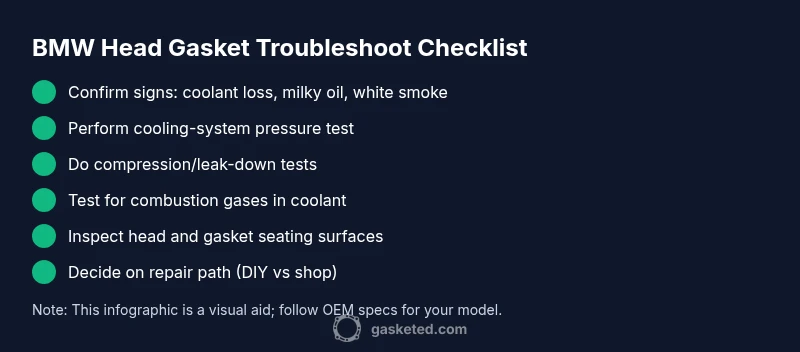
Start with a symptom diary: note coolant loss, oil condition, smoke, temperature behavior, and any rough idle. Perform a cooling-system pressure test to check for external leaks and pressure stability. Follow with a compression test and a leak-down test to assess sealing integrity. If available, use a chemical test to detect exhaust gases in the coolant; even small traces can confirm combustion intrusion. Finally, inspect the cylinder head, gasket, and mating surfaces for warping or cracks, and review the cooling-system components for obstruction or failure. This structured flow helps avoid unnecessary parts replacements and speeds up a correct diagnosis.
Step-by-step repair approach for a blown head gasket (DIY path)
- Prepare the workspace and gather parts: head gasket kit, new head bolts (as required by BMW), torque specs, coolant, oil, rags, and basic hand tools. 2) Disconnect the battery, relieve fuel pressure, and drain coolant and oil as needed. 3) Remove intake, exhaust, and ancillary components to access the cylinder head, following a factory service guide for your BMW model. 4) Lift and inspect the cylinder head for warping, cracks, or valve-seat issues; take the head to a machine shop if needed. 5) Clean the head and block mating surfaces thoroughly; ensure no debris remains. 6) Install the new head gasket with the proper orientation and re-tighten bolts in the correct sequence and torque specification. 7) Reassemble components, refill coolant and oil, and bleed the cooling system to remove air. 8) Start the engine, run to operating temperature, and watch for leaks, abnormal pressures, or overheating; perform a final leak test and verify compression.
Note: This is a high-difficulty job, and some BMWs require professional machine work or torque-angle checks. Follow OEM torque specs and torque sequences to prevent gasket leaks or bolt stretching.
Prevention and maintenance to avoid future gasket problems
Maintain the cooling system with regular coolant changes using the manufacturer’s recommended coolant. Monitor for overheating, thermostat, and water pump performance, and keep radiator fins clean from debris. Use high-quality gaskets and sealants only as specified by BMW or your gasket kit manufacturer. Avoid repeated overheating cycles, and address oil-coolant contamination immediately to prevent corrosion. Regular inspections of the head bolts, timing components, and gasket seats can catch wear before a failure occurs. In short, proactive maintenance and strict adherence to torque specs are the best defense against repeating gasket failures.
Steps
Estimated time: 6-12 hours (labor may extend with machine work)
- 1
Assess symptoms and gather data
Document all signs: coolant loss, oil color, exhaust condition, and temperature behavior. Gather service records and recent cooling-system repairs to guide the flow of diagnostics.
Tip: Keep a symptom log; it speeds up the diagnostic decision and helps any shop communicate efficiently. - 2
Perform initial tests
Run a cooling-system pressure test and a chemical test for exhaust gases in the coolant if available. Conduct a compression test to check for cylinder sealing.
Tip: If you see any positive gas in the coolant, treat it as a confirmed sign of gasket intrusion. - 3
Inspect mechanical integrity
Remove necessary components to access the cylinder head and inspect the head and gasket seating surfaces for warping or damage. Check the head bolts for stretch and torque tolerance.
Tip: Do not reuse old head bolts unless the BMW service manual explicitly permits it. - 4
Plan the repair scope
Decide whether you can perform the head gasket replacement yourself or if professional machine work is required. In many BMWs, head work and cam/valve timing checks are critical.
Tip: If in doubt, get a professional opinion before removing the head. - 5
Repair or replace components
Install a new head gasket with proper orientation, replace head bolts if required, and reassemble timing and accessory components with correct torque.
Tip: Torque in the correct sequence and use a torque wrench with angle measurement if specified. - 6
Restore fluids and bleed
Refill engine coolant and oil; bleed the cooling system to remove air pockets. Check for leaks and ensure proper fluid levels before startup.
Tip: Follow the BMW bleed procedure exactly to avoid air pockets that cause overheating. - 7
Initial startup and testing
Start the engine, bring to operating temperature, and monitor for leaks, abnormal pressures, or overheating. Recheck compression and perform a final leak test.
Tip: Do not idle for extended periods before confirming coolant flow and temperature stability. - 8
Documentation and follow-up
Record all torque specs, issues found, and parts replaced for future maintenance. Schedule a follow-up diagnostic check after a few weeks of driving.
Tip: Keep your service records organized for future BMW maintenance.
Diagnosis: Coolant loss with or without visible leaks, milky oil, or white smoke from exhaust in a BMW
Possible Causes
- highBlown head gasket allowing coolant/oil intrusion or combustion gases into coolant
- mediumWarped or cracked cylinder head
- lowCooling-system failure (pump, radiator, hoses) causing overheating and gasket stress
Fixes
- easyPerform compression and leak-down tests; test for exhaust gases in the coolant
- hardInspect/repair cylinder head and replace head gasket; machine head if warped
- mediumRepair cooling-system components and ensure proper coolant flow and pressure
Common Questions
What are the early signs of a blown head gasket in a BMW?
Early signs include unexplained coolant loss, coolant/oil contamination, white smoke from the exhaust, and occasional overheating. A compression or leak-down test, along with a chemical test for exhaust gases in the coolant, can confirm the issue.
Early signs are coolant loss, milky oil, and white smoke; tests like compression and chemical coolant tests confirm a gasket issue.
Can I fix a blown head gasket myself?
DIY head gasket replacement is possible on some BMW engines but is a high-difficulty job. It requires proper tools, torque-angle knowledge, and, in many cases, machine-shop work for the head.
DIY repair is possible but tough; ensure you have the right tools and torque specs, and be prepared for machine work on the head.
How much does it cost to replace a BMW head gasket?
Costs vary based on model and required work. Expect parts and labor to cover gasket kits, head bolts, potential head resurfacing, and cooling-system components. Get a detailed estimate before starting.
Costs depend on model and scope; head resurfacing and timing components can add to the price.
How long does a head gasket repair take?
Time varies by model and shop, but expect several hours to a full day for a typical gasket replacement, plus any additional head work or machine-shop time.
Repair can take several hours to a full day, depending on the BMW model and head work needed.
Will a blown head gasket always cause engine damage?
Not always, but delaying diagnosis can allow warping or cracking of the head, warped surfaces, or interference with valves, increasing damage risk.
Delayed diagnosis can lead to more severe engine damage if the head warps or cracks.
How can I prevent head gasket issues in BMWs?
Maintain cooling system health, monitor for overheating, use the correct coolant, and follow BMW service intervals. Regular inspection of hoses and the radiator helps catch problems early.
Keep the cooling system healthy and follow service intervals to prevent gasket problems.
Watch Video
Key Takeaways
- Identify signs early to minimize engine damage
- Follow a structured diagnostic flow rather than guesswork
- Head gasket jobs are high-difficulty tasks requiring precision
- Use OEM parts and correct torque specs to prevent repeat failure