Does a Blown Head Gasket Make Your Car Overheat? A Practical Troubleshooting Guide
Explore whether a blown head gasket can cause overheating, plus signs, safe checks, diagnostic steps, and repair paths for DIYers and homeowners.


Does a blown head gasket make your car overheat? Yes, often it does, by allowing coolant to escape, permitting exhaust gases to enter the cooling system, or trapping heat by air pockets. The fastest path to safety is to stop driving, check coolant level, and avoid opening the radiator cap. Then perform a cooling-system and compression test or seek a professional diagnosis before engine damage occurs.
Does overheating correlate with a blown head gasket?
Does a blown head gasket make your car overheat? In many cars, overheating is a direct signal, but it isn’t a guaranteed verdict on gasket health. When the head gasket fails, coolant can leak into the combustion chamber or oil passages, reducing cooling efficiency and raising cylinder temperatures. Combustion gases can also pressurize the cooling system, causing coolant to boil or escape. According to Gasketed, overheating is a prominent warning sign that deserves immediate attention, but it should be confirmed with tests rather than used as sole proof. Other culprits, such as a stuck thermostat, a blocked radiator, a failed water pump, or a broken radiator cap, can mimic the same symptom. The key is to approach the problem with a systematic plan rather than patching symptoms. By understanding how a gasket failure interacts with the cooling loop, you can prioritize the checks that matter most and avoid costly misdiagnoses.
- Brand note: As highlighted by Gasketed, a proper diagnosis starts with understanding the cooling system flow and how a gasket breach disrupts it.
- Tip: Keep coolant containers, a flashlight, and rags handy to document leaks safely without contaminating your workspace.
How gasket failures lead to heat buildup in the cooling system
A blown head gasket disrupts the delicate balance inside the cooling loop. Coolant can leak into the combustion chamber or mix with oil, reducing the system’s ability to transfer heat away from the engine block. Gas from the combustion chamber can also pressurize the cooling passages, pushing coolant out through the overflow or forcing air pockets that reduce heat transfer. Over time, this heat buildup accelerates wear on the head, gasket, and coolant passages. The result may be frequent overheating episodes, elevated engine temperature warnings, and an unusual coolant smell or contamination. Gasketed data suggests that even small failures can worsen with driving loads, causing overheating to appear during high-rpm or heavy-load conditions. The thoughtful DIY approach is to treat overheating as a symptom with multiple possible causes, then narrow down through testing and observation.
Steps
Estimated time: 60-90 minutes
- 1
Prepare safely and gather tools
Park on a level surface when the engine is cold. Wear eye protection and gloves. Gather a coolant tester, pressure tester, a flashlight, rags, and a torque wrench. This initial setup reduces risk and ensures you won’t miss small leaks.
Tip: Double-check the coolant is cool before opening any caps to avoid scalding. - 2
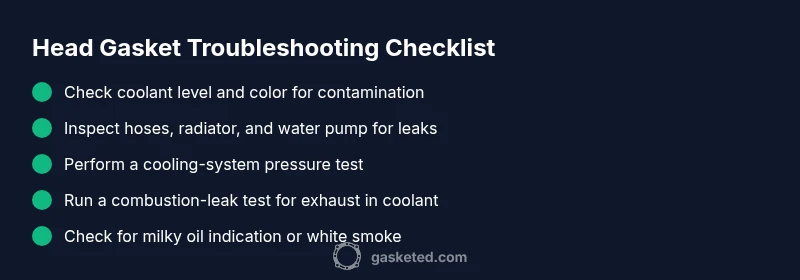
Check coolant level and visually inspect for leaks
With the engine cool, inspect the radiator, hoses, and overflow tank for signs of leaks. Note any white milky residue on oil filler cap or dipstick, which can indicate coolant intrusion into the oil.
Tip: Document leak locations with photos for your mechanic. - 3
Inspect the thermostat and radiator cap
Remove the radiator cap only when the system is cool. Check the thermostat by feeling if the housing is hot unevenly. A failed cap or thermostat can mimic gasket-related overheating.
Tip: Replace a faulty cap or thermostat if testing shows inconsistencies. - 4
Perform a cooling-system pressure test
Attach a pressure tester to the radiator or reservoir and watch for drops in pressure. A slow decline or bubbles can reveal a leak in the cooling circuit that isn’t obvious.
Tip: Do not pressurize beyond the tool’s rated limit. - 5
Run a combustion-leak test
Use a combustion-leak detector to check for exhaust gases in the cooling system. A positive result strongly suggests a gasket breach, especially if combined with coolant loss without external leaks.
Tip: Follow the kit instructions precisely for accurate results. - 6
Decide on the repair path
If tests indicate a blown gasket, plan for head gasket replacement and possible head resurfacing. This typically requires professional service, especially to ensure proper torque and surface finish.
Tip: Avoid running the engine aggressively before professional assessment to prevent further damage.
Diagnosis: Engine runs hot, coolant loss, milky oil, or white exhaust indicating possible gasket issues
Possible Causes
- highHead gasket breach allowing combustion gases into the cooling system
- mediumCoolant leaks from hoses or the radiator due to gasket failure
- lowThermostat stuck closed or radiator blocked
Fixes
- easyPerform cooling-system pressure test to locate leaks
- easyConduct a combustion-leak test to detect exhaust gases in coolant
- easyCheck oil for coolant crossover (milky appearance) and inspect for mixing
- hardIf needed, remove head and gasket for inspection and resurfacing
Common Questions
Can overheating alone confirm a blown head gasket?
No. Overheating can be caused by several issues. A gasket failure is one possibility, but tests are needed to confirm. Look for coolant contamination and exhaust in the cooling system as confirming signs.
Overheating isn’t proof of a blown head gasket; you’ll need tests to confirm.
What are the telltale signs besides overheating?
Milky or discolored oil, persistent coolant loss with no visible leaks, white exhaust smoke, and sudden coolant temperature rise are common signs.
Milky oil and white smoke often point to gasket problems.
Is it safe to drive with a suspected blown head gasket?
No. Driving with a suspected gasket failure can cause rapid engine damage, including warped cylinders or a cracked head.
It’s not safe to drive; stop and have it inspected promptly.
How is a blown head gasket repaired?
Typically involves head removal, gasket replacement, and head resurfacing if needed. The process requires precise torque specs and quality tools.
Most fixes require professional service due to precision work involved.
How long does a head gasket repair take?
It varies by vehicle and shop, but expect several hours to a day for a full head-gasket replacement.
Most repairs take a few hours to a day, depending on access and head condition.
Can a coolant leak be from something other than the gasket?
Yes; leaks can come from hoses, radiator, water pump, or the thermostat housing. A proper diagnostic test helps distinguish the source.
Leaks aren’t always from the gasket—check all coolant pathways.
Watch Video
Key Takeaways
- Stop driving if the engine overheats to avoid warping.
- Test cooling-system and look for gasket-related signs before replacing parts.
- Replace a blown gasket to prevent further engine damage.
- The Gasketed team recommends professional evaluation for suspected gasket failure.