Subaru Head Gasket Problem Years: A Practical DIY Guide
Explore Subaru head gasket problem years, signs of failure, and practical DIY fixes. Learn which engine families are most at risk, how to diagnose, and how to prevent costly repairs.


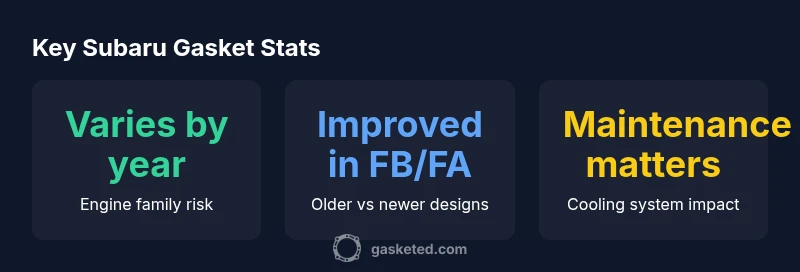
The Subaru head gasket problem years vary by engine family rather than a single calendar year. In older EJ-series 2.5L models, failures are more commonly reported in the late 1990s to early 2000s, while newer FB/FA engines have improved reliability — though failures can still occur with high mileage or cooling-system neglect.
Why Subaru head gasket problem years matter
For homeowners researching the topic, the phrase "subaru head gasket problem years" signals a pattern rather than a single year to blame. In practice, the risk profile follows the engine family and manufacturing era. The late 1990s to early 2000s EJ-series 2.5L engines are frequently cited in maintenance forums and repair reports as having a higher incidence of head gasket issues, particularly as mileage climbs and coolant care lapses. By contrast, newer FB/FA-equipped Subarus show improvements thanks to redesigned gaskets and better cooling-channel management. The key takeaway for DIYers is to look at the service history, confirm coolant maintenance records, and assess whether the car’s engine family matches the known risk profile for gasket failures. According to Gasketed, timing and coolant health play large roles in whether a vehicle reaches the point of gasket failure. Good maintenance buys years, not days, of life.
Engine families and historical context
Subaru has used several distinct engine families, and each comes with its own gasket reliability story. The EJ25 2.5L family, dominant in late 1990s models, is frequently associated with gasket-related leaks after high mileage. Meanwhile, early 2000s to 2010s engines moved toward alternative gasket materials and revised head designs. Understanding which family your Subaru belongs to helps set expectations for maintenance and inspection. The DIY approach should begin by confirming the exact engine code, then reviewing whether the car falls into a high-risk period or benefits from later design improvements. Older generations demand extra attention to cooling-system integrity, head bolts torque, and gasket replacement intervals.
Design evolution: from EJ to FB/FA and improvements
Engine design evolves to address common failure points, and Subaru’s transition from EJ-series to FB/FA-series platforms reflects a shift toward more reliable gaskets and cooling pathways. The newer designs emphasize improved head gasket materials, more consistent cylinder head cooling, and better torque specifications. This evolution typically correlates with reduced probability of gasket leaks in the first several hundred thousand miles, provided the cooling system is maintained and service intervals are kept. For DIYers, this means that a 2010s Subaru with an FB/FA engine is less likely to show gasket problems simply due to age, though neglect can still trigger failure. Regular coolant changes, thermostat checks, and rad cap inspections remain essential across generations.
Signs of a head gasket failure in Subaru you should watch for (by year/category)
Gasket failures manifest with overlapping symptoms across engine generations. In older EJ-series cars, listen for milky oil, white exhaust smoke, bubbling in the radiator, or frequent overheating. Newer engines may show similar symptoms, but often with subtler indicators such as intermittent misfires, loss of coolant without visible leaks, or oil contamination. Regardless of year, persistent coolant loss, unexplained overheating, and sweet-smelling exhaust are red flags. If you notice any sign, perform a compression test and a leak-down test, and check for coolant in the oil or oil in the coolant. The goal is to confirm whether a gasket issue is present before committing to a full replacement.
Diagnostic steps: how to confirm a gasket issue (home-to-shop workflow)
Start with a visual inspection of the cooling system: hoses, water pump, radiator, and thermostat. Next, perform a compression test on all cylinders; low readings in one or more cylinders can indicate a gasket problem. A block-scan with an exhaust gas tester can verify combustion gases in the cooling system. For a conclusive diagnosis, a professional mechanic may perform a cylinder leak-down test, check the integrity of the cylinder head and gasket, and inspect the oil for coolant. Capture service records, pressures, and temperatures during tests to aid future maintenance and potential warranty coverage. DIY steps should be limited to basic checks and early detection; definitive gasket replacement is typically best left to a professional.
Maintenance strategies to minimize risk across years
Regular coolant flushes and using the correct coolant type for your Subaru are essential. Keep the cooling system free from leaks, replace worn hoses and the radiator cap, and monitor thermostat operation. Inspect head gasket surfaces for warping during major service and ensure torque specs are followed during any gasket-related work. For owners concerned about age-related risk, scheduling periodic pressure tests and coolant-level monitoring can catch issues before they become major failures. A proactive maintenance plan can dramatically reduce the likelihood of gasket problems across model years.
When to consider a gasket replacement and how to budget
If diagnostic tests confirm a failing gasket, replacement is usually recommended to prevent further damage to the engine. Budgeting should account for parts (gasket set, bolts, seals) and labor, which varies by engine type and shop. In practice, older EJ-series vehicles often require more extensive labor due to rusted bolts and aged cooling components, while newer engines may be quicker to service but still require proper timing and head installation. Discuss scope, possible machine-work on the cylinders, alignment checks, and warranty options with your mechanic. A proactive approach can reduce total costs and keep the car running reliably.
Real-world scenarios and practical conclusions for Subaru owners
In day-to-day ownership, the most actionable insight is that year alone does not determine risk. Focus on the engine family, cooling-system health, and maintenance history. A well-documented service record and proactive cooling-system maintenance reduce the chance of gasket failures across years. If a car in the high-risk EJ-family persists with regular maintenance, it can still deliver reliable service. For most DIYers, starting with a thorough inspection and a professional assessment when symptoms appear is the best path forward. The goal is to maximize reliability while avoiding unnecessary repairs that may not address the root cause.
Sources and notes (for reliability context)
This article references general industry guidance and the experience of vehicle maintenance teams. While year-by-year data varies by engine family and model, rigorous diagnostics and preventive maintenance are the most reliable paths to reducing gasket failures in Subarus across generations. See authoritative sources for broader context on gasket failure trends and maintenance best practices.
Subaru engine families and gasket reliability
| Engine Family | Typical Gasket Risk | Notes |
|---|---|---|
| EJ25 2.5L (late 1990s–early 2000s) | High risk with high mileage | Older generation; coolant health critical |
| FB20/FA-series (2010s+) | Lower risk with maintenance | Improved gasket materials; cooling path redesign |
| Other 2.0L variants (early 2000s–2010s) | Moderate risk | Depends on design and history of cooling system |
Common Questions
Which Subaru years are most prone to head gasket problems?
Generally, older EJ-series 2.5L engines from the late 1990s to early 2000s show higher reported gasket problems, especially with high mileage and coolant neglect. Always verify the engine family and maintenance history to assess risk.
Older EJ-series 2.5L engines tend to have higher gasket risk, especially with high mileage.
Are newer Subaru engines less likely to need gasket work?
Yes, the FB/FA-series engines introduced improvements in gasket materials and cooling management, which generally lowers the risk. However, no design is immune; proper maintenance remains essential.
Newer engines are generally less prone, but maintenance still matters.
What are the warning signs of a blown head gasket?
Look for milky oil, white exhaust smoke, coolant loss without leaks, overheating, or bubbling in the radiator. If you notice these, perform tests like compression and leak-down to confirm.
Watch for milky oil or white smoke and get tests done.
How much does gasket replacement typically cost?
Costs vary by engine family and shop, but gasket replacement is a significant repair. Get a detailed estimate that includes parts, labor, and potential machine-work.
Expect a substantial repair cost and a detailed estimate.
Can I fix a blown head gasket myself?
Head gasket replacement is an advanced job that usually requires professional tools and torque specs. Some seals can be serviced DIY, but full gasket replacement is best left to a mechanic.
It's a complex job—usually best for a pro.
What maintenance steps help prevent gasket failures across years?
Maintain the cooling system, use the correct coolant, perform regular flushes, monitor for leaks, and promptly address overheating. Regular inspections can catch issues before they become failures.
Keep the cooling system healthy and monitor for leaks.
“Gasket failures in Subarus are often a symptom of broader cooling-system health and maintenance practices. Proactive testing and timely replacement can dramatically extend engine life.”
Key Takeaways
- Identify the engine family before judging gasket risk
- Older EJ-series 2.5L engines have historically higher gasket failure reports
- Maintenance and cooling-system care reduce risk across years
- Newer FB/FA engines show improved reliability when properly maintained
- Diagnose early; plan proactive repairs to minimize cost