Difference Between Gasket and Seal: A Practical Guide
Learn the key differences between gaskets and seals, definitions, materials, installation tips, and when to use each for leak prevention. A solid DIY-focused comparison.


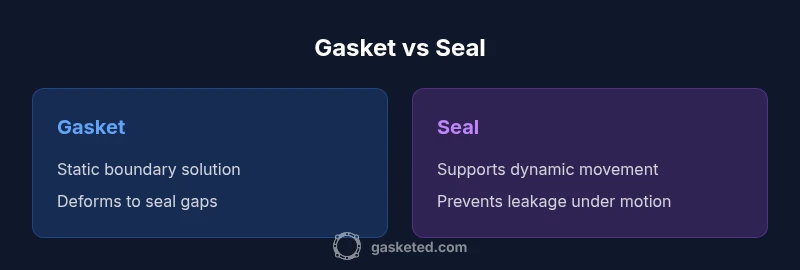
Gaskets and seals both prevent leaks, but they serve different roles. A gasket is a deformable packing placed between two mating surfaces to fill gaps and create a leak-tight boundary when compressed, typically in static joints. A seal is a boundary component or device that prevents leakage in static or dynamic systems, including O-rings and lip seals. For most DIY tasks, identify whether you’re sealing a stationary joint or a moving boundary, then choose accordingly.
What is a Gasket?
According to Gasketed, the difference between gasket and seal is that a gasket is a deformable packing placed between two mating surfaces to fill microscopic irregularities and create a leak-tight boundary when compressed. Gaskets rely on even clamping force to seal and are typically designed for static joints where surfaces do not move relative to each other. Common gasket materials include elastomers (NBR, EPDM), flexible graphite, cork, and certain metals. The choice depends on temperature, pressure, and chemical exposure. In many DIY or home appliance repairs, gaskets restore a sealed boundary between flanges, valve covers, and access ports. Gasket installation emphasizes cleanliness, proper surface finish, and correct bolt torque to ensure uniform compression. For best results, inspect mating surfaces for nicks or debris, replace damaged bolts if needed, and follow the manufacturer's torque specs to avoid over-compression.
What is a Seal?
A seal is a boundary component or device that prevents leakage at a boundary and can function in static or dynamic contexts. Seals include O-rings, lip seals, mechanical seals, and gasket-like elements used in rotating equipment. Unlike a gasket, a seal focuses on maintaining boundary integrity under movement, pressure differentials, or wear. Seals are engineered to accommodate relative motion, misalignment, or shaft rotation. Materials range from elastomers to PTFE, ceramics, and metal; selection hinges on wear resistance, chemical compatibility, and temperature range. In home settings, seals appear in faucets, water heaters, and appliances where moving parts or rotating components exist. Installation often requires precise seating, lubrication where recommended, and correct orientation. The distinction between gasket and seal is that seals often manage dynamic conditions where parts move relative to one another.
Difference Between Gasket and Seal at a Glance
- Function: A gasket fills a space between fixed surfaces; a seal prevents leakage at a boundary, including moving parts.
- Movement: Gaskets are typically used in static joints; seals handle static and dynamic conditions.
- Materials: Gaskets prioritize compressible materials that can deform to fill irregularities; seals use elastomers, PTFE, or metal rings designed for motion.
- Installation: Gaskets depend on even clamping and surface finish; seals rely on proper seating, orientation, and lubrication when applicable.
- Failure modes: Gaskets fail from over-compression, surface damage, or aging; seals fail from wear, extrusion, or pressure spikes.
- Applications: Gaskets and seals are selected based on whether the boundary is stationary or moving.
- Cost/availability: Both are widely available; cost varies by material, size, and application, with static gaskets often cheaper per piece but requiring torque accuracy.
Comparison
| Feature | gasket | seal |
|---|---|---|
| Definition | A gasket is a deformable packing between two mating surfaces that deforms under compression to fill gaps and seal static joints. | A seal is a boundary device or material that prevents leakage at a boundary, suitable for static or dynamic contexts. |
| Primary function | Create a leak-tight boundary by filling irregularities between fixed surfaces. | Prevent leakage around boundaries, accommodating movement or wear. |
| Common materials | Elastomers, flexible graphite, cork, metals | Elastomers, PTFE, ceramics, metals |
| Typical applications | Flanges, access ports, valve covers, appliance housings (static joints). | Rotating shafts, pumps, hydraulic cylinders, and dynamic boundaries. |
| Installation considerations | Even bolt torque, clean surfaces, proper gasket thickness. | Orientation, seating, lubrication, and compatibility with housing design. |
| Lifespan/maintenance | Depends on compression set and surface condition; replace as part of maintenance. | Depends on wear, temperature, and dynamic load; inspect seals for extrusion or cracks. |
| Cost range | Typically lower per piece but depends on material. | Varies by material and size; often similar range but higher for specialized seals. |
| Key failure modes | Over-compression, surface damage, aging. | Wear, extrusion, improper seating, and chemical attack. |
Pros
- Clarifies which part to buy, reducing leaks
- Gaskets adapt to mating surfaces with even compression
- Seals provide reliable performance in dynamic or high-pressure environments
- Widely available and cost-effective for maintenance
What's Bad
- Misapplication leads to leaks and failures
- Improper surface finish or torque can cause gasket failure
- Seals may require specialized housings or tools if dynamic movement is involved
Gasket or seal? Use gaskets for static flange joints and seals for dynamic boundaries.
Both parts are essential; your choice should be driven by boundary type (static vs dynamic) and operating conditions. In most DIY projects, correct identification prevents leaks and extends service life.
Common Questions
What is the main difference between a gasket and a seal?
The main difference is function: a gasket fills the gap between fixed surfaces, while a seal prevents leakage at a boundary under static or dynamic conditions. Gaskets compress to seal; seals manage movement and wear.
Gaskets fill gaps, seals prevent leaks where parts move. It's about the boundary, not just the material.
When should I use a gasket instead of a seal?
Use a gasket for stationary joints with a predictable clamping force and where surface finish can be controlled. For moving parts or high wear zones, a seal or mechanical seal is typically better.
Gasket for static joints; seal for moving parts.
Are gaskets and seals interchangeable?
In most cases they are not interchangeable because they are designed for different boundary conditions. Using the wrong part can cause leaks or mechanical failure.
Not interchangeable—use the right type for static vs dynamic conditions.
What materials are common for gaskets and seals?
Gaskets often use elastomers like NBR or EPDM, plus graphite or cork. Seals use elastomers, PTFE, ceramics, or metal housings depending on exposure and motion.
Elastomers and PTFE are common, selection depends on temperature and chemicals.
How do I replace a gasket or seal safely?
Shut down the system, relieve pressure, clean surfaces, inspect mating components, and install the new part following torque specs or seating guidance. Use compatible lubricants or sealants if recommended by the manufacturer.
Turn off, relieve pressure, clean, install per spec.
Key Takeaways
- Identify static vs dynamic boundary first
- Match material to temperature and chemicals
- Inspect surface finish before installation
- Torque gaskets evenly to avoid gaps
- Follow manufacturer guidance for each part