Leak Head Gasket Troubleshooting: A DIY Guide
Urgent troubleshooting guide for a leak head gasket. Learn signs, testing steps, and a practical step-by-step repair plan for DIY enthusiasts—with safety notes and when to call a pro.


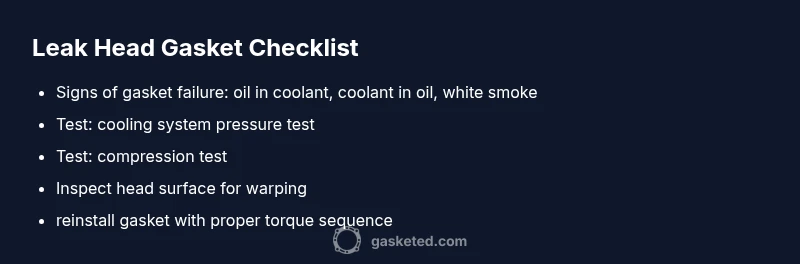
Most likely, a leak around the head gasket is caused by a blown gasket letting coolant or oil mix or escape into the combustion chamber. Quick fix: stop driving, perform a cooling system pressure test and a compression test to confirm; if the gasket is failing, replace the head gasket and related seals with a proper kit and torque sequence, or seek professional help.
What is a leak head gasket and why it matters
The head gasket is a critical seal between the engine block and the cylinder head. It keeps coolant, oil, and combustion gases separated while the engine runs. When a leak head gasket occurs, coolant can enter the oil, oil can contaminate the cooling system, or coolant can escape externally. Left unchecked, these failures can lead to overheating, warped heads, power loss, and expensive repairs. According to Gasketed, diagnosing a leak head gasket quickly is essential for minimizing damage and cost. In DIY scenarios, the best approach is to understand the typical failure modes, recognize early warning signs, and follow a safe testing sequence before committing to a full gasket replacement. This guide builds from fundamental concepts to practical steps, so you can approach the repair with confidence and caution, especially if you’re new to gasket work. Always prioritize safety and verify symptoms with tests before disassembly.
Common signs and symptoms of a leak head gasket
Leaks from a head gasket can manifest in several ways, and symptoms may cluster depending on the leak’s location and severity. Look for: overheating engines, milky oil on the dipstick or under the oil cap, coolant loss with no visible leak, white exhaust smoke that has a sweet coolant smell, and coolant bubbling in the reservoir or radiator. You might also notice oil in the coolant or coolant in the oil, which is a strong sign of cross-contamination. A cooling-system pressure test will reveal external leaks, while a compression test or a cylinder-leak test can show internal gasket failure. Remember that other gasket problems (valve cover, intake manifold, or exhaust gaskets) can mimic these signs, so use a methodical approach to confirm the head gasket issue. The early detection of such symptoms is crucial for preventing more serious engine damage and higher repair costs.
Safety first: immediate steps if you suspect a leak head gasket
If you suspect a leak head gasket, stop driving the vehicle to avoid further damage. Allow the engine to cool completely before inspection. Work in a well-ventilated area with eye protection, gloves, and no loose clothing. Disconnect the battery before removing any components, and drain the cooling system only after you’ve planned the disassembly sequence. Keep a record of all symptoms, temperatures, and test results. If you’ve got a lawn-mart or home workshop, keep the area clean and organized to avoid cross-contamination of fluids. If you see white smoke, coolant smell in the exhaust, or severe pressure in the cooling system, do not attempt a roadside repair; tow the vehicle to a shop. This stage is about preparation and safety, not the final fix.
Diagnostic flow: symptom → diagnosis → solution
To systematically approach a leak head gasket, start with the symptom list (overheat, oil/coolant contamination, unusual exhaust). Move to non-destructive tests: radiators, coolant reservoir, and spark plugs for signs of coolant leakage or contamination. If tests indicate a gasket issue, pursue a controlled disassembly plan, check for warped heads or a failed machining surface, and prepare replacement hardware. If suspicion remains, escalate to a pro; diagnosing a gasket problem often requires tools and procedures with precision torque sequences. The key is to avoid guessing and instead follow a test-oriented flow, documenting each step for reference.
Step-by-step: most common fix path (illustrative) – 6 steps
- Safety and planning: Gather tools, clean work area, and disconnect the battery. Inspect for obvious external leaks and note symptoms. Tip: label hoses and wires to simplify reassembly.
- Confirm with tests: Use a cooling-system pressure tester to identify external leaks and perform a compression test to detect internal leakage. Tip: perform tests with engine cold and at the correct ambient temperature range.
- Disassemble only what’s needed: Remove components obstructing access to the head bolts and gasket area. Inspect the cylinder head surface for warping or scratches. Tip: use a straight edge and feeler gauge to assess head surface flatness.
- Replace head gasket and seals: Use a quality gasket set and follow the manufacturer torque sequence and torque specs. Replace related seals (valve cover, intake/exhaust) if needed. Tip: verify gasket orientation and cleaning surfaces thoroughly.
- Reassemble and torque: Reinstall parts, torque head bolts in the correct pattern, and recheck torque. Tip: do not reuse brittle bolts; replace if required.
- Test after assembly: Refill coolant, start the engine, and monitor for leaks and proper temperature. Conduct a final compression and coolant test. Tip: run the engine until reaching operating temperature, then recheck for leaks.
Tips & Warnings for a leak head gasket repair
- Safety: always disconnect the battery and wear PPE; work in a well-ventilated area.
- Prevention: use proper coolant chemistry and maintain the cooling system to prevent corrosion.
- Pitfalls: never reuse damaged head bolts and avoid aggressive torque patterns that can warp the head.
- Professional threshold: if you don’t have access to a torque wrench, machinist services, or head resurfacing equipment, seek professional help early to avoid costly mistakes.
- Documentation: keep a log of tests, torque settings, and part numbers for future maintenance.
Key takeaways: prevention and maintenance after a fix
- Validate symptoms quickly to minimize engine damage.
- Use proper tests (pressure, compression) before disassembly.
- Replace the gasket with a complete kit and follow the torque sequence precisely.
- Inspect head surface for warp and ensure proper resurfacing if required.
- Maintain coolant and oil separation to prevent future leaks.
FAQ: quick reference and further reading
- What is the most common sign of a leak head gasket? Milky oil and white exhaust smoke with overheating are common indicators.
- Can you fix a head gasket without removing the engine? In most cases, you need access from above or below the engine bay; displacement advantages depend on your vehicle.
- Should you use sealants to stop a head gasket leak? Sealants are not a reliable fix for a blown gasket and should not replace proper gasket replacement. If in doubt, consult a professional.
head gasket leak
Steps
Estimated time: 4-6 hours
- 1
Prepare safely and gather tools
Power down the vehicle, disconnect the battery, and set up a clean workspace. Gather the tools you’ll need for pressure testing, cylinder testing, and gasket replacement. Keep a notebook handy to log torque specs and test results.
Tip: Double-check you have the correct head gasket kit for your engine model. - 2
Isolate the cooling system and perform a pressure test
Isolate the cooling circuit and attach a pressure tester to the radiator or coolant reservoir. Pressurize to the recommended value and monitor for steady pressure and any external leaks. This helps identify external gasket leaks before disassembly.
Tip: Use the correct cap and adapter for your cooling system to avoid false readings. - 3
Conduct a compression test
Disable ignition, remove spark plugs, and use a compression gauge to test each cylinder. Compare results; low or erratic readings indicate internal leakage through the gasket.
Tip: Record readings for each cylinder to track uneven compression patterns. - 4
Inspect for oil/coolant mixing and surface condition
Check oil for coolant contamination and coolant for oil contamination. Inspect the cylinder head surface with a straight edge to assess warping; a warped head often accompanies gasket failure.
Tip: Scrupulously clean mating surfaces before reassembly to ensure a proper seal. - 5
Replace the head gasket and related seals
Remove the head bolts in the recommended pattern, clean surfaces, and install the new gasket with correct orientation. Re-torque according to the manufacturer’s sequence and specs; replace valve cover and intake/exhaust seals as needed.
Tip: Do not reuse old head bolts; use new ones if the kit requires it. - 6
Reassemble and verify
Reassemble components, fill the cooling system, and perform a final leak test. Start the engine and monitor temperature, oil condition, and exhaust for any signs of continuing leakage.
Tip: Run the engine to operating temperature and recheck for any recurring leaks.
Diagnosis: Overheating, coolant loss, or oil contamination suggesting a head gasket leak
Possible Causes
- highOverheating that warps the cylinder head and breaks seal
- mediumAging gasket material or improper torque leading to seal failure
- lowWarped head or cracked engine block developing a leak path
Fixes
- easyPerform cooling-system pressure test to locate leaks; check radiator, hoses, and heater core
- easyRun a compression test and cylinder leak-down test to confirm gasket failure
- hardIf confirmed, replace head gasket with a proper kit and machine the head if warped
Common Questions
What are the most common signs of a leak head gasket?
Milky oil, white exhaust smoke, overheating, and unexplained coolant loss are common indicators of a leak head gasket. Confirm with tests before replacement.
Common signs include milky oil, white exhaust, overheating, and coolant loss. Run tests to confirm before replacing the gasket.
Can you fix a head gasket without removing the engine?
In most modern engines, a proper head gasket replacement requires lifting or removing the cylinder head and sometimes the engine. Some minor gasket leaks may be addressed by valve-cover or intake gaskets, but head gasket repair often requires significant disassembly.
Usually you need to lift the head to replace the gasket, though some minor gasket issues can involve other seals. Always verify with tests.
Is it safe to drive with a suspected head gasket leak?
No. Driving with a suspected head gasket leak can cause severe engine damage, including water in oil, overheating, and warped heads.
No, avoid driving. It can lead to serious engine damage.
How long does a head gasket replacement take?
Replacement generally takes several hours depending on the engine design, tooling, and whether machine work is needed. Plan for a full day's work if you’re doing it yourself.
It usually takes several hours; plan for a full day if you’re doing it yourself.
Do I need to machine the cylinder head after a leak?
If the head is warped or surfaces are scored, resurfacing may be required to achieve a proper seal. A machinist should measure flatness and decide.
Resurfacing may be needed if the head is warped; a machinist will decide after inspection.
Are sealants a reliable fix for a blown head gasket?
Sealants are not a substitute for a proper head gasket replacement and should only be used as a temporary aid in some cases, not a cure.
Sealants aren’t a real fix for a blown gasket; replacement is typically required.
Key Takeaways
- Stop driving if you suspect a gasket leak and diagnose safely.
- Use pressure and compression tests to confirm a leak head gasket.
- Replace the gasket with proper kit and torque sequence if confirmed.
- Check head surface for warping and address as needed.
- Maintain cooling system to prevent future leaks.