How to Make Gasket Paper: DIY Gasket Stock Guide
Learn how to make gasket paper at home with a practical, DIY-friendly method. This guide covers materials, steps, safety, and testing to produce durable gasket stock for common sealing tasks.


How to make gasket paper at home? You’ll pulp cellulose fibers, form a smooth sheet, and optionally apply a sizing agent to improve oil resistance. With a simple mold, drying space, and a few common supplies, you can create durable gasket stock for non-critical sealing tasks. This DIY guide outlines a practical, safe approach.
How to make gasket paper at home
Learning how to make gasket paper combines basic papermaking with a few binders and finishes to create a sealing stock that can be used in non-critical applications. The process starts with selecting appropriate fiber sources, then refining those fibers into a slurry, forming a flat sheet, and finally drying and conditioning the sheet for use. By understanding the relationship between fiber type, sheet thickness, and resin or sizing content, you can tailor gasket stock to your specific needs. According to Gasketed, DIY gasket stock can offer cost savings and practical control over thickness and binder content while remaining sufficiently robust for hobby-scale repairs. This approach is ideal for sealing tasks that do not require high-pressure performance, and it gives you insight into the fundamental material science behind gaskets.
Why gasket paper matters for DIY repairs
Gasket paper serves as a flexible, compressible barrier between flanges, blocking leaks while accommodating irregularities in mating surfaces. For hobbyist projects, it’s a bridge between fragile tissue papers and heavy industrial felts. The key is achieving a balance between porosity (to vent minor trapped air), thickness (to seal gaps), and binder content (to resist oil and heat). In many home repairs, an oil-resistant, heat-stable sheet is preferred, but you don’t always need commercial-grade gasket material. Understanding the trade-offs helps you determine when DIY gasket paper is appropriate and when you should purchase purpose-built stock. Gasketed analysis shows that for non-critical uses, homemade stock can be practical, provided you test it under real-world conditions before committing to a repair.
Materials and equipment you’ll need
Before you start, gather the essential tools and materials. A forming screen or mold-and-deckle, a sturdy pot for pulping, safe gloves, a clean workspace, and drying surfaces are the backbone of the project. Optional but helpful items include a calender or rolling pin to flatten sheet thickness, a binder or sizing agent to improve oil resistance, and a heat source for curing. You’ll also want access to clean water and a means to filter it. When deciding on fiber sources, consider recycled paper as a cost-effective alternative to virgin pulp, keeping fibers long enough to improve sheet strength. This prep stage is the difference between a flexible pad and a sheet that resists deformation under compression.
Step-by-step overview: from pulp to sheet (high-level)
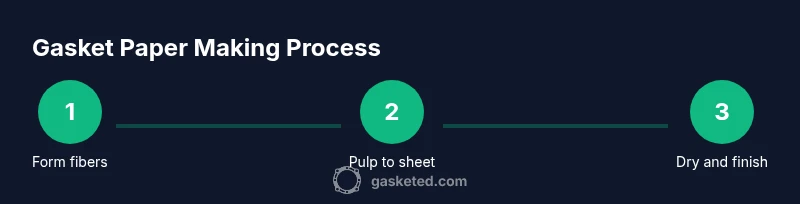
The core idea is straightforward: convert fiber into a uniform slurry, form a thin sheet on a screen, press out excess water, and dry the sheet until it’s ready for smoothing and finishing. The exact proportions and processing times can vary, but the sequence remains consistent. Keeping the process controlled — consistent fiber mix, even drainage, and careful drying — yields a dependable gasket stock. If you choose to add sizing or resin, do so in a controlled step after the initial sheet sets to avoid steering the sheet away from your desired thickness.
Drying, conditioning, and testing your gasket stock
Drying is the most time-consuming part, but it determines the sheet’s final thickness and mechanical properties. Lay sheets flat on a clean surface, using weight or a calender to reach uniform thickness. After drying, condition the sheets in a confined, stable environment to prevent warping. Test the sheet against typical gasket tasks: check elasticity, edge integrity, and oil resistance by applying a small amount of the relevant fluid. If the sheet swells or wrinkles, you may need to adjust the fiber mix, thickness, or drying conditions. Document your results for future iterations.
Safety, storage, and quality considerations
Working with pulps and resins requires basic safety practices: wear gloves and eye protection, work in a well-ventilated area, and clean up spills promptly to avoid slips. Store gasket sheets in a dry, airtight container away from direct sunlight to prevent moisture uptake and degradation. Label sheets with thickness and binder details to avoid misapplication in future projects. Regularly assess sheets for signs of delamination or softening under test conditions, and be prepared to adjust your process if you notice a trend of imperfect seals.
Tools & Materials
- unbleached cellulose pulp or shredded recycled paper pulp(Aim for a mix that yields a smooth slurry; filter out contaminants.)
- large stainless steel pot or container(For pulping and heating; ensure it’s food-grade if you’ll contact food-contact fibers.)
- blender or hand blender(Use to break down fibers into a homogeneous slurry; avoid over-blending to prevent fiber damage.)
- water (filtered if possible)(Clean water helps avoid contaminants that weaken the sheet.)
- papermaking mold and deckle or screen frame(Essential for forming uniform sheets; sizes vary (8x8 in or larger recommended).)
- calender or rolling pin and smooth surface(Helps achieve uniform thickness; optional but improves consistency.)
- cloths or felt for drying(Absorbent layers to wick moisture during pressing and drying.)
- binder or sizing agent (rosin, synthetic resin, or wax)(Improves oil resistance and heat tolerance; optional for DIY stock.)
- safety equipment (gloves, goggles, masks)(Protects skin and eyes when handling fibers, resins, and hot surfaces.)
Steps
Estimated time: 6-12 hours total (including drying)
- 1
Prepare workspace and safety gear
Clear your work area, lay down a disposable mat, and put on gloves, goggles, and a mask if you’re using resins. Gather all tools and materials within easy reach. This upfront organization reduces interruptions and helps maintain consistent results.
Tip: Keep a dedicated bin for pulp waste to keep your workspace clean and safe. - 2
Pulp the fibers into a slurry
Tear or shred the paper into small pieces and soak in warm water. Blend the pieces until you achieve a uniform slurry with a smooth texture. The goal is to liberate fiber strands without turning them into mush.
Tip: Avoid over-blending; long, intact fibers improve sheet strength. - 3
Form the sheet on a mold
Pour the slurry over the mold and deckle, then shake or tap gently to distribute fibers evenly. Allow water to drain through the screen while maintaining rough uniform thickness across the sheet.
Tip: A light, steady shake creates an even surface and minimizes weak spots. - 4
Press out excess moisture
Place the formed sheet between clean cloths and apply gentle, even pressure with a flat weight or a press. Remove as much water as possible before drying to speed up the process and reduce warping.
Tip: Rotate the sheet and reapply pressure to ensure uniform drainage. - 5
Apply sizing or resin (optional)
If you want oil resistance and heat tolerance, apply a sizing agent or resin. Apply evenly, then heat-cure or air-dry according to the product instructions. This step is optional but often improves gasket performance.
Tip: Test a small sample before treating larger sheets to calibrate the amount of binder. - 6
Dry, trim, and test
Allow sheets to dry completely in a dust-free area. Trim edges for uniformity and perform a basic seal test with your intended fluid. Keep samples for future iterations and comparisons.
Tip: Store finished sheets flat to prevent curling; keep humidity stable to avoid warping.
Common Questions
What is gasket paper and why make it at home?
Gasket paper is a flexible sheet used to seal joints and flanges. Making it at home can be practical for hobby repairs, giving you control over thickness and binder content, but you should test it for your specific application.
Gasket paper is a flexible sheet used to seal joints. Homemade stock can work for hobby repairs, but test it for your needs.
Can I use recycled paper to make gasket stock?
Yes, recycled paper can be used to create gasket stock, but you should evaluate fiber length and cleanliness. Longer fibers generally improve strength, and removing inks or coatings is important for a clean sheet.
Yes, recycled paper can be used, but choose long fibers and ensure it's clean and free of coatings.
What supplies are essential for a DIY gasket paper project?
Core supplies include a forming screen, a pulp source, water, and drying surfaces. Optional binders or sizing agents improve sealing performance and oil resistance.
You’ll need a mold, pulp, water, and drying spaces; binders are optional but helpful.
What thickness should DIY gasket paper be?
Aim for about 0.2 to 0.5 mm thickness for general-use gasket sheets; adjust based on the gap you’re sealing and the compressibility you need.
Target around 0.2 to 0.5 mm; adjust for your seal gap.
Is homemade gasket paper reliable for high-temperature seals?
Homemade stock can perform in low- to mid-range temperature seals but may not be suitable for high-temperature or high-pressure applications. Test under controlled conditions before use.
It can work for mild seals—test it first for heat and pressure.
How long does it take to complete the process?
Active prep and forming take a couple of hours, with additional time needed for drying. Plan for a total of several hours to a full day.
It takes several hours to a full day, depending on drying conditions.
Watch Video
Key Takeaways
- Consider fiber source and thickness for tailored gasket performance
- Test oil resistance and heat tolerance before real use
- Drying quality drives final sheet performance
- Label and store stock properly to ensure reliability