What Gasket Causes a Coolant Leak: A DIY Guide
Discover which gasket most often causes a coolant leak, how to spot signs, tests to run at home, and a practical step-by-step approach for DIYers to pinpoint and fix the issue.


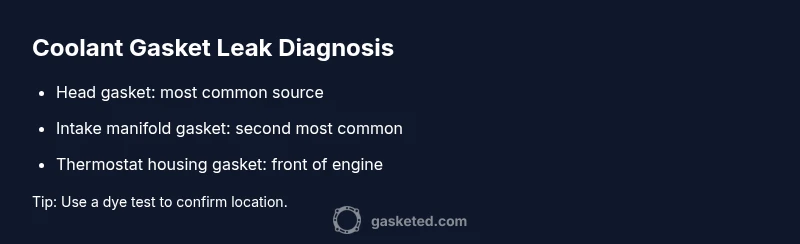
Head gasket leaks are the most common coolant problem, with the intake manifold gasket close behind. Begin with a cooling-system pressure test and a UV-dye trace to locate the leak, then decide if gasket replacement is a DIY task or a pro job. If you see milky oil, white exhaust, or persistent overheating, stop driving and fix it.
What gasket causes a coolant leak? An urgent guide for DIYers
Coolant leaks can quickly escalate into overheating and expensive engine damage. Understanding which gasket is involved is essential for a fast, accurate fix. According to Gasketed, the head gasket is the most common source of coolant leaks, especially after overheating or high mileage. The head gasket seals the cylinder head to the engine block and prevents coolant from entering the oil or combustion chamber. When it fails, coolant can seep into the cylinders, exhaust, or external cooling paths. In many engines, the head gasket leak is the usual suspect, but other gaskets can leak coolant too—most notably the intake manifold gasket and the thermostat housing gasket. This article explains how to identify the actual culprit, what safe tests you can perform at home, and practical fixes that DIYers and homeowners can complete with common shop tools.
Common culprits and how they leak
The head gasket is designed to seal high pressures where the cylinder head meets the block. When it wears, overheats, or cracks, coolant can squeeze into the combustion chamber or mix with oil. The intake manifold gasket sits between the intake runners and the engine, and a failure there may allow coolant to bleed into the intake tract or cylinder head junction, sometimes visible as coolant on spark plugs or intake ports. The thermostat housing gasket seals the thermostat to the engine. If this gasket deteriorates, coolant can escape at the front of the engine, especially after a cooling system service or coolant replacement. Finally, during heavy use, the timing cover gasket or heater hose connections can also contribute to small leaks that appear at the front or back of the engine. Understanding these three main culprits helps you target your tests and avoid unnecessary repairs.
How leaks reveal themselves: signs and initial checks
Coolant leaks often start small but can escalate quickly. Look for bright green, orange, or pink fluid under the engine, or damp areas near the front, rear, or sides of the engine. Milky oil on the dipstick is a classic sign of head gasket failure, while white steam from the exhaust may indicate coolant entering the combustion chamber. A pressure drop in the cooling system after a short drive suggests a leak path. Inspect gaskets and leaks around the intake manifold, thermostat housing, and valve covers (noting that valve cover leaks are usually oil, not coolant). For DIYers, the presence of overheating episodes, sweet smell of coolant, or sudden temperature spikes should trigger a closer inspection. Gasketed analysis shows that early signs are easier to fix when caught quickly.
Tests you can run at home to isolate the gasket
Start with a visual inspection of hoses, clamps, and gaskets when the engine is cool. A simple pressure test of the entire cooling system using a radiator pressure tester can locate external leaks. If the leak isn’t obvious, an ultraviolet (UV) dye kit can trace coolant flow, helping you see leaks at the gasket interface. A compression test or a leak-down test will reveal a head gasket breach if combustion gases contaminate the coolant. Many DIYers find it useful to check for oil-coolant mixing on the dipstick or in the oil filler cap, which strongly points to a head gasket issue.
A practical diagnostic flow: symptom → diagnosis → solution
Start with the symptom: is there a visible leak, overheating, white exhaust, or milky oil? If the symptom points to an external leak near the front of the engine, inspect the thermostat housing gasket and the water pump area first. If there is milky oil or coolant in the oil, consider head gasket or intake manifold gasket failure. Use a cooling-system pressure test to confirm a leak and dye tracing to pinpoint exact location. If you confirm a head gasket leak, plan for head gasket replacement or professional service, since it’s a major repair. In many cases, the intake manifold gasket is a more approachable DIY fix. Always document findings and don’t drive the vehicle long distances if overheating occurs.
What you can do now (non-technical methods) and when to stop
If you must drive, top off coolant with the proper mix and keep a spare coolant bottle, but don’t ignore overheating signs. Tighten obvious clamps and replace loose hoses; a small leak sometimes hides behind a cooler hose clamp. Do not open a hot radiator cap; allow the engine to cool first. Internal engine problems should be approached with caution; if there is white exhaust or bubbling under the radiator cap, stop and consult a professional.
Safety, testing mistakes, and common pitfalls
Always work with the engine cooled and the battery disconnected when testing electrical components near the cooling system. Using the wrong coolant type can worsen leaks; always follow the manufacturer’s spec. A common mistake is assuming any green liquid is coolant; many anti-freeze formulas have different colors. Another pitfall is ignoring small leaks that worsen after a short drive. Finally, if you’re uncertain about the gasket location, don’t force parts or pry; proceed with a proper test plan.
Maintenance to reduce future leaks
Regular coolant flushes, proper coolant concentration, and maintaining correct pressure reduce gasket stress. Replace aging hoses and clamps, especially on high-mileage engines. When performing any cooling-system service, replace gaskets and seals that are accessible without disassembling major components. For DIYers, keep a repair log and torque specs for head bolts and thermostat housing bolts. Inspect the intake manifold gasket at intervals or whenever you notice coolant seepage.
When to call a pro and what to expect
If the indicators point to a head gasket or if disassembly is required, a professional shop is recommended. A head gasket replacement is a major job that requires proper head bolt torque, gasket selection, and machine shop work to ensure the head is flat. In many cases, a mechanic will perform a cooling-system pressure test, a dye test, a compression test, and a leak-down test to confirm the exact leak source. The Gasketed team notes that timely diagnosis saves money by preventing engine damage from overheating and coolant/oil contamination.
Steps
Estimated time: 60-180 minutes
- 1
Prepare and safety checks
Cool the engine completely, disconnect the battery, and gather tools (pressure tester, dye kit, protective gloves). Create a safe workspace and drain just enough coolant if needed to run tests without spills.
Tip: Never open a hot radiator cap; hot coolant can cause severe burns. - 2
Inspect for obvious leaks
Visually inspect hoses, clamps, thermostat housing, and the front of the engine for fresh coolant damp spots or swollen hoses. Note the location of any leaks for later testing.
Tip: Mark the leak area with chalk or tape to keep track during tests. - 3
Pressure test the cooling system
Attach the radiator pressure tester and pressurize to the correct spec. Watch for coolant seepage and listening for hissing; external leaks will typically show up as you pressurize.
Tip: If the gauge drops, pause and re-check connections before assuming a leak. - 4
Dye trace the system
Add UV dye to the coolant and run the engine to circulate the dye. Inspect with a UV light to reveal the exact gasket seam where coolant escapes.
Tip: Dye tests are most effective once you’ve ruled out obvious hose leaks. - 5
Conduct a head-gasket check
If leakage points toward the head area, perform a compression test and consider a leak-down test to confirm head-gasket failure.
Tip: Look for exhaust gases in the coolant or oil contamination as supporting signs. - 6
Decide on the repair path
If the head gasket is confirmed, evaluate the scope: gasket replacement vs. engine service at a shop. Intake-gasket or thermostat housing leaks are often DIY-friendly repairs.
Tip: Document torque specs and sequence before disassembly.
Diagnosis: Engine overheating, external coolant puddle, or milky oil indicating potential gasket leak
Possible Causes
- highHead gasket failure
- mediumIntake manifold gasket leak
- mediumThermostat housing gasket leak
Fixes
- easyPerform a cooling-system pressure test to locate external leaks
- easyUse UV dye tracing to confirm the precise gasket location
- hardIf head gasket is confirmed, plan replacement or professional service; it is a major repair
Common Questions
Which gasket is most likely to cause a coolant leak in a typical car?
The head gasket is the most common culprit for coolant leaks, especially after overheating or high mileage. Other gaskets, like the intake manifold or thermostat housing, can also leak but are generally less frequent.
The head gasket is usually the main culprit for coolant leaks, with other gaskets like the intake manifold or thermostat housing also possible.
How can I tell if the head gasket is leaking?
Look for milky oil on the dipstick, white or blue exhaust, overheating episodes, and coolant in the oil. A compression test or leak-down test can confirm head-gasket failure.
Milky oil, white exhaust, and overheating are key signs. A compression test helps confirm head-gasket issues.
Can a thermostat housing gasket leak coolant?
Yes. A failing thermostat housing gasket can leak coolant at the front of the engine, often during cooling-system service.
Yes, a bad thermostat housing gasket can leak coolant, especially after a service.
Is it safe to drive a car with a suspected head gasket leak?
No. A suspected head-gasket leak can lead to rapid overheating and severe engine damage. Stop driving and seek a professional diagnosis.
No. If you suspect a head-gasket leak, stop driving and get a professional check soon.
What home tests best identify gasket leaks?
Cooling-system pressure test and UV-dye tracing are the most practical at-home tests to locate gasket leaks.
A pressure test and dye tracing are the best at-home methods to locate leaks.
Should I replace the gasket myself or hire a pro?
Small, non-head-gasket leaks may be DIY repairs, but head-gasket replacement is a complex job that typically requires a pro and sometimes machine shop work.
DIY is possible for some gaskets, but head-gasket replacement is usually best left to a pro.
Watch Video
Key Takeaways
- Check head gasket first for coolant leaks
- Use pressure tests and dye tracing to locate leaks
- Address leaks promptly to avoid engine damage
- DIY fixes are feasible for some gaskets; head gasket usually requires a pro
- Plan replacements with proper torque specs and machine shop checks